
- Home
- Concerts
- Subscription Concerts
- Program C
- No. 2068 Subscription (Program C)
No. 2068 Subscription (Program C)
NHK Hall
Google Map Seating Chart


Program
Sibelius / Andante festivo
Finnish composer Jean Sibelius (1865–1957) left his double mark on music history, as an important symphonist following the pan-European tradition and as the establisher of the Finnish national identity in music. He left us seven completed symphonies and one concerto (discussed below), while in the field of the symphonic (tone) poem, he derived inspiration from the country’s nature, history or literature to create masterpieces including Four Legends from the Kalevala (Lemminkäinen Suite) premiered in 1896 and Finlandia (1899/1900).
Sibelius established his international reputation during his lifetime and passed away in 1957 at age 91. Unexpectedly, his last major work Tapiola was composed as early as in 1926. He then bowed himself out of full-blown creative activities for thirty odd years, during which he famously burned the manuscript of his unfinished Symphony No. 8 through self-criticism.
Performed today, the version for string orchestra (with timpani as an option) of Andante festivo (Festive Andante) dates from this retreat period. It was originally a string quartet written in 1922 as a commission to mark the anniversary of a sawmill in Finland. He re-orchestrated the work for string orchestra in 1938 to conduct it the following year for a radio broadcast (Sibelius’s only existing recording of his own work). This single-movement piece is, contrary to the title, of awe-inspiring solemnity. The placid main theme given at the start in G major recurs in various forms, and the piece concludes in a plagal “Amen” cadence like a hymn.
[Kumiko Nishi]
Sibelius / Violin Concerto D Minor Op. 47
Jean Sibelius (1865–1957) bloomed relatively late as a composer. Born in Finland, then a part of the Russian Empire, he received only a few piano lessons when he was around 7 and began to get violin training at age 15. He soon formed a trio at home with his siblings and started to play in a string quartet. The young violinist made quick progress, whilst a harmony book given to sixteen-year-old Sibelius as a gift in the summer of 1882 led to the composition of one of his earliest works.
Sibelius studied violin further at the Helsinki Music Institute from 1885 to 1889, taking private composition lessons. He then honed his composition skills in Berlin and Vienna. According to a well-known anecdote, he didn’t pursue a concert violinist career because of, besides his blossoming talent for composition, an intense stage fright he suffered from.
The Violin Concerto in D minor is the only concerto the prolific composer left us. It was completed in 1904 between the Symphony No. 2 (1901) and No. 3 (1907). Following the 1904 premiere conducted by the composer and some additional performances receiving mixed reviews, he revised it in 1905.
Sibelius’ Violin Concerto is abundant in unconventional approaches to the genre. Not surprisingly, the capable-violinist composer fills the solo part with highly demanding techniques such as the double or triple stops (playing two or three notes simultaneously). Meanwhile, Sibelius attaches the same weight to the soloist and the orchestra to create a finely designed symphonic architecture. The first movement of considerable length is in flexible sonata form with three themes. Against our expectation, the soloist doesn’t give a grand cadenza (a virtuosic solo without orchestra) towards the end but in the middle of the movement immediately after the exposition of the themes. The lyrical second movement in A–B–A form is followed by the finale, a vigorously folkish rondo with the rhythmical main theme introduced by the violin solo at the beginning.
[Kumiko Nishi]
Rakhmaninov / Symphony No. 3 A Minor Op. 44
Russian composer Sergei Rakhmaninov (1873–1943) passed away in exile in California, USA, in 1943 during the height of World War II. His reliance on the Western 19th-century Romantic idioms was always unswerving until his final compositional phase, as shown in his last work Symphonic Dances (1940). In fact, he followed the footsteps of his idol Peter Ilich Tchaikovsky (1840–1893) who trained Anton Arensky (1861–1906), Rakhmaninov’s harmony teacher. Music history textbooks have often contrasted Rakhmaninov with his two progressive compatriots, Alexander Scriabin (1872–1915), his schoolfellow who created the so-called “mystic chord”, and Igor Stravinsky (1882–1971) whose different styles were invariably ahead of the curve.
Born into a Russian noble family, Rakhmaninov composed the Symphony No. 1 (1895) and No. 2 (1907) before he bid an eternal farewell to his motherland following the 1917 Bolshevik Revolution. Like the cliché, his life was stranger than fiction. With all his possessions left behind and at the risk of his life, he departed Petrograd (Saint Petersburg) for good with his wife, two daughters and only a few scores. They arrived in Stockholm via Finland, and then lived in Copenhagen for some time. Having a family to support abroad, from then he devoted himself to appear on concert stages going back and forth between Europe and USA as one of the greatest pianists of the century.
The Symphony No. 3 is hence one of only six opus-numbered works the busy piano virtuoso wrote during a quarter of a century of his life in exile. It was composed in 1935–1936 mostly at the Villa Senar that he built on Lake Lucerne, Switzerland, and named so after the couple’s names Sergei and Natal’ya Rakhmaninov. It is not hard to imagine that the stunning view and the silence the villa offered to him greatly inspired his pen. The piece had its premiere in 1936 in Philadelphia, USA, under the direction of Leopold Stokowski.
The Symphony No. 3 is profoundly Romantic as with Rakhmaninov’s two pre-exile symphonies. However, it also shows his pursuit of rhythmical vibrancy characteristic of his later compositions. Before the main sonata vigorously bursts into, the opening movement has a brief melancholic introduction revealing a motif reminiscent of the Dies Irae (Day of Wrath) melody (mentioned later). This motif will be reused at pivotal points of the entire work as a unifying element. The symphony is atypically in three movements, notwithstanding the slow second movement in C-sharp minor has the scherzo-like section with buoyant rhythms midway. Commonly known is that during the valiant final movement, the Dies Irae melody from the Catholic Mass for the Dead is heard more distinctly. Symbolic of death and/or resurrection, the melody is famously present in the composer’s many works including the Symphonies No. 1 and No. 2.
[Kumiko Nishi]
[Encore]
June 19: Liszt (arr. by N.Milstein) / Mephisto Waltz No.1 (excerpt)
June 20: Bach / Partita for Violin No. 2 D Minor BWV1004 - III. Sarabanda
Violin: HIMARI
Artists
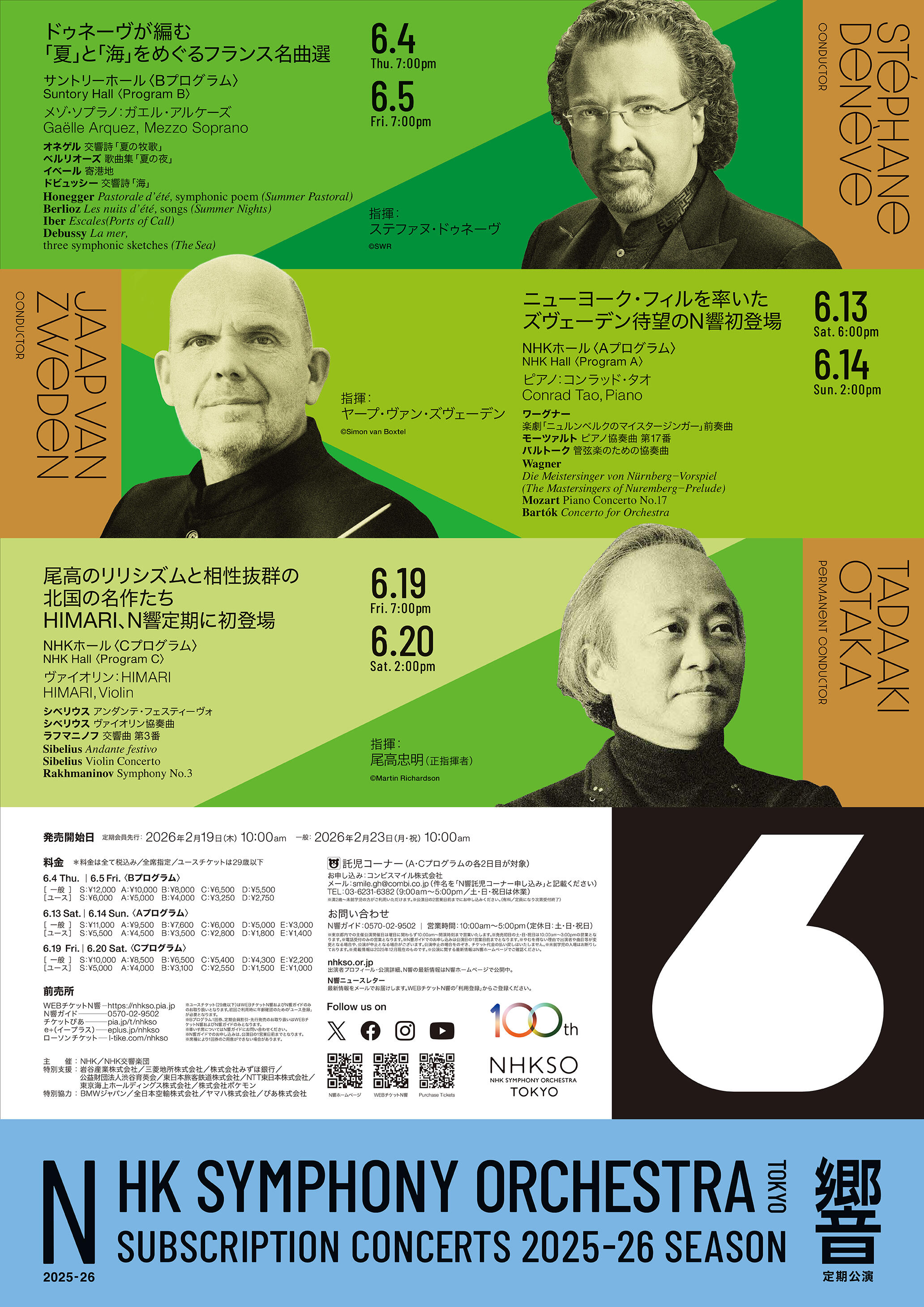
 ConductorTadaaki Otaka
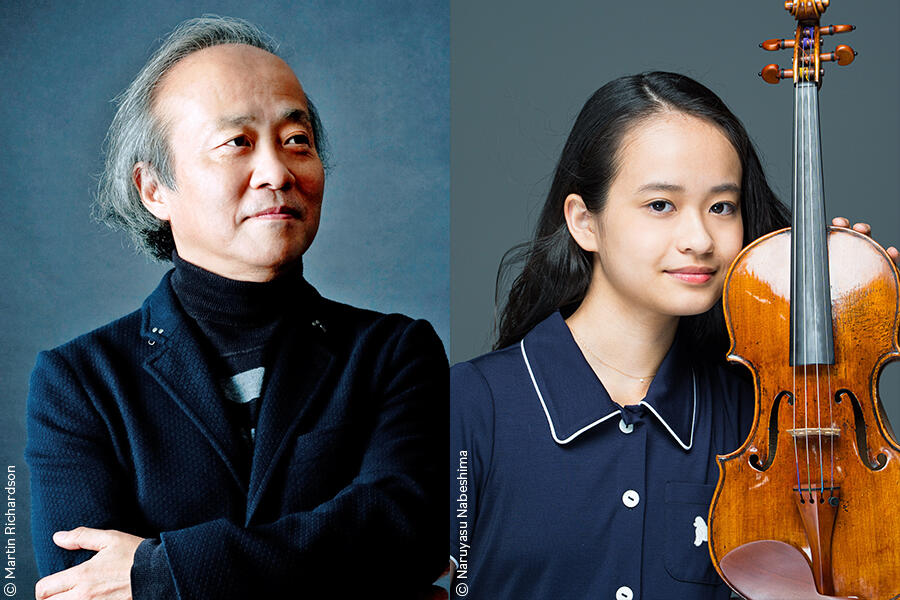
Long esteemed as one of Japan’s finest conductors, Tadaaki Otaka has been Permanent Conductor of the NHK Symphony Orchestra since 2010. He is currently Music Director of the Osaka Philharmonic Orchestra, Laureate Conductor of the Sapporo Symphony Orchestra, Conductor Laureate of the Tokyo Philharmonic Orchestra, Honorary Guest Conductor of the Yomiuri Nippon Symphony Orchestra and Honorary Conductor Laureate of the Kioi Hall Chamber Orchestra.
Born as a son of composer and conductor Hisatada Otaka, he studied with Hideo Saito in Tokyo before honing his skills in Vienna. He made his professional broadcasting debut in 1971 with the NHK Symphony Orchestra with which he toured China in 2012 to commemorate forty years of the normalization of diplomatic ties between Japan and China.
A familiar figure on podiums throughout the world, he is particularly known in the UK with a distinguished tenure as Principal Conductor of the BBC National Orchestra of Wales from 1987 to 1995. After making his Proms debut in 1988, he was awarded the CBE in 1997 and became the first Japanese ever to receive the prestigious Elgar Medal from the Elgar Society in 2000. He has received invitations to the London Symphony Orchestra, Rundfunk-Sinfonieorchester Berlin, hr-Sinfonieorchester Frankfurt, Bamberger Symphoniker, Oslo Philharmonic and others.
This time, he and the NHK Symphony Orchestra will perform Rakhmaninov’s Symphony No. 3 for the first time. Known as a leading specialist of Sibelius, he will also conduct the composer’s Violin Concerto alongside the teenage virtuoso HIMARI as the soloist.
 ViolinHIMARI
Born in 2011 in Japan, HIMARI has been described as a once-in-a-generation talent, for her incredible technique, playful and imaginative interpretations, and ability to convey emotional depth. She became the youngest student admitted to the prestigious Curtis Institute of Music in Philadelphia, where she studies with Ida Kavafian.
Last season, she received widespread acclaim for her European debut with the Berliner Philharmoniker. In the current season, she debuts at the Ravinia Festival with the Chicago Symphony Orchestra, and with the London Philharmonic Orchestra at the Royal Festival Hall.
She has won top prizes in numerous international competitions, including the Lipinski & Wieniawski International Violin Competition (Grand Prix), Arthur Grumiaux International Violin Competition, Andrea Postacchini International Violin Competition, and the Schelkunchik International Music Competition. She became the youngest performer at the Salzburg Festival in 2019, and won the Public Award at the Mini Violini in Montreal in 2023.
She made her sensational debut with the NHK Symphony Orchestra in 2023 playing Paganini’s Violin Concerto No. 1. For her reunion with the orchestra, she will serve as the soloist of Sibelius’s Violin Concerto that she performed with the Orchestre de la Suisse Romande led by Jonathan Nott during their 2025 Japanese tour.
Download

Ticket
Single Tickets Release Date
Pre-sales for Subscribers:Thursday, February 19, 2026 10:00am
*about subscribers
Sale to General Public:Monday, February 23, 2026 10:00am
Price
| S | A | B | C | D | E | |
|---|---|---|---|---|---|---|
| Ordinary Ticket | 10,000 | 8,500 | 6,500 | 5,400 | 4,300 | 2,200 |
| Youth Ticket | 5,000 | 4,000 | 3,100 | 2,550 | 1,500 | 1,000 |
*tax included
*Subscribers receive a 10% discount (Available at NHKSO WEB Ticket and N-Kyo Guide)
*For wheelchair-accessible seats, please refer to the N-Kyo Guide
*Please note that single tickets may not be available depending on ticket price range
Youth Tickets
Youth Tickets are great options for those of 29 years old and younger
Subscription tickets
Release Date
ANNUAL SUBSCRIPTION TICKETS
Sun., July 13, 2025 10:00am
[For Subscribers: Sun., July 6, 2025 10:00am]
SEASONAL SUBSCRIPTION TICKETS (SPRING)
Sat., February 14, 2026 10:00am
[For Subscribers: Tue., February 10, 2026 10:00am]
Where to buy
NHKSO WEB Ticket | Fri., June 19 (In English / Seats not selectable on the English site)
NHKSO WEB Ticket | Sat., June 20 (In English / Seats not selectable on the English site)
NHKSO WEB Ticket (In Japanese / Seats selectable)
N-Kyo Guide (Purchase by telephone only)
Other Ticket Agents
Organized by: NHK (Japan Broadcasting Corporation) / NHK Symphony Orchestra, Tokyo
*Repertoire, conductor, soloists and program order are subject to change without notice.
*Pre-school children are not allowed in the concert hall.
