
- Home
- Concerts
- Subscription Concerts
- Program A
- No. 2067 Subscription (Program A)
No. 2067 Subscription (Program A)
NHK Hall
Google Map Seating Chart


Program
Wagner / Die Meistersinger von Nürnberg - Vorspiel (The Mastersingers of Nuremberg - Prelude)
German Romantic composer Richard Wagner (1813–1883) founded Musikdrama (music drama) as represented by his four-part Der Ring des Nibelungen (The Ring of the Nibelung). In this operatic genre for which he wrote both libretto and music, the drama and the music are indissolubly united on an unprecedented level, especially by the scrupulous use of the numerous leitmotifs (recurrent melodic or/and harmonic elements associated with certain character, feeling, setting or so).
Premiered in 1868 in Munich, Die Meistersinger von Nürnberg (The Mastersingers of Nuremberg) is the only comedy among Wagner’s music dramas, although it far exceeds the genre taking the tradition and innovation of the art as its subject on a heroic scale. It took two decades for him to complete it since he worked on the first draft of the libretto in 1845.
Mastersingers are German craftsmen from the 15th and 16th centuries who were also amateur but masterful poet-composer-singers. Set in the mid-16th century and based in historical facts, the story features Nuremberg’s mastersingers including humane shoemaker Hans Sachs (1494–1576), and reaches its climax with their song-creating contest. Overall the music is diatonic compared to Wagner’s music drama Tristan und Isolde (1859) well-known for its chromatic, tonally ambiguous harmony.
The Prelude of Die Meistersinger reveals several important leitmotifs from the music drama proper. The opening melody in C major is the majestic Motif of the Mastersingers, and soon we hear the brassy and bouncy Motif of the Mastersingers’ March from the scene of their arrival at the contest (Act 3). These motifs will be splendidly restated in a contrapuntal (polyphonic) way towards the end of this optimistic Prelude.
[Kumiko Nishi]
Mozart / Piano Concerto No. 17 G Major K. 453
An independent mind, Wolfgang Amadeus Mozart (1756–1791) blazed a trail for the new lifestyle of musicians when he went freelance in 1781 after serving the Salzburg court. During the last decade of his short life before his death in 1791, he, now based in Vienna, earned his daily bread by composing, performing concerts, giving private lessons and having his works published.
Concerto for piano solo was the most important genre for Mozart to shine in the city’s music scene both as a composer and pianist (since he was a wunderkind, piano was the instrument he excelled at the most). He wrote in Vienna as many as six numbered piano concertos (No. 14 K. 449 – No. 19 K. 459) only in 1784 and six more (No. 20 K. 466 – No. 25 K. 503) in 1785-86 to stylistically perfect the Classical piano concerto. They will be followed sporadically by No. 26 K. 537 Coronation (1788) and No. 27 K. 595 (1791), his last piece of the genre.
Except for No. 4 K. 41, an arrangement of other composers’ pieces, No. 17 K. 453 is Mozart’s only numbered piano concerto written in G major. It was composed as a commission from Barbara Ployer (1765–1811), one of his favorite piano-composition pupils. This teenage talented pianist supposedly first performed it in 1784 at the residence of her uncle Gottfried Ignaz von Ployer, the Salzburg court’s agent in Vienna.
The most frequently mentioned of this concerto is the last movement. Instead of being in rondo form as was customary, this finale is written as the theme and its five variations. Especially, the dim fourth variation and the bright fifth variation make a sharp contrast, prior to an operatic coda. The cheerful staccato theme, given at the beginning of the movement, has repeatedly reminded commentators of the musical character of lovable Papageno the Bird-Catcher from Mozart’s opera Die Zauberflöte (The Magic Flute) (1791). There is an anecdote that one month after composing No. 17, Mozart got a starling which was able to sing this theme and cherished it for three years.
[Kumiko Nishi]
Bartók / Concerto for Orchestra
Hungarian composer Béla Bartók (1881–1945) was also an accomplished pianist and a leading ethnomusicologist who collected and analyzed numerous folk melodies mainly of Eastern Europe. He, although not Jewish, left Europe in 1940 to protest the Nazis. On the east coast of America, his new home, he ended up becoming terminally ill and enduring the hardships of poverty. The progressive works he had composed in Europe weren’t in high favor with the American music world, he couldn’t gain piano performance engagements sufficiently, and the war prevented him from receiving royalties from Europe. After a battle with leukemia, he passed away in New York in September 1945.
Despite the difficulties, a handful of his compositions from this period are incredibly inspiring. Among those who rendered a generous help to Bartók was the American Society of Composers, Authors and Publishers (ASCAP). Although he was not a member, the ASCAP bore his medical expenses and saw to it that he could recover and compose at Saranac Lake in New York State and Asheville in North Carolina.
Another figure who offered his help was Serge Koussevitzky, then the Conductor of the Boston Symphony Orchestra. Hearing from Hungarian violinist Joseph Szigeti about Bartók, Koussevitzky visited the composer in hospital in May 1943 and requested him to write a new work with an exceptionally large amount of commission fees. Driven by creative enthusiasm, Bartók composed the Concerto for Orchestra at Saranac Lake at an inconceivable speed. It had the warmly-received world premiere in December 1944 in Boston with Koussevitzky conducting his orchestra. Attending the event, Bartók found the coda to be abrupt, which would be his main concern at the revision of the piece in 1945.
In the Concerto for Orchestra, each section of the orchestra plays a soloistic role rather than focusing on accompanying a single solo instrument, in the tradition of the works of the same title by Paul Hindemith (1925) and Zoltán Kodály (1940). Bartók’s takes a symmetrical five-movement structure, and according to his program note, the work’s mood gradually progresses from the “sternness” of the first movement Introduzione (Introduction) and the “lugubrious death-song” of the central third movement Elegia (Elegy), to the “life-assertion” of the fifth movement Finale. Opened and closed by a side drum (without snares), the scherzo-like second movement Giuoco delle coppie (Game of Pairs) has different pairs of wind instruments perform one after the other as the title suggests. The fourth movement Intermezzo interrotto (Interrupted intermezzo) famously quotes, during the cynical central “interruption” section, the march theme of “invasion” from Dmitri Shostakovich’s Symphony No. 7 Leningrad. The symphony had a high popularity then in the United States following the broadcasted American premiere given by Arturo Toscanini conducting the NBC Symphony Orchestra in July 1942.
[Kumiko Nishi]
[Encore]
Ravel (arr. by Conrad Tao) / Ma Mère l'Oye, suite (Mother Goose) - Le jardin féerique (The Fairy Garden)
Artists
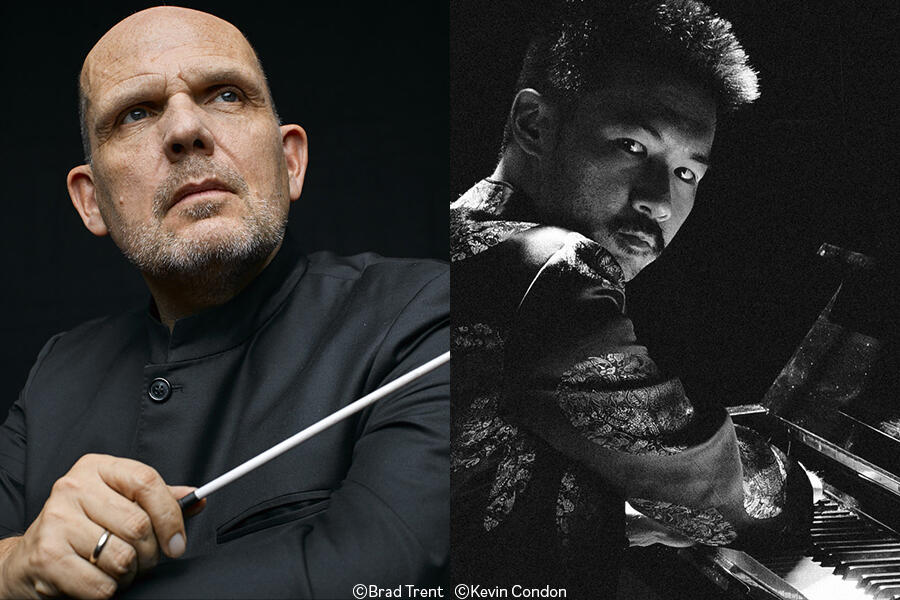
 ConductorJaap van Zweden
Born in Amsterdam, Jaap van Zweden was appointed at age 19 the youngest-ever concertmaster of Amsterdam’s Royal Concertgebouw Orchestra and began his conducting career almost twenty years later. He is currently Music Director of the Seoul Philharmonic Orchestra, Artist-in-Residence of Taiwan’s Evergreen Symphony Orchestra, and Music Director-Designate of the Orchestre Philharmonique de Radio France, after serving as Music Director of the New York Philharmonic for six seasons and of the Hong Kong Philharmonic Orchestra for twelve seasons. He remains Conductor Emeritus of the Antwerp Symphony Orchestra and Honorary Chief Conductor of the Netherlands Radio Philharmonic Orchestra.
He has guest conducted the Orchestre de Paris, Royal Concertgebouw Orchestra, Gewandhausorchester Leipzig, Berliner Philharmoniker, Staatskapelle Berlin, Orchestra dell’Accademia Nazionale di Santa Cecilia, London Symphony Orchestra and others. This season has seen a deepening of his relationship with the Chicago Symphony Orchestra in Chicago and on a European tour. His presence as leading light in the Asian classical music scene has been underscored this season by appearances with orchestras in Beijing, Shanghai and Guangzhou.
His long-awaited NHK Symphony Orchestra debut will enable us to enjoy a program around Bartók’s Concerto for Orchestra that he conducted in Chicago, New York and at his debut with the Berliner Philharmoniker. As for the Prelude from Die Meistersinger von Nürnberg with which he will open today’s concert, he famously excels as a Wagner conductor. Indeed, he led the Hong Kong Philharmonic Orchestra in first-ever performances in Hong Kong of the composer’s Ring Cycle. His acclaimed performances of Lohengrin, Die Meistersinger von Nürnberg, and Parsifal – the last of which earned him the prestigious Edison Award for Best Opera Recording in 2012 – are also available on CD and DVD.
 PianoConrad Tao
Born in 1994, Conrad Tao is an American pianist and composer celebrated for his boundary-defying artistry as well as his powerful performances of traditional repertoire. Recipient of the Avery Fisher Career Grant and the Gilmore Young Artist Award, he was extolled by New York Magazine as “the kind of musician who is shaping the future of classical music,” and by The New York Times for his “probing intellect and open-hearted vision.”
In the cureent season he performs with the Chicago Symphony Orchestra under Karina Canellakis, the Los Angeles Philharmonic under Marin Alsop, and the New York Philharmonic under Santtu-Matias Rouvali; he also joins Matthias Pintscher and the Konzerthausorchester Berlin for Pintscher’s NUR. Recent highlights include his return to Carnegie Hall with Debussy’s 12 Études and his original composition Keyed In, as well as appearances with the Boston Symphony Orchestra, Cleveland Orchestra, Seoul Philharmonic Orchestra, and Philadelphia Orchestra. In 2024, he toured Europe with Pintscher and the Kansas City Symphony to mark the 100th anniversary of Rhapsody in Blue.
As a composer, his orchestral work Everything Must Go premiered with Jaap van Zweden conducting the New York Philharmonic.
This is his first collaboration with the NHK Symphony Orchestra, alongside van Zweden who praises his talent and frequently collaborates with him.
Download
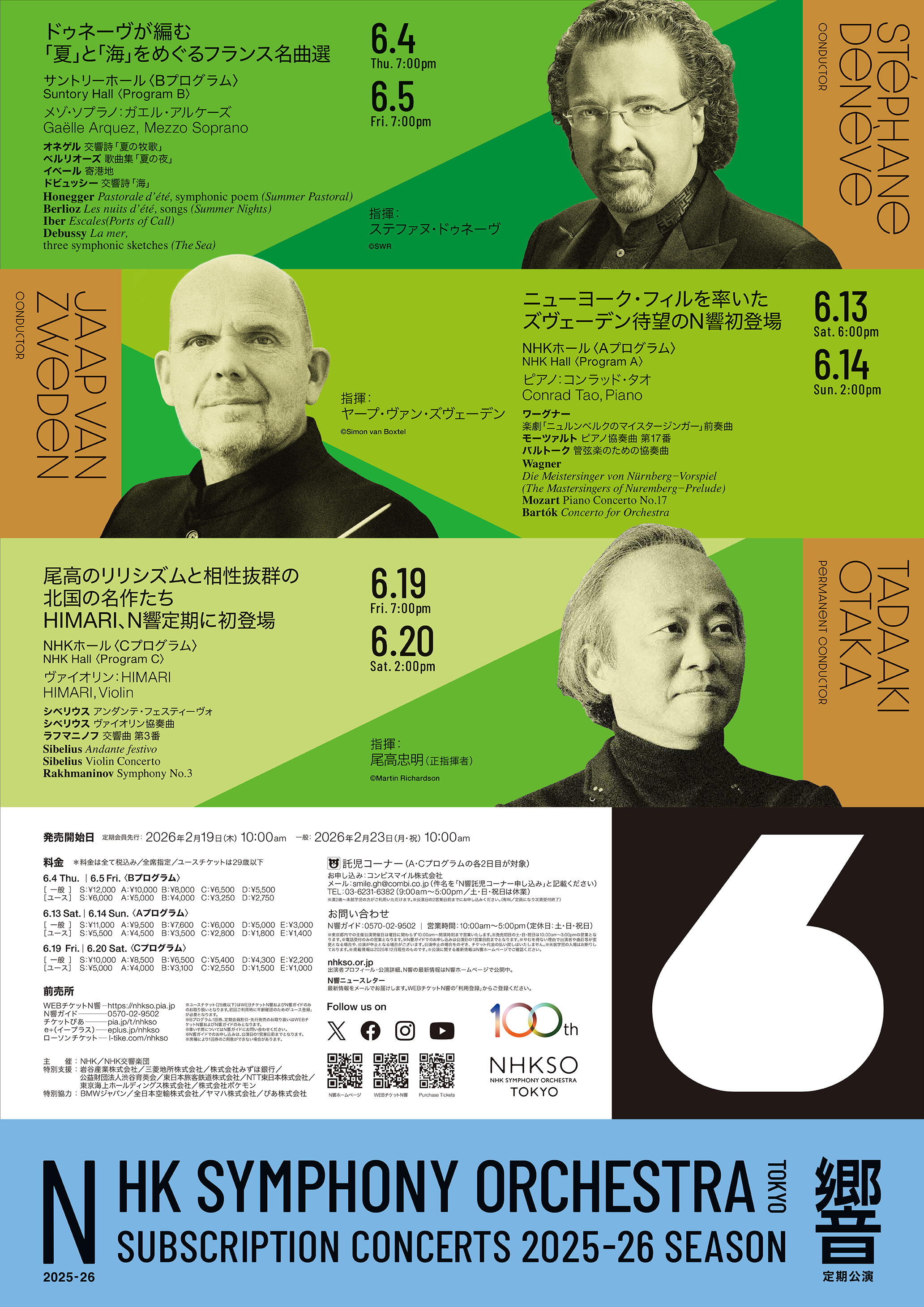

Ticket
Single Tickets Release Date
Pre-sales for Subscribers:Thursday, February 19, 2026 10:00am
*about subscribers
Sale to General Public:Monday, February 23, 2026 10:00am
Price
| S | A | B | C | D | E | |
|---|---|---|---|---|---|---|
| Ordinary Ticket | 11,000 | 9,500 | 7,600 | 6,000 | 5,000 | 3,000 |
| Youth Ticket | 5,500 | 4,500 | 3,500 | 2,800 | 1,800 | 1,400 |
*tax included
*Subscribers receive a 10% discount (Available at NHKSO WEB Ticket and N-Kyo Guide)
*For wheelchair-accessible seats, please refer to the N-Kyo Guide
*Please note that single tickets may not be available depending on ticket price range
Youth Tickets
Youth Tickets are great options for those of 29 years old and younger
Subscription tickets
Release Date
ANNUAL SUBSCRIPTION TICKETS
Sun., July 13, 2025 10:00am
[For Subscribers: Sun., July 6, 2025 10:00am]
SEASONAL SUBSCRIPTION TICKETS (SPRING)
Sat., February 14, 2026 10:00am
[For Subscribers: Tue., February 10, 2026 10:00am]
Where to buy
NHKSO WEB Ticket | Sat., June 13 (In English / Seats not selectable on the English site)
NHKSO WEB Ticket | Sun., June 14 (In English / Seats not selectable on the English site)
NHKSO WEB Ticket (In Japanese / Seats selectable)
N-Kyo Guide (Purchase by telephone only)
Other Ticket Agents
Organized by: NHK (Japan Broadcasting Corporation) / NHK Symphony Orchestra, Tokyo
*Repertoire, conductor, soloists and program order are subject to change without notice.
*Pre-school children are not allowed in the concert hall.
