- Home
- Concerts
- Subscription Concerts
- Program C
- No. 2078 Subscription (Program C)
No. 2078 Subscription (Program C)


Program
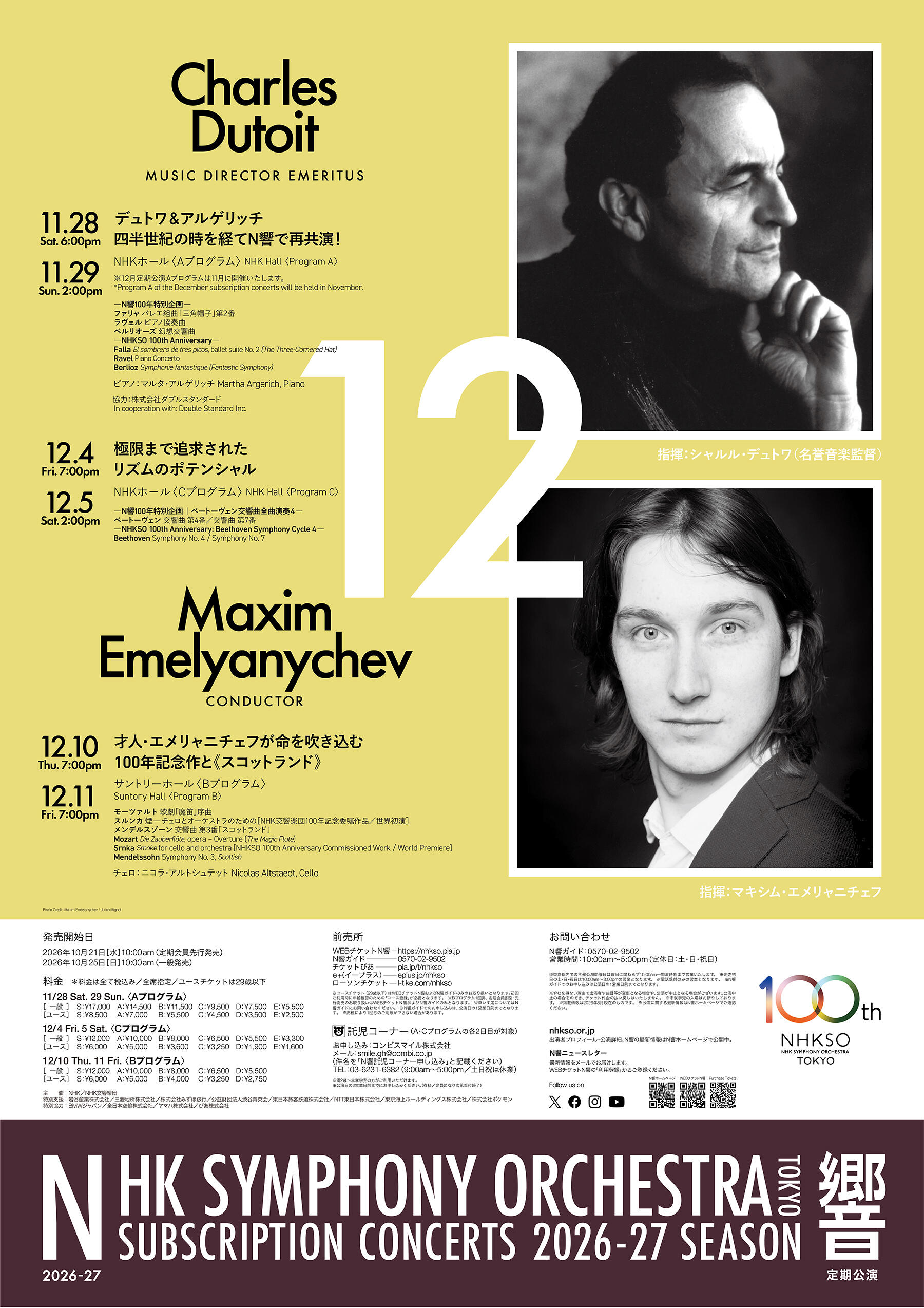
- NHKSO 100th Anniversary: Beethoven Symphony Cycle 4 -
Beethoven / Symphony No. 4 B-flat Major Op. 60
This program is a part of the musical journey through all of Ludwig van Beethoven (1770–1827)’s nine symphonies that the NHK Symphony Orchestra, Tokyo (hereafter NHKSO) has invited us on during the current 2026/27 season. The project is to mark the 200th anniversary of the German composer’s death and the 100-year milestone of the NHKSO since its 1926 foundation. In 1927, the newborn orchestra commemorated the 100th anniversary of Beethoven’s death performing seven of his symphonies and three of his piano concertos. The NHKSO has since deepened its relationship with his great musical legacy, particularly through the full cycles of his symphonies in 1936–37 and in 1970.
Compared to his teacher Joseph Haydn(1732–1809) who left us a significant number of symphonies, Beethoven composed only a handful. Each of his nine symphonies are nevertheless monumental and represent watershed moments, not only in his career but also in music history. For many composers after Beethoven, writing the “first” symphony was a synonym with confronting a nemesis, not to mention Johannes Brahms (1833–1897) who spent over twenty years to complete his No. 1.
Although every work of Beethoven is not unimportant, most experts agree that his odd numbered symphonies are more audacious and tense than his relatively moderate even numbered ones. And the fact that his Fourth is not the exception was foregrounded by Robert Schumann (1810–1856), a great admirer of the work, referring to it as “a slender Greek maiden between two Nordic giants,” namely the revolutionary Third (Eroica) and the intensely dramatic Fifth (Destiny).
Beethoven dedicated the Fourth to the Silesian Count Franz von Oppersdorff. In 1806 when the composer visited the nobleman, the latter’s private orchestra played the former’s Second—thus an even numbered symphony—in welcome. As it was Oppersdorff’s favorite work, the wealthy music lover commissioned the guest to write a new one for him. Beethoven subsequently completed the Fourth the same year, but some say that it had already been finished when he received the commission.
The Fourth’s home key is B-flat major. However, Beethoven begins the work with a mysterious, harmonically obscured introduction following the example of Haydn. With a dramatic crescendo, this preface flows into the main vivacious section of the first movement in sonata form. Its crisp first theme is given by strings, while the floaty second theme is firstly entrusted to the winds. The lyrical and sometimes plaintive character of the next slow movement is possessed with the dotted rhythm introduced by the second violins at the start. The following scherzo-like energetic movement is cast in A–B–A–B–A form. It is, rhythmically speaking, highly ingenious as if anticipating the composer’s exploration in the Seventh (discussed below). The finale in sonata form is not seemingly a sonata, as the first theme’s perpetual motion with sixteenth notes dominates the movement throughout. The end is prepared wittily by pregnant silences and a brief slow-motion moment.
[Kumiko Nishi]
Beethoven / Symphony No. 7 A Major Op. 92
Ludwig van Beethoven (1770–1827) has been profoundly admired and even awed by his successors like Franz Schubert (1797–1828) and Schumann, especially because of his dauntless spirit and insatiable pursuit of musical innovations. Beethoven’s nine symphonies, all disparate, show us concisely how he always set off for new horizons at every work to bring unprecedented ideas to fruition.
Beethoven’s epochal Fifth Symphony Destiny (1808) became the model among models of an abstract symphony sculpted with highly elaborate motivic development for all composers to come, while his unusual five-movement Sixth Pastorale (1808) having official programmatic content, blazed the trail for future programmatic symphonies with a genuine Romantic spirit such as Symphonie fantastique (1830) by Hector Berlioz (1803–1869) and acres of symphonic (tone) poems. The following Seventh is, of all Beethoven’s symphonies, arguably the most closely connected with the notion of dance, displaying an unrelenting rhythmic vitality. We can hear why Richard Wagner (1813–1883), another great admirer of Beethoven, extolled this piece with the celebrated expression, “apotheosis of dance.”
Completed in 1812, the Seventh was premiered the next year in Vienna under the composer’s own baton alongside his patriotic orchestral piece Wellington’s Victory (often called the Battle Symphony) in the same program. The first sonata movement of the Seventh is opened with a large Apollonian, peaceful introduction before the light-hearted main section dominated by repeated dotted rhythm starts. The second movement in a steady duple meter is a sort of march, which is in a way, the most fundamental form of dance. Its slower tempo and obsessively repeated note in a dark mood seem to evoke a funeral procession. The third movement is a brisk scherzo with two contrasting sections alternating with each other (A–B–A–B–A). The fourth movement, again in sonata form, is a Dionysian wild finale distinctive of a repeated rhythm with an accent on the second beat. The conclusion is probably the most euphoric in the history of symphonies.
[Kumiko Nishi]
Artists
 ConductorCharles Dutoit
Charles Dutoit has captivated audiences throughout the world for over six decades with his charismatic, elegant, passionate and idiomatic interpretations. He is Music Director Emeritus of the NHK Symphony Orchestra after having served as its Principal Conductor (1996–1998) and Music Director (1998–2003).
Born in Lausanne in 1936, he commenced his career as a violinist, before participating in the conducting masterclasses given by Herbert von Karajan at the Lucerne Festival. He furthered his studies by attending the legendary Ernest Ansermet’s rehearsals in Geneva. Under Ansermet’s influence, he was able to cultivate his apprenticeship of the Ballets Russes composers: Stravinsky, Ravel and Debussy. In 1959, he made his professional conducting debut with the Orchestre de Chambre de Lausanne and Martha Argerich as soloist. During his first trip to the United States, he met Pierre Monteux and Charles Munch at the Tanglewood Music School.
Former Artistic Director and Principal Conductor of the Royal Philharmonic Orchestra, he enjoyed an artistic collaboration with the Philadelphia Orchestra for thirty-two years. He was Music Director of the Orchestre symphonique de Montréal for twenty-five years and held the same position with L’Orchestre National de France for ten years. His interest in mentoring young artists has led to positions as Music Director of the Pacific Music Festival in Sapporo and the Verbier Festival Orchestra.
His latest collaboration with the NHK Symphony Orchestra took place in 2025 with two programs featuring Messiaen and Holst as well as celebrating Ravel’s anniversary year. This marks his first appearance with Martha Argerich and the orchestra in Japan in three decades. The second program will have him focus on Beethoven as a part of the orchestra’s project commemorating the 200th anniversary of the German composer’s death.
[Kumiko Nishi]

Ticket
Single Tickets Release Date
Pre-sales for Subscribers:Wednesday, October 21, 2026 10:00am
*about subscribers
Sale to General Public:Sunday, October 25, 2026 10:00am
Price
| S | A | B | C | D | E | |
|---|---|---|---|---|---|---|
| Ordinary Ticket | 12,000 | 10,000 | 8,000 | 6,500 | 5,500 | 3,300 |
| Youth Ticket | 6,000 | 5,000 | 3,600 | 3,250 | 1,900 | 1,600 |
*Tax included
*Subscribers receive a 10% discount (Available at NHKSO WEB Ticket in Japanese and N-Kyo Guide)
*Pre-sales for subscribers are only available at NHKSO WEB Ticket (In Japanese) and N-Kyo Guide
*For wheelchair-accessible seats, please refer to the N-Kyo Guide
*Please note that single tickets may not be available depending on ticket price range
Youth Tickets
Youth Tickets are great options for those of 29 years old and younger
Subscription tickets
Release Date
ANNUAL SUBSCRIPTION TICKETS
Sun., July 12, 2026 10:00am
[For Subscribers: Sun., July 5, 2026 10:00am]
SEASONAL SUBSCRIPTION TICKETS (WINTER)
Fri., October 16, 2026 10:00am
[For Subscribers: Tue., October 13, 2026 10:00am]
Where to buy
NHKSO WEB Ticket | Fri., December 4 (In English / Seats not selectable on the English site)
NHKSO WEB Ticket | Sat., December 5 (In English / Seats not selectable on the English site)
NHKSO WEB Ticket (In Japanese / Seats selectable)
N-Kyo Guide (Purchase by telephone only)
Other Ticket Agents
Organized by: NHK (Japan Broadcasting Corporation) / NHK Symphony Orchestra, Tokyo
*Repertoire, conductor, soloists and program order are subject to change without notice.
*Pre-school children are not allowed in the concert hall.
