- Home
- Concerts
- Subscription Concerts
- Program C
- No. 2075 Subscription (Program C)
No. 2075 Subscription (Program C)


Program
- NHKSO 100th Anniversary: Beethoven Symphony Cycle 3 -
Beethoven / Coriolan, overture Op. 62
One of the figures who made the most significant contribution to classical music history, German composer Ludwig van Beethoven (1770–1827) established his career in Vienna, Austria. He arrived in the Capital of Classical Music in 1792 as a virtuoso pianist-composer and keyboard-improviser. After studying composition under Joseph Haydn (1732–1809) and others there, he premiered his Symphony No. 1 in 1800 to mark a crucial step forward as a symphonist.
The dramatic overture Coriolan in C minor, written in early 1807, dates from the same period as the Symphony No. 4. The first performances of the two works were allegedly the highlights of the private concerts held in March 1807 at the palace of the composer’s patron Prince Lobkowitz in Vienna.
Beethoven wrote the overture for the play of the same name by his close friend Heinrich Joseph von Collin, while it is unclear whether the composition was spontaneous or requested. This five-act tragedy concluding with the noble death of Roman general Coriolanus, had enjoyed popularity and frequent revivals since its 1802 premiere.
The overture conveys the characters’ personalities and the atmospheres of the drama’s crucial moments through music, rather than faithfully tracing the plot. Opened by a few tense chords, the overture in sonata form has the fervently combative first theme evoking the war-hero protagonist, and the affectionate second theme likely portraying his family who dissuade him from attacking his home city of Rome.
[Kumiko Nishi]
Beethoven / Symphony No. 2 D Major Op. 36
The current season of the NHK Symphony Orchestra, Tokyo (hereafter NHKSO) has invited us on a journey through all of Ludwig van Beethoven (1770–1827)’s nine symphonies. This is to mark the 200th anniversary of his death and the 100-year milestone of the NHKSO since its 1926 foundation. In 1927, the newborn orchestra commemorated the 100th anniversary of the composer’s death performing seven of his symphonies and three of his piano concertos. The NHKSO has since deepened its relationship with his great musical legacy.
Compared to his teacher Haydn who left us a significant number of symphonies, Beethoven composed only a handful. Each of his nine symphonies are nevertheless monumental in their own way and represent watershed moments, not only in his career but also in music history. For many composers after Beethoven, writing the “first” symphony was a synonym with confronting a nemesis, not to mention Johannes Brahms (1833–1897) who spent over twenty years to complete his No. 1.
As an opposite case of Gustav Mahler (1860–1911) who wrote the dark Symphony No. 6 Tragische (Tragic) at the peak of his happiness, Beethoven composed the cheerful Symphony No. 2 in D major facing his deteriorating hearing in despair. He started work on it in earnest in the autumn of 1801—after he had completed works including the Piano Sonata No. 14 Moonlight —and perfected the symphony in 1802 presumably while resting in the village of Heiligenstadt following his doctor’s advice. During this stay, Beethoven penned the famous Heiligenstadt Testament. In this letter addressed to his brothers, he writes his suffering of hearing difficulty, feelings of loneliness and isolation, suicidal urges that tormented him, yet his steadfast determination to fulfill his mission as an artist.
The Symphony No. 2 was premiered in April 1803 at the Theater an der Wien, where Beethoven served as the resident composer. It adopts, overall, a conventional structure following Haydn, while one catches glimpses throughout of Beethoven’s eagerness to breathe new life into this genre even more than in his No. 1 (1799).
During the extended introduction of the opening movement, Beethoven surprises us with his astonishingly bold key changes. The subsequent main sonata section, marked Allegro con brio (fast and with vigor), has low strings introduce the elating first theme in D major, before the winds present the bucolic second theme in A major. The second movement in A major, performed without trumpets and timpani, is well-known for its melodious beauty. The third movement in D major is historically significant, as Beethoven replaces the traditional courtly minuet movement with an energetic and lively scherzo for the first time in his symphonies. The finale, again in D major, is a rondo-sonata. The principal (rondo) theme, given at the start, is of comical nature, and the large coda in high spirits is packed with various unexpected twists.
[Kumiko Nishi]
Beethoven / Symphony No. 6 F Major Op. 68, Pastoral
Ludwig van Beethoven (1770–1827) penned his Symphony No. 6 from 1807 to 1808. It was premiered in December 1808 in Vienna together with its exceedingly famous symphonic sibling No. 5 (Destiny). The two works are generally regarded as worlds apart, No. 6 being considered much more moderate in respect of style and character like his other even-numbered symphonies. However, it is in reality as epochal as No. 5 in another way, as it blazed a trail for future programmatic symphonies with the genuine Romantic spirit such as Symphonie fantastique (1830) by Berlioz and acres of symphonic (tone) poems.
Worthy of mention is that No. 6 is Beethoven’s only symphony having five movements (moreover, the last three ones are performed continuously) and official programmatic contents: he called the work “Pastoral Symphony, or Recollections of Country Life” and imparted each movement a detailed, descriptive subtitle. Nevertheless, he reminded us about his ultimate objective, emphasizing that the work is “more an expression of feeling than tone-painting.”
This novel stance is explicitly found in the subtitle of the literally-pastoral first movement “Awakening of cheerful feelings on arrival in the countryside.” The listeners may well project this protagonist with “feelings” on Beethoven himself who loved spending time in nature. He ingeniously built this entire sonata movement with the opening melodic/rhythmic motifs heard on the first violins (A–B-flat–D–C / C–B-flat–A–G–C). The most realistic and picturesque is the second movement “Scene by the brook.” Here, the composer even specifies which birds solo wind instruments embody during the cadenza-like moment towards the end: nightingale (flute), quail (oboe) and cuckoo (clarinets). The next merry scherzo is said to parody a-slightly-lazy rural bandsmen at moments. The fourth movement is scored for the largest orchestra of the whole symphony including timpani and piccolo which portray thunder and lightning respectively. The finale, or “Shepherd’s song. Cheerful and grateful feelings after the storm,” closes the symphony in peace giving thanks to the Creator.
[Kumiko Nishi]
Artists
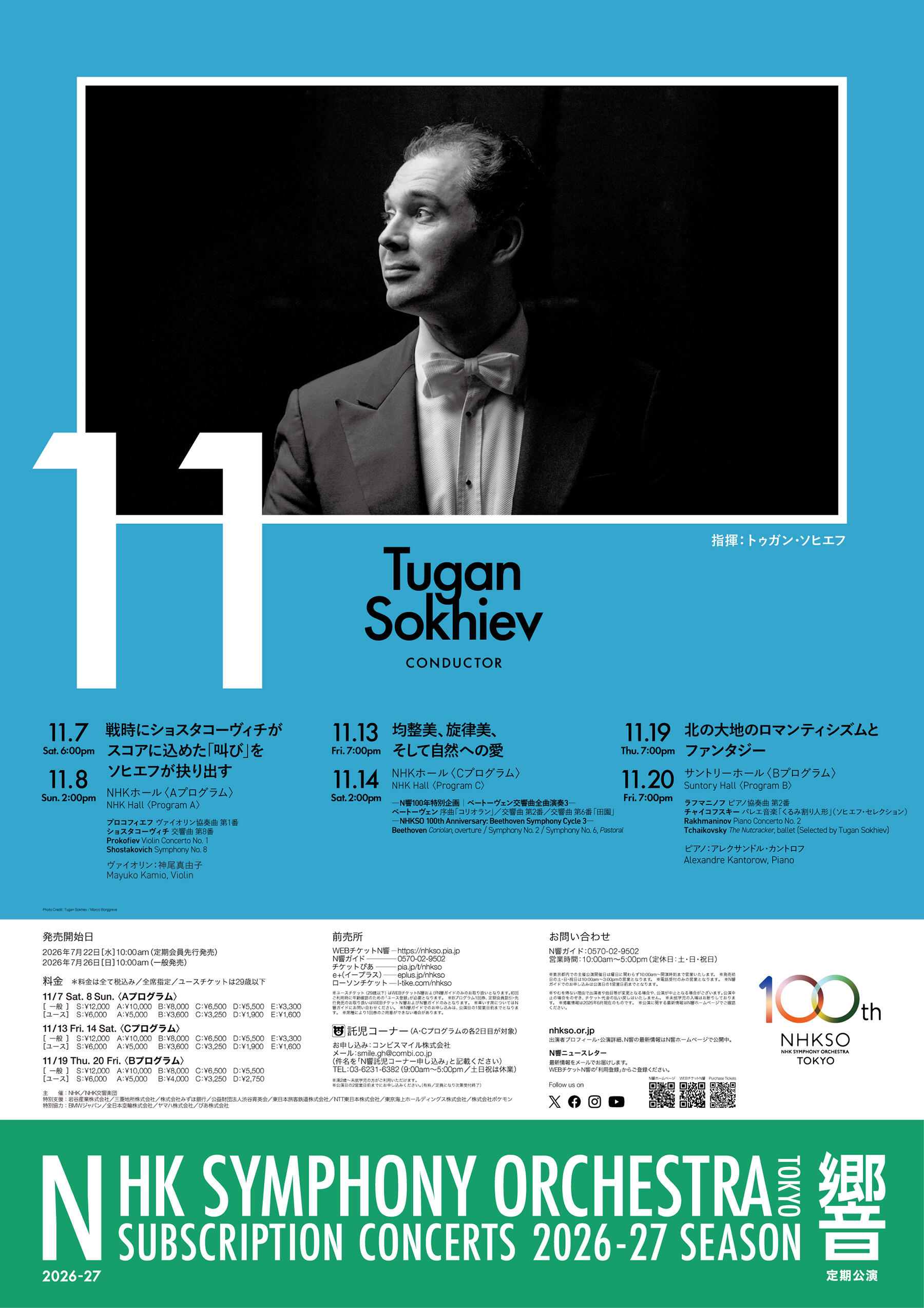
 ConductorTugan Sokhiev
Internationally renowned conductor Tugan Sokhiev, one of the last students of legendary teacher Ilya Musin at the St. Petersburg Conservatory, divides his time between the symphonic and operatic repertoire. He was newly appointed Principal Conductor and Artistic Advisor of the Orchestre de la Suisse Romande beginning with this season.
A former Music Director of the Orchestre national du Capitole de Toulouse, he enjoys close and privileged relationships with orchestras such as the Wiener, Berliner and Münchner Philharmoniker orchestras, Symphonieorchester des Bayerischen Rundfunks and Gewandhausorchester Leipzig. Outside Europe, he is invited to conduct the finest U.S. orchestras including the Boston and Chicago Symphony Orchestras. Passionate about his work with singers, he was Music Director and Chief Conductor of the Bolshoi Theatre in Moscow from 2014 to 2022. Recently, he conducted a new production of Iolanta at the Wiener Staatsoper and gave tours with the Wiener Philharmoniker (Asia), the Münchner Philharmoniker (Asia and Europe) and the Staatskapelle Dresden (Europe), conducting the Wiener Philharmoniker’s celebrated Sommernachtskonzert in the Schönbrunn Palace.
Highlights of the last season include his collaborations with the Wiener Philharmoniker for their gala concert celebrating Johann Strauss II’s 200th birthday, with the Berliner Philharmoniker at the Osterfestspiele Salzburg, his Cleveland Orchestra debut, and his conducting of a new production of Tannhäuser at the Opernhaus Zürich.
He made his NHK Symphony Orchestra debut in 2008 conducting Shostakovich’s Symphony No. 5. Since his first appearance at their subscription concerts in 2013, he has spent several weeks almost every year with the orchestra. This time, he programed orchestral works by Beethoven and Russian composers, coupling them with Prokofiev’s and Rachmaninov’s concertos to collaborate with soloists Mayuko Kamio and Alexandre Kantorow, both the International Tchaikovsky Competition winners.
[Kumiko Nishi]

Ticket
Single Tickets Release Date
Pre-sales for Subscribers:Wednesday, July 22, 2026 10:00am
*about subscribers
Sale to General Public:Sunday, July 26, 2026 10:00am
Price
| S | A | B | C | D | E | |
|---|---|---|---|---|---|---|
| Ordinary Ticket | 12,000 | 10,000 | 8,000 | 6,500 | 5,500 | 3,300 |
| Youth Ticket | 6,000 | 5,000 | 3,600 | 3,250 | 1,900 | 1,600 |
*Tax included
*Subscribers receive a 10% discount (Available at NHKSO WEB Ticket in Japanese and N-Kyo Guide)
*Pre-sales for subscribers are only available at NHKSO WEB Ticket (In Japanese) and N-Kyo Guide
*For wheelchair-accessible seats, please refer to the N-Kyo Guide
*Please note that single tickets may not be available depending on ticket price range
Youth Tickets
Youth Tickets are great options for those of 29 years old and younger
Subscription tickets
Release Date
ANNUAL SUBSCRIPTION TICKETS/
SEASONAL SUBSCRIPTION TICKETS (AUTUMN)
Sun., July 12, 2026 10:00am
[For Subscribers: Sun., July 5, 2026 10:00am]
Where to buy
NHKSO WEB Ticket | Fri., November 13 (In English / Seats not selectable on the English site)
NHKSO WEB Ticket | Sat., November 14 (In English / Seats not selectable on the English site)
NHKSO WEB Ticket (In Japanese / Seats selectable)
N-Kyo Guide (Purchase by telephone only)
Other Ticket Agents
Organized by: NHK (Japan Broadcasting Corporation) / NHK Symphony Orchestra, Tokyo
*Repertoire, conductor, soloists and program order are subject to change without notice.
*Pre-school children are not allowed in the concert hall.
