- Home
- Concerts
- Subscription Concerts
- Program A
- No. 2074 Subscription (Program A)
No. 2074 Subscription (Program A)


Program
Prokofiev / Violin Concerto No. 1 D Major Op. 19
Born in Sontsivka village (today in Ukraine) in Imperial Russia, Sergei Prokofiev (1891–1953) was trained by Anatoly Lyadov (1855–1914) and Nikolai Rimsky-Korsakov (1844–1908) at the Saint Petersburg Conservatory. The young composer-pianist Prokofiev attracted the Russian music scene’s attention as a daring “enfant terrible” with his earliest compositions marked by a fierce modernism as represented by the Piano Concerto No. 1 (1912).
Following the 1917 Bolshevik Revolution, Prokofiev left his home in May 1918 by permission of the Soviet authorities. For the next eighteen years, he traveled back and forth between America and Europe in pursuit of greater renown. His Violin Concerto No. 1, penned in 1916–1917, is one of his masterpieces born of his brilliant inspiration just before this emigration, alongside works including the opera The Gambler (1915–1917), Symphony No. 1 Classical (1916–1917), and Visions fugitives (1915–1917) for piano.
Prokofiev wrote the Violin Concerto No. 1 with the premiere in his mind by the Polish violinist Paul Kochanski, then based in Russia. However, this didn’t happen due to the revolutionary turmoil. It finally received the world-premiere in 1923 in Paris under Serge Koussevitzky (who had just fled the USSR) conducting his own orchestra and its concert master Marcel Darrieux as soloist. To Parisian audiences seeking out the cutting edge, this concerto evidently sounded outdated and overly Romantic. The legendary violinist Joseph Szigeti was one of the first to make its true worth known to the world, delivering its brilliant rendition in Prague and Leningrad in 1924, before becoming the first in the world to record it in 1935.
This concerto takes an unusual tempo layout with three slow-fast-slow movements. The first movement, often likened to a daydream, has the violin solo introduce the drifting first theme marked “sognando (dreamily)” at the start, and the bouncy second theme played “narrante (like a story-telling) .” In contrast, the middle scherzo movement offers a demoniac motoric burst of notes typical of Prokofiev. The finale takes us back into the lyrical world of daydreams, and concludes amidst an ethereal atmosphere recalling the end of the first movement.
[Kumiko Nishi]
Shostakovich / Symphony No. 8 C Minor Op. 65
Dmitry Shostakovich (1906–1975) was born in Saint Petersburg a decade before the Russian Empire collapsed. The son of an amateur singer father (who was an engineer) and a pianist mother, he revealed his astonishing musical talent soon after he started to play piano and compose at an early age. During the turbulence following the 1917 Bolshevik Revolution, he studied composition with Maximilian Steinberg (Nikolai Rimsky-Korsakov’s pupil and son-in-law) at the Petrograd (Saint Petersburg) Conservatory. Starting with the successful 1926 premiere of the Symphony No. 1, Shostakovich went on to establish himself as the most important symphonist to follow Gustav Mahler (1860–1911) and Jean Sibelius (1865–1957).
Having experienced the Revolution at age 11, Shostakovich remained behind the Iron Curtain, unlike Sergei Rakhmaninov (1873–1943) who exiled himself, Igor Stravinsky (1882–1971) who decided to stay in the West, nor above-mentioned Prokofiev who lived outside the USSR for almost two decades. On their native soil, especially during the era of Joseph Stalin from 1924 to 1953, the authorities utilized every art form as a vehicle for their propaganda. Many of artists who didn’t meet the official Soviet style called “socialist realism” were destined for purge, labor camp, torture or execution.
As for Shostakovich, the regime condemned his opera in 1936 so he rehabilitated himself writing the “exemplary” Symphony No. 5 (1937). Four years later, his Symphony No. 7 Leningrad, penned in the midst of the Great Patriotic War (Eastern Front), received worldwide recognition as a masterpiece prefiguring the triumph against the Nazism. He then set to work on the Symphony No. 8 in the summer of 1943 immediately after the Red Army’s victory at Stalingrad. However, contrary to the Party’s expectation, it didn’t turn out to be another patriotically exultant symphony with a triumphal finish. Enraged, the Party would later ban it from performance.
Like Ludwig van Beethoven’s Fifth (Destiny), Shostakovich’s Eighth begins in C minor and ends in C major, provided their conclusions are miles apart. The latter is cast unconventionally in five movements of which the last three are played without pause. Moreover, the anguished first movement in modified sonata form takes up approximately half of the whole symphony. At the beginning, low strings declare a dreadful three-note motif (C–B-flat–C) which would play, in slightly different shapes, important roles in all other movements. After the next sarcastic scherzo movement, the machinelike third movement is shackled by a remorseless ostinato (persistently repeated phrase). The slow fourth movement in G-sharp minor, a passacaglia (continuous variation on a bass theme), is also haunted by a relentless repeat: tam-tam (gong) leads to the forceful statement of the theme followed by its eleven variations. The work attains C major at the opening of the finale in rondo sonata form, where the inverted three-note motif (C–D–C) is the base of the idyllic main theme given by bassoon. The momentary optimism makes way for likely the most dispirited C-major close in symphonic history.
[Kumiko Nishi]
Artists
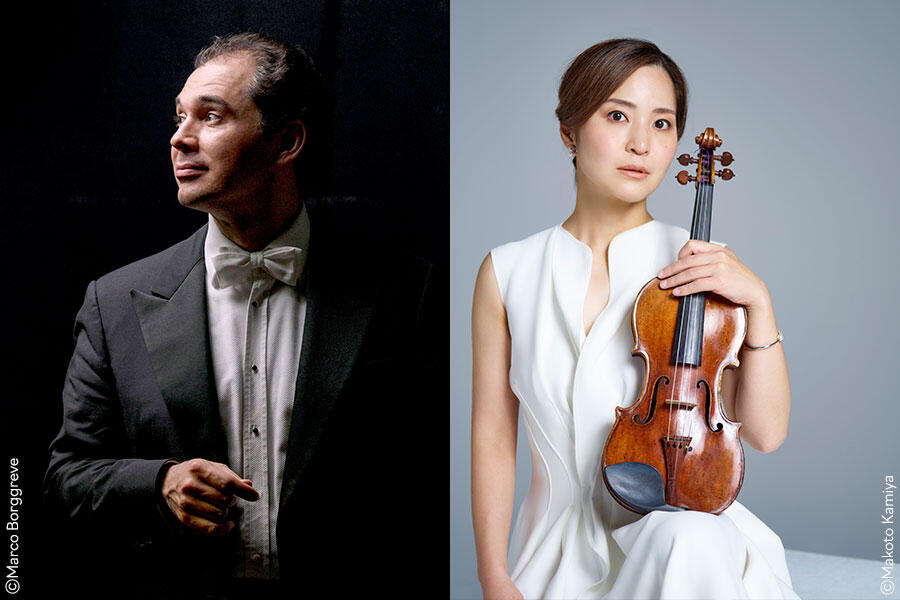
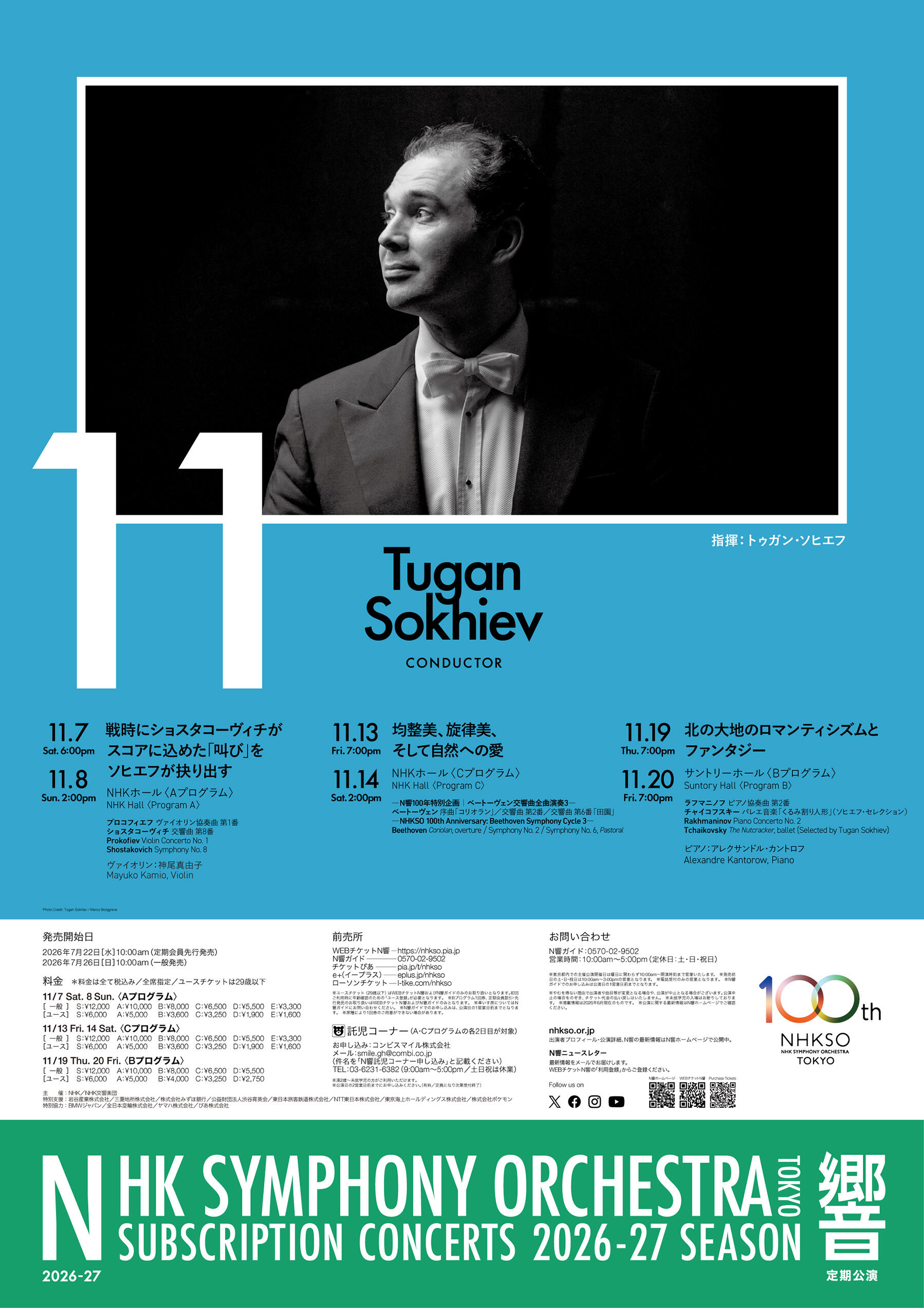
 ConductorTugan Sokhiev
Internationally renowned conductor Tugan Sokhiev, one of the last students of legendary teacher Ilya Musin at the St. Petersburg Conservatory, divides his time between the symphonic and operatic repertoire. He was newly appointed Principal Conductor and Artistic Advisor of the Orchestre de la Suisse Romande beginning with this season.
A former Music Director of the Orchestre national du Capitole de Toulouse, he enjoys close and privileged relationships with orchestras such as the Wiener, Berliner and Münchner Philharmoniker orchestras, Symphonieorchester des Bayerischen Rundfunks and Gewandhausorchester Leipzig. Outside Europe, he is invited to conduct the finest U.S. orchestras including the Boston and Chicago Symphony Orchestras. Passionate about his work with singers, he was Music Director and Chief Conductor of the Bolshoi Theatre in Moscow from 2014 to 2022. Recently, he conducted a new production of Iolanta at the Wiener Staatsoper and gave tours with the Wiener Philharmoniker (Asia), the Münchner Philharmoniker (Asia and Europe) and the Staatskapelle Dresden (Europe), conducting the Wiener Philharmoniker’s celebrated Sommernachtskonzert in the Schönbrunn Palace.
Highlights of the last season include his collaborations with the Wiener Philharmoniker for their gala concert celebrating Johann Strauss II’s 200th birthday, with the Berliner Philharmoniker at the Osterfestspiele Salzburg, his Cleveland Orchestra debut, and his conducting of a new production of Tannhäuser at the Opernhaus Zürich.
He made his NHK Symphony Orchestra debut in 2008 conducting Shostakovich’s Symphony No. 5. Since his first appearance at their subscription concerts in 2013, he has spent several weeks almost every year with the orchestra. This time, he programed orchestral works by Beethoven and Russian composers, coupling them with Prokofiev’s and Rachmaninov’s concertos to collaborate with soloists Mayuko Kamio and Alexandre Kantorow, both the International Tchaikovsky Competition winners.
[Kumiko Nishi]
 ViolinMayuko Kamio
Japanese violinist Mayuko Kamio, the gold medalist of the 2007 International Tchaikovsky Competition, is widely praised for her luxurious silken tone, long expressive phrasing and virtuoso techniques.
She made her concerto debut in Tokyo at age 10 under the baton of Charles Dutoit, in a concert broadcast on NHK television. She has since appeared with the world’s eminent ensembles and musicians, including the Tonhalle-Orchester Zürich with Mstislav Rostropovich, Israel Philharmonic and Münchner Philharmoniker both under Zubin Mehta, and the Budapest Festival Orchestra under Iván Fischer.
She was trained by Dorothy DeLay and Masao Kawasaki at the Aspen Music Festival and in the pre-college division of The Juilliard School, before studying with Koichiro Harada at the Toho Gakuen School of Music. She then worked with Zakhar Bron at the Hochschule für Musik und Theater in Zurich.
She has collaborated with the NHK Symphony Orchestra regularly for many years. As for Prokofiev, she performed his Violin Concerto No. 2 with the orchestra under Tugan Sokhiev in 2008 and under Vladimir Ashkenazy in 2011. This time, she will play the composer’s concerto No. 1 rejoining the orchestra led by Sokhiev.
She plays on the 1731 “Rubinoff” made by Antonio Stradivari, kindly offered by the Munetsugu Collection in Tokyo.
[Kumiko Nishi]

Ticket
Single Tickets Release Date
Pre-sales for Subscribers:Wednesday, July 22, 2026 10:00am
*about subscribers
Sale to General Public:Sunday, July 26, 2026 10:00am
Price
| S | A | B | C | D | E | |
|---|---|---|---|---|---|---|
| Ordinary Ticket | 12,000 | 10,000 | 8,000 | 6,500 | 5,500 | 3,300 |
| Youth Ticket | 6,000 | 5,000 | 3,600 | 3,250 | 1,900 | 1,600 |
*Tax included
*Subscribers receive a 10% discount (Available at NHKSO WEB Ticket in Japanese and N-Kyo Guide)
*Pre-sales for subscribers are only available at NHKSO WEB Ticket (In Japanese) and N-Kyo Guide
*For wheelchair-accessible seats, please refer to the N-Kyo Guide
*Please note that single tickets may not be available depending on ticket price range
Youth Tickets
Youth Tickets are great options for those of 29 years old and younger
Subscription tickets
Release Date
ANNUAL SUBSCRIPTION TICKETS/
SEASONAL SUBSCRIPTION TICKETS (AUTUMN)
Sun., July 12, 2026 10:00am
[For Subscribers: Sun., July 5, 2026 10:00am]
Where to buy
NHKSO WEB Ticket | Sat., November 7 (In English / Seats not selectable on the English site)
NHKSO WEB Ticket | Sun., November 8 (In English / Seats not selectable on the English site)
NHKSO WEB Ticket (In Japanese / Seats selectable)
N-Kyo Guide (Purchase by telephone only)
Other Ticket Agents
Broadcast
 NHK-FMBest of Classic
No. 2074 Subscription (Program A)
Thursday, Nov 26, 2026 7:35PM - 9:15PM
Program:
Prokofiev / Violin Concerto No. 1 D Major Op. 19
Shostakovich / Symphony No. 8 C Minor Op. 65
Conductor:Tugan Sokhiev
Violin:Mayuko Kamio
Recorded:November 7, 2026 NHK Hall
Organized by: NHK (Japan Broadcasting Corporation) / NHK Symphony Orchestra, Tokyo
*Repertoire, conductor, soloists and program order are subject to change without notice.
*Pre-school children are not allowed in the concert hall.
