
- Home
- Concerts
- Subscription Concerts
- Program C
- No. 2073 Subscription (Program C)
No. 2073 Subscription (Program C)


Program
- NHKSO 100th Anniversary: Beethoven Symphony Cycle 2 -
Beethoven / Egmont, incidental music Op. 84 – Overture
In the lead up to 2027, the 200th anniversary of Ludwig van Beethoven(1770–1827)’s death, orchestras around the world will be embarking on the journey of Beethoven’s orchestral music. The NHK Symphony Orchestra, Tokyo is performing the symphony cycle and piano concerto cycle during the 2026–27 season, and today’s concert is the second in its symphony cycle. Hopefully it will be a great opportunity not only for classical music fans, but for people who are discovering Beethoven’s music for the first time.
The concert opens with the Egmont Overture, a masterpiece from Beethoven’s middle period. In 1809, Beethoven was commissioned to compose incidental music for the Vienna premiere of Johann Wolfgang von Goethe’s play Egmont by the director of the Burgtheater. During 1809–1810, Beethoven wrote ten musical numbers for the play, including the overture which has become a staple of the orchestral repertoire.
The protagonist of the play, Count of Egmont, was a historical figure—a sixteenth century Flanders nobleman, who challenged the Spanish rule in Flanders and fought for freedom of his people. Beethoven is said to have admired the play.
Beethoven condenses the story of the play into ten minutes of music. The introduction (Sostenuto ma non troppo) in F minor sets the dark and oppressive mood, which accelerates into the Allegro section that depicts the heroic character of Count of Egmont. The triumphant coda in F major is a powerful message that ultimately freedom will prevail.
[Nahoko Gotoh]
Beethoven / Symphony No. 8 F Major Op. 93
Ludwig van Beethoven (1770–1827)’s Symphony No. 8 stems from the same period as his Egmont Overture. He composed the work in 1812 while he was still working on his Seventh Symphony. Out of Beethoven’s nine symphonies, this is one of the shortest, with a typical performance time of around 25 minutes. Another interesting link to the Egmont Overture is that Beethoven worked on this symphony in the summer of 1812 in the Bohemian spa town of Teplitz (now Teplice in the Czech Republic), and it was there that Beethoven met Goethe for the first and only time.
The first public performance of Symphony No. 8 took place in February 1814 in the Große Redoutensaal in Vienna’s Hofburg Palace, in a program that also included the Seventh Symphony and Wellington’s Victory. Sandwiched between these colossal works, one can imagine that this symphony must have been overshadowed, but if you listen to it carefully, it’s full of ingenious ideas and meticulous working out of motifs. In fact, according to legend, Beethoven himself considered the Eighth to be much better than the Seventh.
The first movement, Allegro vivace e con brio, in 3/4 begins without an introduction. Interestingly, the vibrant opening gesture already contains all the motifs that form the first movement. Listen out for the clever shifts of rhythms and the transformation of these motifs. The quiet ending of the movement is unusual in Beethoven’s symphonic output.
The short and humorous second movement in 2/4, indicated Allegretto scherzando, replaces the slow movement in this symphony. “Scherzando” means “jokingly” and you can hear that Beethoven is in a playful mood here with perhaps a reference to Haydn’s Clock Symphony. This is followed by a minuet third movement, which is also unusual in Beethoven’s symphonies. The lyrical trio section features for two horns, clarinet and cello.
In the final movement, Allegro vivace, the jovial first theme is followed by the lyrical second theme. The work reaches a culmination in the huge, dynamic coda section, in which Beethoven utilizes the full range of the orchestra.
[Nahoko Gotoh]
Beethoven / Symphony No. 5 C Minor Op. 67
Ludwig van Beethoven (1770–1827)’s groundbreaking Symphony No. 5 was composed the earliest of the three works performed today. He started sketches in 1804, but the progress was interrupted by several works such as his opera Fidelio, the three Razumovsky string quartets, and the Appassionata piano sonata. It was finally completed in 1808, and the first performance took place on 22 December that year at the Theater an der Wien, together with his Symphony No. 6 Pastoral.
Significantly, the Fifth was the first symphony Beethoven composed in the minor key: C minor. Other works of Beethoven in C minor include the Piano Sonata Pathétique, the Piano Concerto No. 3, and his final piano sonata, Op. 111. What did this key mean for Beethoven? Renowned American pianist and scholar, Charles Rosen, states that the “key of C minor has come to symbolize his artistic character. In every case, it reveals Beethoven as Hero”. He also mentions that C minor shows Beethoven at “his most extroverted form”. Indeed, this symphony is highly extrovert and heroic.
The symphony opens with the iconic four-note motif—da-da-da-dum—which even people who have no interest in classical music would be familiar with. It is often called the “fate motif” because Anton Schindler, Beethoven’s assistant and early biographer, claimed that these four notes represented “fate knocking on the door,” but this is now considered dubious. Yet, the image of Beethoven taking fate by the throat has endured, and it is certainly tempting to hear this symphony as a journey from struggle to victory, considering the difficulties the composer faced, especially his worsening deafness. This idea appealed especially to the Romantic aesthetics of the nineteenth century.
Regardless of whether the motif represents fate or not, it clearly dominates the symphony. The motif is varied in all sorts of ways and combined like pieces of a jigsaw puzzle. What’s more, Beethoven used this motif in all the movements, not just the first movement. Furthermore, the use of the piccolo and trombones in symphonic music was highly novel for the time.
In the first movement, the fate motif is passed around various instruments of the orchestra in various forms. In contrast, the second theme, in E-flat major, is melodious and tranquil, but soon it becomes absorbed in the main theme. The second movement, which opens with a melody on the cellos and violas, is in the form of theme and variations. The third movement, a scherzo based on the main motif rhythm, continues into the fourth movement without a break, and Beethoven provides an exhilarating transition from C minor to the triumphant C major. In the Presto coda, Beethoven obsessively emphasizes C major—in fact, the last 29 bars are only C major chords. This was totally unprecedented at the time, and it must surely have astonished the audience.
[Nahoko Gotoh]
Artists
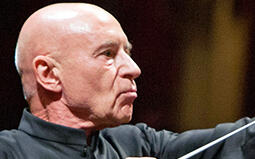 ConductorChristoph Eschenbach
Christoph Eschenbach, born February 20, 1940 in German occupied Breslau (now Wrocław, Poland), was a war orphan, raised in Schleswig-Holstein and Aachen by his mother’s cousin, the pianist Wallydore Eschenbach. Her lessons laid the foundation of his illustrious musical career. Following piano studies with Eliza Hansen and conducting with Wilhelm Brückner-Rüggeberg, he won notable piano awards that helped to pave the way for his growing international fame.
Supported by mentors such as George Szell and Herbert von Karajan, the focus of Eschenbach’s career increasingly moved to conducting. He has held prominent positions at the Tonhalle-Orchester ZÜrich, Houston Symphony, NDR Sinfonieorchester (now NDR Elbphilharmonie Orchester), Philadelphia Orchestra, Orchestre de Paris, Washington National Symphony Orchestra, and Konzerthausorchester Berlin. He is currently Artistic Director at the NFM Wrocław Philharmonic. Alongside his prestigious appointments, Eschenbach has always attached great importance to his extensive activities as a guest conductor, working with orchestras such as the Wiener Philharmoniker, Berliner Philharmoniker, Chicago Symphony Orchestra, London Philharmonic Orchestra, and the NHK Symphony Orchestra, Tokyo.
Eschenbach has received numerous awards, including the Ernst von Siemens Music Prize in 2015 for his achievements as conductor and pianist.
He made his debut at the NHK Symphony Orchestra’s subscription concerts in 2017, when his performance of the complete Brahms symphonies attracted considerable attention. Since then, he has appeared with the orchestra on numerous occasions primarily in Austro-German repertoire.
[Nahoko Gotoh]
Download
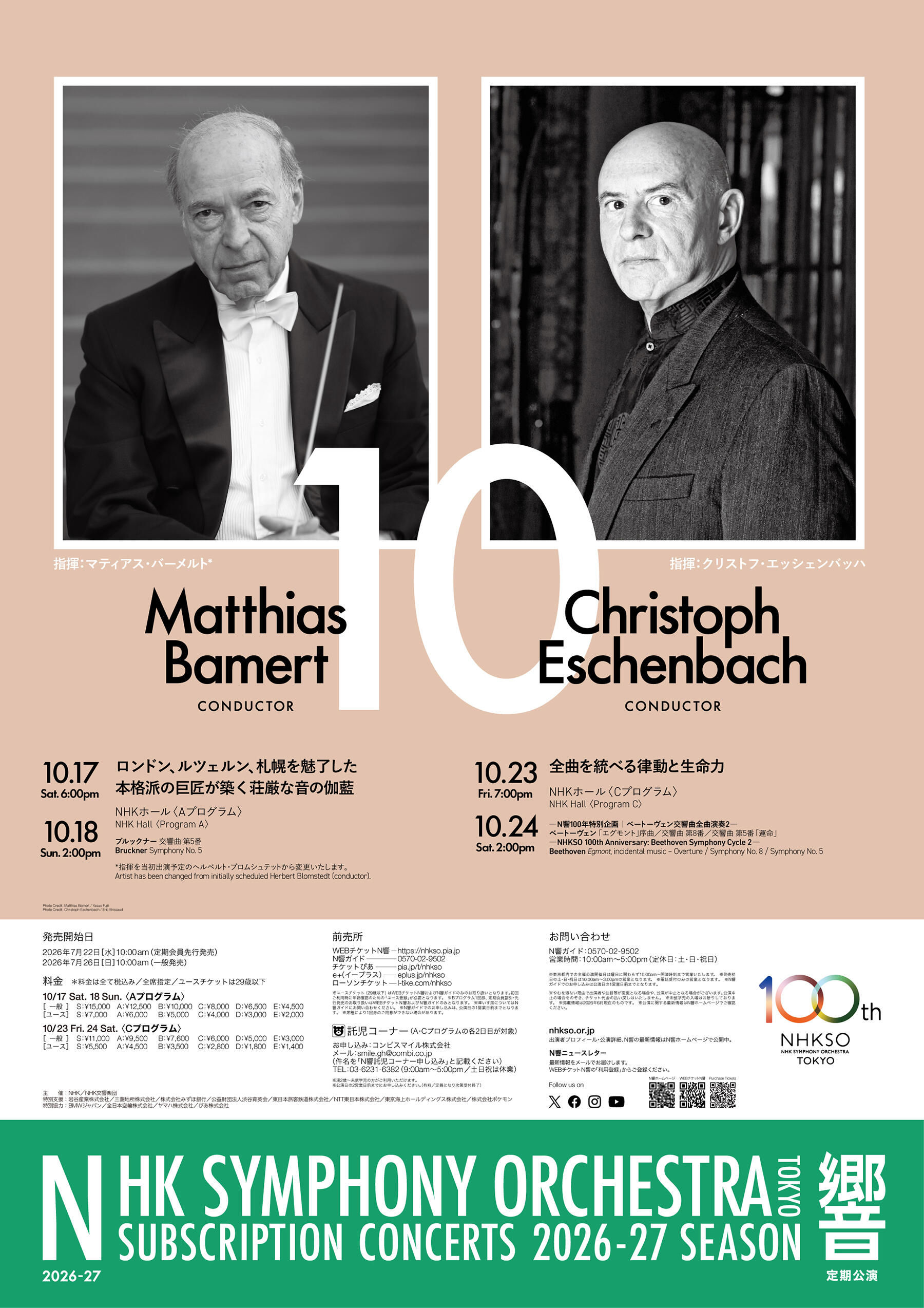
Ticket
Single Tickets Release Date
Pre-sales for Subscribers:Wednesday, July 22, 2026 10:00am
*about subscribers
Sale to General Public:Sunday, July 26, 2026 10:00am
Price
| S | A | B | C | D | E | |
|---|---|---|---|---|---|---|
| Ordinary Ticket | 11,000 | 9,500 | 7,600 | 6,000 | 5,000 | 3,000 |
| Youth Ticket | 5,500 | 4,500 | 3,500 | 2,800 | 1,800 | 1,400 |
*Tax included
*Subscribers receive a 10% discount (Available at NHKSO WEB Ticket in Japanese and N-Kyo Guide)
*Pre-sales for subscribers are only available at NHKSO WEB Ticket (In Japanese) and N-Kyo Guide
*For wheelchair-accessible seats, please refer to the N-Kyo Guide
*Please note that single tickets may not be available depending on ticket price range
Youth Tickets
Youth Tickets are great options for those of 29 years old and younger
Subscription tickets
Release Date
ANNUAL SUBSCRIPTION TICKETS/
SEASONAL SUBSCRIPTION TICKETS (AUTUMN)
Sun., July 12, 2026 10:00am
[For Subscribers: Sun., July 5, 2026 10:00am]
Where to buy
NHKSO WEB Ticket | Fri., October 23 (In English / Seats not selectable on the English site)
NHKSO WEB Ticket | Sat., October 24 (In English / Seats not selectable on the English site)
NHKSO WEB Ticket (In Japanese / Seats selectable)
N-Kyo Guide (Purchase by telephone only)
Other Ticket Agents
Broadcast
 NHK-FMBest of Classic
No. 2073 Subscription (Program C)
Friday, Oct 30, 2026 7:35PM - 9:15PM
Program:
- NHKSO 100th Anniversary: Beethoven Symphony Cycle 2 -
Beethoven / Egmont, incidental music Op. 84 – Overture
Beethoven / Symphony No. 8 F Major Op. 93
Beethoven / Symphony No. 5 C Minor Op. 67
Conductor:Christoph Eschenbach
Recorded:October 17, 2026 NHK Hall
Organized by: NHK (Japan Broadcasting Corporation) / NHK Symphony Orchestra, Tokyo
*Repertoire, conductor, soloists and program order are subject to change without notice.
*Pre-school children are not allowed in the concert hall.
