
- Home
- Concerts
- Subscription Concerts
- Program C
- No. 2071 Subscription (Program C)
No. 2071 Subscription (Program C)


Program
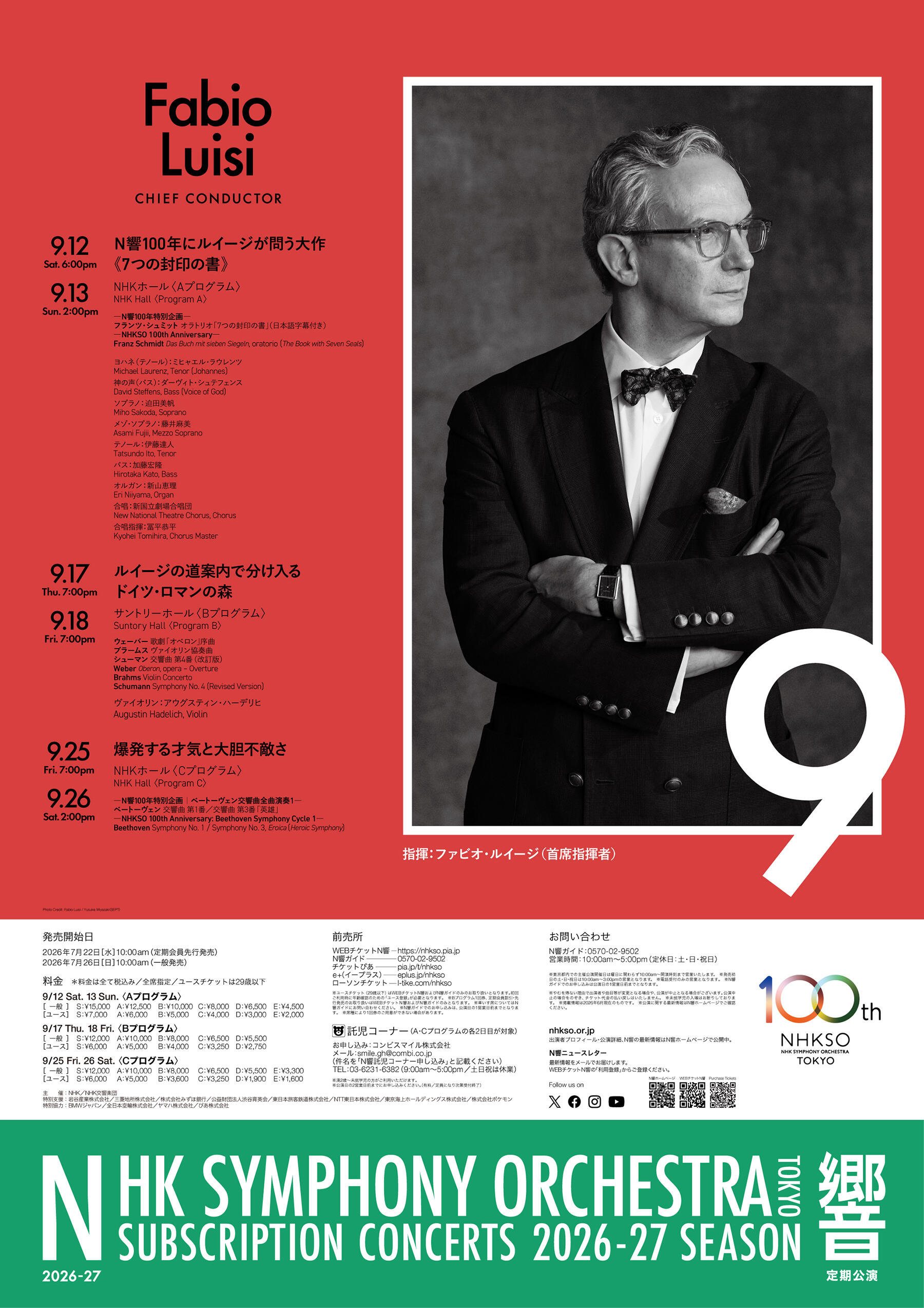
- NHKSO 100th Anniversary: Beethoven Symphony Cycle 1 -
Beethoven / Symphony No. 1 C Major Op. 21
This 2026/27 season of the NHK Symphony Orchestra, Tokyo (hereafter NHKSO) has invited its audience on a journey through all of Ludwig van Beethoven (1770–1827)’s nine symphonies. This cycle is to mark the 200th anniversary of the German composer’s death and the 100-year milestone of the NHKSO since its 1926 foundation. In 1927, the newborn orchestra commemorated the 100th anniversary of Beethoven’s death performing seven of his symphonies and three of his piano concertos. The NHKSO has since deepened its relationship with his great musical legacy, particularly through the full cycles of his symphonies in 1936–37 and in 1970.
Compared to Joseph Haydn (1732–1809) and Wolfgang Amadeus Mozart (1756–1791) who both left us a significant number of symphonies, Beethoven composed only a handful. Each of his nine symphonies are nevertheless monumental in their own way and represent watershed moments, not only in his career but also in music history. For many composers after Beethoven, writing the “first” symphony was a synonym with confronting a nemesis, not to mention Johannes Brahms (1833–1897) who spent over twenty years to complete his No. 1.
Beethoven wrote the Symphony No. 1 mostly in 1799 at age 29, after he had moved to Vienna in 1792 from his hometown Bonn. During these first seven years in Vienna—the city had mourned Mozart’s death since 1791—, Beethoven first made his name as a virtuoso pianist-composer and a peerless keyboard-improviser, while completing his composition studies under the city’s musical figures including Haydn. Meanwhile, the Viennese audience and music-loving aristocrats awaited Beethoven’s symphonies more and more eagerly to hold him in high regard as a thoroughly established composer. In other words, his Symphony No. 1 is not a student work from his youth but, instead, an ambitious one unveiled to the Viennese music scene only after he was fully prepared.
Beethoven’s Symphony No. 1 is molded into a conventional fast-slow-minuet-fast structure following Haydn and Mozart. However, it occasionally brings a touch of unexpectedness and inventiveness offering a glimpse of how eager Beethoven was to impress the Viennese. The most surprising thing is how the symphony opens, as the slow introduction doesn’t begin in C major, the home key, but with a dissonant chord (a dominant seventh of F major). On top of that, the establishment of C major is postponed until the main vivacious sonata section of the first movement starts. Full of contrasts and at a fast tempo, unexpectedly, the third minuet movement gives the impression of a scherzo. This foretells Beethoven’s Symphony No. 2 (1802), where he will replace the traditional courtly minuet movement with a lively scherzo for the first time in his symphonies. The orchestration also seemed to be unusual to the composer’s contemporaries. Indeed, a newspaper review following the 1800 premiere pointed out that the symphony sounded more like a wind ensemble than an orchestra owing to its heavy wind scoring.
[Kumiko Nishi]
Beethoven / Symphony No. 3 E-flat Major Op. 55, Eroica (Heroic Symphony)
Friend of liberty, Ludwig van Beethoven (1770–1827) saw Napoleon Bonaparte as the embodiment of the French Revolution’s ideal. He originally composed Symphony No. 3 in honor of the First Consul of France. After the completion in 1804, however, the German composer was disappointed at the news of Napoleon declaring himself emperor, and famously erased the title “Bonaparte” as well as the dedication on the manuscript’s title-page. The symphony was eventually published under the title “Sinfonia Eroica (Heroic Symphony), Composed to Celebrate the Memory of a Great Man.” With regard to who is “a Great Man,” experts have mentioned various possibilities including Prince Louis Ferdinand of Prussia (1772–1806) who fought in the French Revolutionary Wars.
This colossal, unconventional work was a big step for Beethoven trying to break from the traditional Classical style established and developed by Haydn, Mozart and himself. The first movement in E-flat major is an extended sonata with an exceptionally long development. The fleeting introduction lets the whole orchestra resound only twice the tonic chord of E-flat major. Immediately after that, the cellos sing the first theme, a simple broken chord, which will be elaborately developed through the entire movement. We then hear, in the place of a mellifluous movement, a grave funeral march in C minor.
Beethoven chose for the third movement a lively scherzo instead of a graceful minuet as he had already done in his Symphony No. 2. The trio (central) section with three horns evoking a hunting scene is a highlight. The truly heroic last movement is also unconventional as it is not a rondo but a set of variations on a theme. The theme given by the pizzicato low strings had been used previously in Beethoven’s Die Geschöpfe des Prometheus (The Creatures of Prometheus)(1801), a ballet about the heroic Greek god who stole the fire from Zeus to give it to mankind, as well as in his Variationen und Fuge für Klavier (Variations and Fugue for Piano) op. 35 (1802) nicknamed Eroica-Variationen (Eroica Variations).
[Kumiko Nishi]
Artists
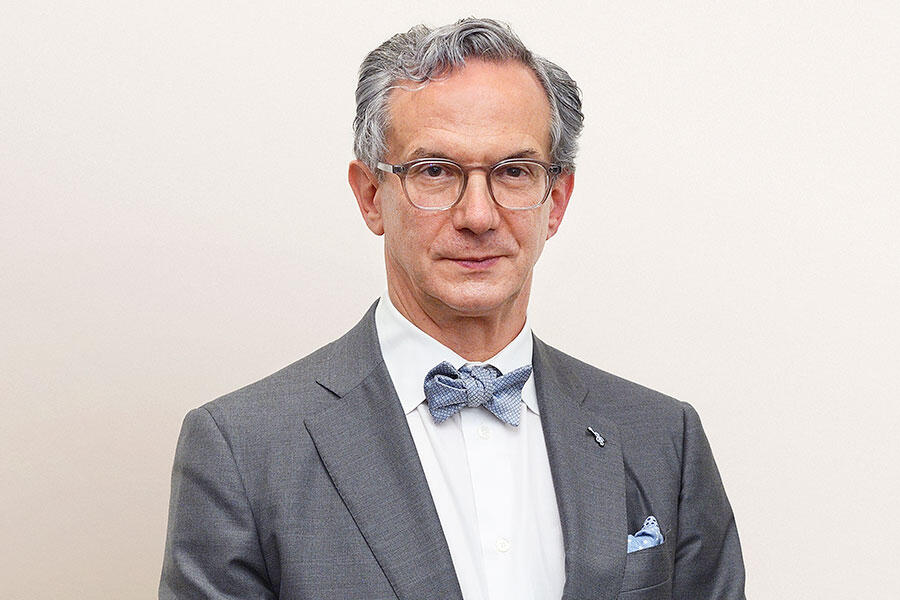
 ConductorFabio Luisi
Fabio Luisi hails from Genoa. He first conducted the NHK Symphony Orchestra in 2001 and became its Chief Conductor in September 2022. He performed Verdi’s Requiem to celebrate his appointment, and Mahler’s Symphonie der Tausend for the orchestra’s 2000th subscription concert in 2023. In 2024, he led the orchestra’s Taiwanese tour, and then in May 2025, he successfully led its European tour scheduled in conjunction with Amsterdam’s Mahler Festival at The Concertgebouw, the Prague Spring Festival and the Dresdner Musikfestspiele: the NHK Symphony Orchestra was the first Asian orchestra to appear at the Mahler Festival, performing the composer’s Symphonies No. 3 and No. 4 to critical praise. In September 2028, he will become Honorary Conductor Laureate of the NHK Symphony Orchestra.
Currently he serves as the Principal Conductor of the Danish National Symphony Orchestra and the Music Director of the Dallas Symphony Orchestra, and previously he was General Music Director of the Opernhaus Zürich, Principal Conductor of New York’s Metropolitan Opera, Chief Conductor of the Wiener Symphoniker, General Music Director of the Staatskapelle Dresden and the Sächsische Staatsoper, Principal Conductor and Chief Conductor of the MDR-Sinfonieorchester, Artistic Director of the Orchestre de la Suisse Romande, Chief Conductor of the Tonkünstler Orchester and Artistic Director of the Grazer Symphonisches Orchester. He is also Music Director of Puglia’s Festival della Valle d’Itria Martina Franca and Emeritus Conductor of Orchestra Sinfonica Nazionale della Rai. He is a frequent guest of leading orchestras including the Berliner Philharmoniker, the Royal Concertgebouw Orchestra and the Saito Kinen Orchestra, opera houses and festivals worldwide.
In recording, his complete Nielsen symphonic cycle with the Danish National Symphony Orchestra was recognized with Limelight and Abbiati Awards in 2023, while its first volume was named Recording of the Year by Gramophone. He received a Grammy Award for his leadership of the last two operas of Wagner’s Ring cycle at the Metropolitan Opera, as released on DVD. His second CD with the NHK Symphony Orchestra, Mahler: Symphony No. 5 will be released in September 2026.
He is an accomplished composer and maker of perfumes.
[Kumiko Nishi]
Download

Ticket
Single Tickets Release Date
Pre-sales for Subscribers:Wednesday, July 22, 2026 10:00am
*about subscribers
Sale to General Public:Sunday, July 26, 2026 10:00am
Price
| S | A | B | C | D | E | |
|---|---|---|---|---|---|---|
| Ordinary Ticket | 12,000 | 10,000 | 8,000 | 6,500 | 5,500 | 3,300 |
| Youth Ticket | 6,000 | 5,000 | 3,600 | 3,250 | 1,900 | 1,600 |
*Tax included
*Subscribers receive a 10% discount (Available at NHKSO WEB Ticket in Japanese and N-Kyo Guide)
*Pre-sales for subscribers are only available at NHKSO WEB Ticket (In Japanese) and N-Kyo Guide
*For wheelchair-accessible seats, please refer to the N-Kyo Guide
*Please note that single tickets may not be available depending on ticket price range
Youth Tickets
Youth Tickets are great options for those of 29 years old and younger
Subscription tickets
Release Date
ANNUAL SUBSCRIPTION TICKETS/
SEASONAL SUBSCRIPTION TICKETS (AUTUMN)
Sun., July 12, 2026 10:00am
[For Subscribers: Sun., July 5, 2026 10:00am]
Where to buy
NHKSO WEB Ticket | Fri., September 25 (In English / Seats not selectable on the English site)
NHKSO WEB Ticket | Sat., September 26 (In English / Seats not selectable on the English site)
NHKSO WEB Ticket (In Japanese / Seats selectable)
N-Kyo Guide (Purchase by telephone only)
Other Ticket Agents
Organized by: NHK (Japan Broadcasting Corporation) / NHK Symphony Orchestra, Tokyo
*Repertoire, conductor, soloists and program order are subject to change without notice.
*Pre-school children are not allowed in the concert hall.
