
- Home
- Concerts
- Subscription Concerts
- Program B
- No. 2066 Subscription (Program B)
No. 2066 Subscription (Program B)
Suntory Hall
Google Map Seating Chart


Program
Honegger / Pastorale d’été, symphonic poem (Summer Pastoral)
Born to Swiss parents in northern France, Arthur Honegger (1892–1955) studied music in German-speaking Zurich, Switzerland, and at the Paris Conservatoire. Together with Darius Milhaud (1892–1974), Francis Poulenc (1899–1963) and others, young Honegger formed in 1916 “Les Six (The Six)”, the Parisian avant-garde group worshiping Satie’s simple language against all sorts of German late-Romantic excess. Nevertheless, Honegger’s individual taste and style partly due to his dual Swiss-French identity made him stand out as unique: he professed his admiration for Richard Wagner – an enemy of “Les Six”– , besides owing a great deal to Richard Strauss and, above all, J. S. Bach.
Honegger is well-known for his large-scale works such as the incidental music Le roi David (The King David)(1921), modernist Pacific 231 (1923), mystic oratorio Jeanne d’Arc au bûcher (Joan of Arc at the Stake)(1935) and the serious Symphony No. 3 Liturgique (Liturgical) (1946). Smaller-scale and Impressionistic, the symphonic poem Pastorale d’été (Summer Pastoral) from Honegger’s early years presents us another side to his style. It was written in the summer of 1920 when the twenty-eight-year-old composer spent his vacation at the picturesque Alpine village Wengen in Switzerland.
The score is headed with “J’ai embrassé l’aube d’été (I embraced the summer dawn)”, a quote from French poet Arthur Rimbaud’s poem Aube (Dawn). The music in A–B–A’ form first gives a bucolic tune on a horn, and the central B section, marked “lively and joyous”, starts with the winds singing a danceable folkish melody.
[Kumiko Nishi]
Berlioz / Les nuits d’été, songs Op. 7 (Summer Nights)
Born in south-eastern France and trained at the Paris Conservatoire, Hector Berlioz (1803–1869) laid the groundwork for Romanticism in music. For him, music was inseparably linked to the poetic, the dramatic and the programmatic. His Symphonie fantastique (Fantastic Symphony)(1830) pioneered the symphonic (tone) poem, a Romantic genre that Franz Liszt (1811–1886) would soon invent. Berlioz’s novel works would also pave a path for the Musikdrama (music drama) and leitmotifs of Richard Wagner (1813–1883).
Originally, Berlioz composed Les nuits d’été (Summer Nights) for voice and piano in 1840–1841. This delicate song cycle comprises six settings of poems from the collection La comédie de la mort (The Comedy of Death) by Théophile Gautier (1811–1872), one of the French Romantic poets whom the composer deepened a friendship with. Berlioz, the author of a historical orchestration treatise (1843), orchestrated the fourth song “Absence” in 1843 for French-Spanish singer Marie Recio (his future second wife) so she could sing it during his important German tour from December 1842 to May 1843. For publication as a set, he arranged the remainder for voice and orchestra in 1855–1856.
I Villanelle celebrates the return of spring, “the month blessed by lovers.” Dimmer, II Le Spectre de la rose (The Specter of the Rose) has a rose’s wraith talk to a maiden on whose breast he has found his tomb. III Sur les lagunes (On the Lagoons) is a lament by a sailor whose sweetheart is dead. “Over me the immense night spreads out like a shroud. I sing my romance that heaven alone hears”. IV Absence is about lost love. A man grieves over the absence of his ex-lover and the distance between their hearts. V Au cimetière (At the Cemetery) describes a pale dove, sad and lonely, singing a plaintive song at sunset at the white tomb. Contrastive, VI L’île inconnue (The Unknown Isle) is a friendly barcarole inviting a young beauty to sail: “Take me, says the beauty, to the faithful shore where love lasts forever!”
[Kumiko Nishi]
Ibert / Escales (Ports of Call)
Born in Paris during the Belle Époque, Jacques Ibert (1890–1962) entered the Paris Conservatoire in 1910 where his counterpoint and orchestration teacher André Gedalge (who had trained Ravel) influenced him greatly. It was in Gedalge’s class that Ibert met Darius Milhaud (1892–1974) and above-mentioned Arthur Honegger (1892–1955): with Francis Poulenc (1899–1963) and three other composers, Milhaud and Honegger would soon form “Les Six (The Six) .” While this forward-thinking circle livened up Paris until the early 1920s, Ibert was mostly absent from the capital. During the First World War, he went to the front as a nurse first, before being sent to the French northern coast as a naval officer. Then immediately after the war, he won the Prix de Rome (a prestigious scholarship) in 1919 to stay in Rome from 1920 to 1923.
A product of this Italian sojourn, Escales (Ports of Call) (1922) was premiered in Paris by the Orchestre Lamoureux in 1924 to high praise. Inspired by the composer’s Mediterranean cruise, this vivid orchestral triptych sets sail from Rome for Sicily, first (I Rome – Palermo): muted violins and a flute commence a Debussyan waterscape, and a trumpet subsequently announces the lively Italian folk dance “tarantella.” II Tunis – Nefta reproduces an Arabic “desertscape” with the oboe’s snake-charmer-like meandering tune. III Valencia describes a festive scene of the Iberian port town with the rhythms of the Spanish folk dance “seguidilla” as well as castanets and guitar-inspired string effects.
[Kumiko Nishi]
Debussy / La mer, three symphonic sketches (The Sea)
By leaving the traditional language in terms of harmony, form and tone color, French composer Claude Debussy (1862–1918) had a great influence on music history in the 20th century. His La mer (The Sea) is often described as a representative example of Impressionist music, despite his dislike of the label. As a reaction against excessively emotional music of the late Romantic period, Impressionism in music is characterized by more objective approaches and suggestion of atmosphere or feeling.
A great lover of the ocean, Debussy confessed in a letter, “I was destined for the lovely career of a sailor, and only a quirk of fate led me to another path.” Completed in 1905, La mer paints a vivid picture of a mighty ocean changing every moment as the subtitle (“Three Symphonic Sketches”) hints. Nevertheless, this music rises above descriptive, programmatic music. Indeed, the novelty of the work resides in its rigid but unconventional structure with cyclic themes (mentioned below) and a minute motivic manipulation, which is the reason why it is often compared to a modern three-movement symphony.
I De l’aube à midi sur la mer (From Dawn to Noon on the Sea) has a harmonically ambiguous introduction where two cyclic themes (recurrent elements unifying the whole work) are heard: a sliding-upward motif of two notes repeated by cellos at the beginning, and a fanfare-like sinuous melody revealed softly by English horn and trumpet. The main section in D-flat major becomes animated gradually and reaches its climax with brilliant brass. II Jeux de vagues (Play of the Waves) is an intricately constructed yet jolly scherzo, fitful like water in constant change. III Dialogue du vent et de la mer (Dialogue of the Wind and the Sea) is a turbulent dialogue of which the main theme, a chromatically rising motif, is introduced by low strings at the start. In addition, this movement recalls the two cyclic themes in different ways with different instrumentation. The triptych ends at a high volume, which is unusual for Debussy, with the magnificent coda animated by the cyclic themes.
[Kumiko Nishi]
Artists
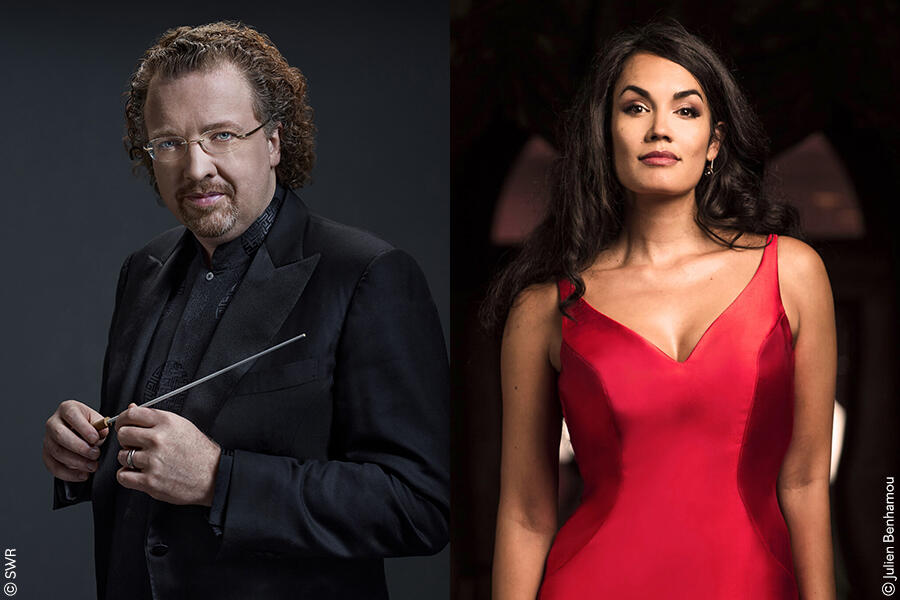
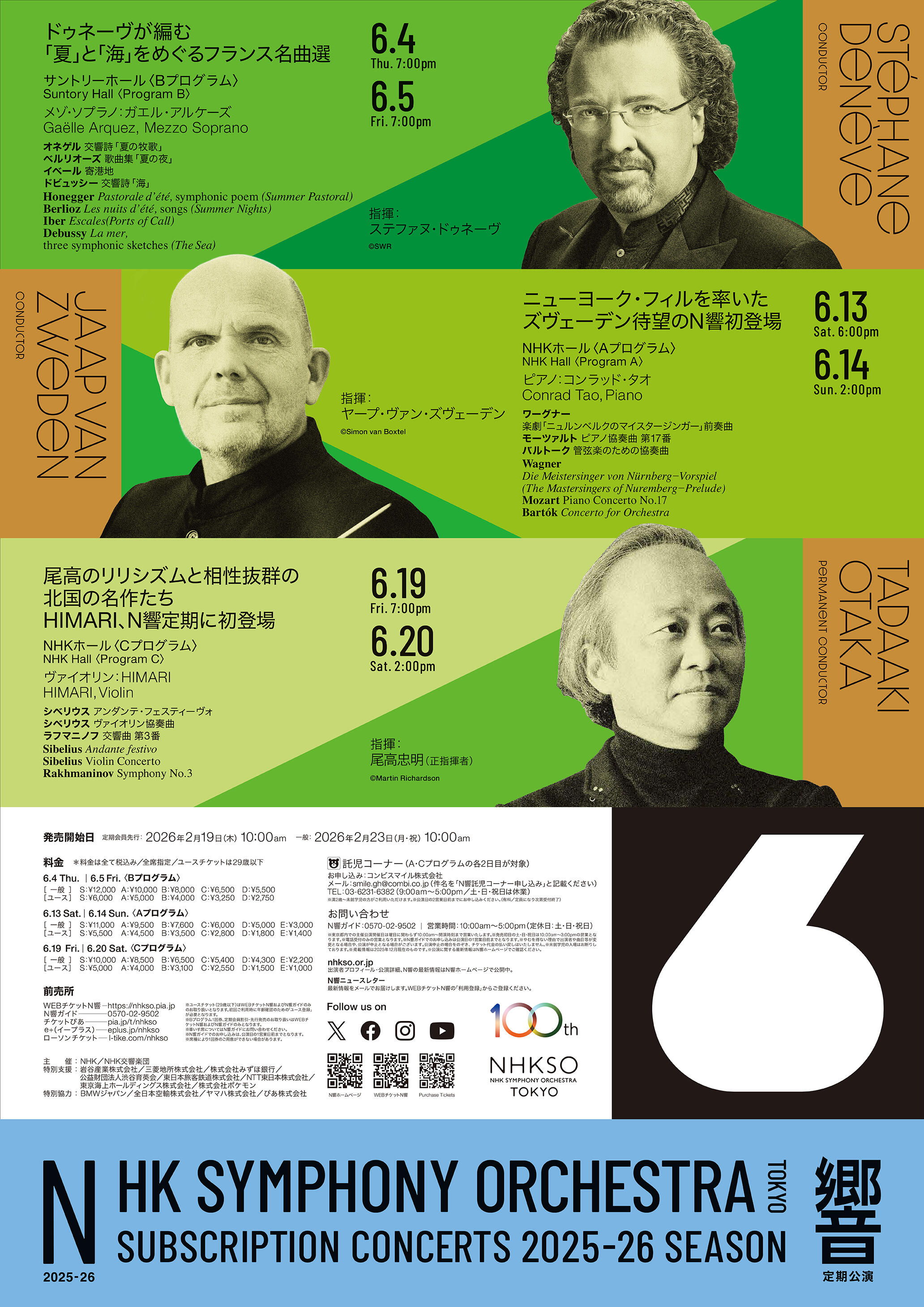
 ConductorStéphane Denève
French conductor Stéphane Denève is Music Director of the St. Louis Symphony Orchestra, Artistic Director of the New World Symphony and Principal Guest Conductor of the Netherlands Radio Philharmonic Orchestra. He previously served as Principal Guest Conductor of The Philadelphia Orchestra, Chief Conductor of the Brussels Philharmonic, Chief Conductor of the SWR Symphonieorchester and Music Director of the Royal Scottish National Orchestra.
A graduate of the Paris Conservatoire, he worked closely in his early career with Sir Georg Solti, Georges Prêtre and Seiji Ozawa.
Recent engagements include appearances with the Berliner Philharmoniker, Symphonieorchester des Bayerischen Rundfunks, Wiener Symphoniker, Royal Concertgebouw Orchestra, BBC Symphony Orchestra (BBC Proms), Royal Stockholm Philharmonic Orchestra (2020 Nobel Prize concert), Orchestre national de France and the Orchestre philharmonique de Radio France. He made his Carnegie Hall debut with the Boston Symphony Orchestra, and subsequently conducted the annual gala with The Philadelphia Orchestra, John Williams and Yo-Yo Ma. In 2022, he led the official 90th Birthday Gala for John Williams at the Kennedy Center with the National Symphony Orchestra. In 2023, he conducted the Saito Kinen Orchestra of the Seiji Ozawa Matsumoto Festival at Tokyo’s Suntory Hall alongside John Williams.
In the field of opera, he has led productions at the Royal Opera House, Opéra national de Paris, Teatro alla Scala, Deutsche Oper Berlin, Dutch National Opera (including a new production of Pelléas et Mélisande with the Royal Concertgebouw Orchestra for the Holland Festival).
Since his 2015 debut, he has deepened his relationship with the NHK Symphony Orchestra. This time, the expert of his homeland’s music will conduct the French program featuring Berlioz, Debussy, Honegger and Ibert.
 Mezzo SopranoGaëlle Arquez
French mezzo-soprano Gaëlle Arquez is one of the most prominent opera stars. After graduating from the Paris Conservatoire, she made her debut at the Opéra national de Paris in Michael Haneke’s production of Don Giovanni (Zerlina) under the direction of Philippe Jordan. She has since established herself on the international stage, performing in leading opera houses including the Metropolitan Opera, Teatro alla Scala, Royal Opera House, Staatsoper Berlin, Theater an der Wien, Wiener Staatsoper and the Opéra national de Paris.
She has earned international acclaim for the breadth and versatility of her repertoire, with particular distinction in her signature role of Carmen. In the current season, she made her debut at the Grand Théâtre de Genève as Isabella in Julien Chavaz’ new production of L’Italiana in Algeri under the baton of Michele Spotti.
Recent concert highlights include Chausson’s Poème de l’amour et de la mer with the Wiener Symphoniker, Ravel’s Scheherazade with the Orchestre Philharmonique de Monte-Carlo, and Iphigénie in Gluck’s Iphigénie en Tauride in a semi-staged production at the Elbphilharmonie in Hamburg under Thomas Hengelbrock.
At her highly anticipated Japanese debut with the NHK Symphony Orchestra conducted by her compatriot Stéphane Denève, she will sing Berlioz’s French song cycle Les nuits d’été.
Download

Ticket
Program B
No. 2066 Subscription (Program B)
Suntory Hall
Google Map
Seating Chart
Single Tickets Release Date
Pre-sales for Subscribers:Thursday, February 19, 2026 10:00am
*about subscribers
Sale to General Public:Monday, February 23, 2026 10:00am
Price
| S | A | B | C | D | |
|---|---|---|---|---|---|
| Ordinary Ticket | 12,000 | 10,000 | 8,000 | 6,500 | 5,500 |
| Youth Ticket | 6,000 | 5,000 | 4,000 | 3,250 | 2,750 |
*tax included
*Subscribers receive a 10% discount (Available at NHKSO WEB Ticket and N-Kyo Guide)
*For wheelchair-accessible seats, please refer to the N-Kyo Guide
*Please note that single tickets may not be available depending on ticket price range
Youth Tickets
Youth Tickets are great options for those of 29 years old and younger
Subscription tickets
Release Date
ANNUAL SUBSCRIPTION TICKETS
Sun., July 13, 2025 10:00am
[For Subscribers: Sun., July 6, 2025 10:00am]
Where to buy
NHKSO WEB Ticket | Thu., June 4 (In English / Seats not selectable on the English site)
NHKSO WEB Ticket | Fri., June 5 (In English / Seats not selectable on the English site)
NHKSO WEB Ticket (In Japanese / Seats selectable)
N-Kyo Guide (Purchase by telephone only)
Organized by: NHK (Japan Broadcasting Corporation) / NHK Symphony Orchestra, Tokyo
*Repertoire, conductor, soloists and program order are subject to change without notice.
*Pre-school children are not allowed in the concert hall.
