
- Home
- Concerts
- Subscription Concerts
- Program C
- No. 2053 Subscription (Program C)
No. 2053 Subscription (Program C)


Program
Chopin / Piano Concerto No. 2 F Minor Op. 21
Poland’s national hero Frédéric François Chopin (1810–1849) was born to a French father and a Polish mother near Warsaw. A child prodigy, the future Poet of the Piano received elementary piano lessons from his mother and sister before studying composition under Józef Elsner privately and at Warsaw’s High School of Music. Elsner encouraged his talented pupil to extend his own individuality, which laid the groundwork for Chopin’s highly personal artistry.
Chopin’s works, mostly piano music, are marked by melodic beauty that he owes to his strong attachment for Italian operas and their flowing, ornamental “Bel Canto” singing style. He was an unequaled pianist and improviser himself, which is reflected in the graceful virtuosity, inventive harmonic twists and ornaments found in his piano writing. Finally, we must not forget his ties with the musical heritage of his beloved mother country. Polish folk dances’ elements, particularly their rhythms, provide his music with colors and liveliness. His two youthful piano concertos blend those characteristics with influences from older composer-pianists such as Johann Nepomuk Hummel and John Field.
No. 2 in F minor is Chopin’s first piano concerto (but published as his second). The rising star penned it in 1829 at age 19, after he gave successful concerts in Vienna performing his Variations on “Là ci darem la mano” from Don Giovanni and Rondo à la Krakowiak, both for piano and orchestra. He premiered No. 2 during his public concert debut in Warsaw in March 1830. The highly-anticipated event, sold out, gathered 900 audience members.
An extensive orchestral introduction opens No. 2 announcing the tense first theme on violins and the idyllic second theme on an oboe, before the pianist’s dramatic entrance. The intimate middle movement, evoking a nocturne, expresses Chopin’s love for the soprano Konstancja Gładkowska according to his letter to a friend. The final rondo movement is famous for its rhythms of mazurka, a Polish folk dance, and the utilization by violins and violas of the col legno technique of striking the strings with the bow’s wood.
[Kumiko Nishi]
Nielsen / Symphony No. 4 Op. 29, The Inextinguishable
Born in the Danish Island of Funen in 1865, Carl Nielsen (1865–1931) is considered one of the most essential Nordic composers alongside Jean Sibelius (1865–1957) from Finland, the same age as him, and Edvard Grieg (1843–1907) from Norway. Nielsen studied composition at the Royal Danish Academy of Music in Copenhagen under his compatriot Niels Gade, Grieg’s teacher as well. Nielsen then started his career as an orchestral violinist while composing, before serving as a conductor with the Royal Theatre in the capital and the Orchestra of the Copenhagen Music Society.
Nielsen left us a vast catalogue including six unconventional, inventive, beautiful symphonies (first heard on his native soil during his lifetime between 1894 and 1925), concertos, two operas and a profusion of songs and choral works.
The Symphony No. 4 was penned between the summer of 1914 and the beginning of 1916. At the time, both the composer and the world surrounding him stood at the crossroads, even though Denmark remained neutral during World War I. While going through a marital crisis, Nielsen gained self-confidence as a composer and conductor more than ever following the successful premieres under his own baton of his Symphony No. 3 Sinfonia Espansiva and Violin Concerto in 1911. Three years later, he left a conducting position at the Royal Theatre to be a freelance musician for the first time since 1889, which allowed him to spend more time composing the Symphony No. 4.
Nielsen conducted the premiere of No. 4 in Copenhagen in 1916, which was followed immediately by its performances in Stockholm and Berlin. No. 4 was even blessed with the British premiere by the London Symphony Orchestra under the composer’s baton in 1923. Alongside the Symphony No. 5, No. 4 is considered today one of Nielsen’s greatest works.
Regarding the subtitle The Inextinguishable given by the composer himself, the program notes for the premiere and the comments made by Nielsen on various occasions are informative. According to them, the subtitle is an attempt “to suggest what only the music itself has the power to express fully: the elementary will to life.” “Music is life, and like it[, ] inextinguishable,” stated Nielsen.
No. 4 is a single-movement symphony composed of four contrastive parts. The most distinctive features are its unpredictable unfoldment, even in the first part in sonata form, and a vital role played by two sets of timpani. Violins and the first timpani assume the calm transition from the kaleidoscopic first part to the pastoral second part. The grievous slow third part begins with a lament sung by violins backed with the first timpani. The second timpani finally appears right before the last Allegro part where two sets of timpani have a heated exchange. The symphony concludes in E major with the support of the second timpani’s powerful cadence.
[Kumiko Nishi]
[Encore]
December 12: J.S.Bach / Goldberg-Variationen BWV988 - "Aria"
December 13: Chopin / Waltz C-sharp Minor Op. 64-2
Piano: Eric Lu
Artists
 ConductorFabio Luisi
Fabio Luisi hails from Genoa. He first conducted the NHK Symphony Orchestra in 2001 and became its Chief Conductor in September 2022. He performed Verdi’s Requiem to celebrate his appointment, and Mahler’s Symphonie der Tausend for the orchestra’s 2000th subscription concert in 2023. In 2024, he led the orchestra’s Taiwanese tour, and then in May 2025, he successfully led its European tour scheduled in conjunction with Amsterdam’s Mahler Festival at The Concertgebouw, the Prague Spring Festival and the Dresdner Musikfestspiele: the NHK Symphony Orchestra was the first Asian orchestra to appear at the Mahler Festival, performing the composer’s Symphonies No. 3 and No. 4 to critical praise.
Currently the Principal Conductor of the Danish National Symphony Orchestra and the Music Director of the Dallas Symphony Orchestra, he was General Music Director of the Opernhaus Zürich, Principal Conductor of New York’s Metropolitan Opera, Chief Conductor of the Wiener Symphoniker, General Music Director of the Staatskapelle Dresden and the Sächsische Staatsoper, Principal Conductor and Chief Conductor of the MDR-Sinfonieorchester, Artistic Director of the Orchestre de la Suisse Romande, Chief Conductor of the Tonkünstler Orchester and Artistic Director of the Grazer Symphonisches Orchester. He is also Music Director of Puglia’s Festival della Valle d’Itria Martina Franca and Emeritus Conductor of Orchestra Sinfonica Nazionale della Rai. He is a frequent guest of leading orchestras including the Berliner Philharmoniker, the Royal Concertgebouw Orchestra and the Saito Kinen Orchestra, opera houses and festivals worldwide.
In recording, his complete Nielsen symphonic cycle with the Danish National Symphony Orchestra was recognized with Limelight and Abbiati Awards in 2023, while its first volume was named Recording of the Year by Gramophone. He received a Grammy Award for his leadership of the last two operas of Wagner’s Ring cycle at the Metropolitan Opera, as released on DVD. His first CD with the NHK Symphony Orchestra, Bruckner: Symphony No. 8 (1st version) was released in May 2025.
He is an accomplished composer and maker of perfumes.
 PianoEric Lu (The Winner of the 19th International Chopin Piano Competition)
Eric Lu was awarded the First Prize at the 19th International Chopin Piano Competition held in Warsaw in October 2025. In the history of this prestigious event, he is one of the only two pianists who became the winner performing Chopin’s Piano Concerto No. 2 in F minor, considered more introverted than No. 1, at the final round; the other is his teacher Dang Thai Son, the winner of the 10th edition in 1980.
Lu also won the First Prize at the Leeds International Piano Competition in 2018, after coming to international attention as the Fourth Prize winner at the International Chopin Piano Competition in 2015 aged just 17. A former BBC New Generation Artist from 2019 to 2022, he received the Avery Fisher Career Grant in 2021.
Born on December 15, 1997 in Massachusetts, USA, he is a graduate of the Curtis Institute of Music, studying with Robert McDonald and Jonathan Biss. He already debuted with the world’s major orchestras including the Chicago Symphony Orchestra, London Symphony Orchestra, Boston Symphony Orchestra, Los Angeles Philharmonic and the Oslo Philharmonic alongside Riccardo Muti, Marin Alsop, Vasily Petrenko, Edward Gardner, Thomas Dausgaard, Earl Lee, Ryan Bancroft, Ruth Reinhardt and Martin Fröst, among others.
This is his first collaboration with the NHK Symphony Orchestra.
Download
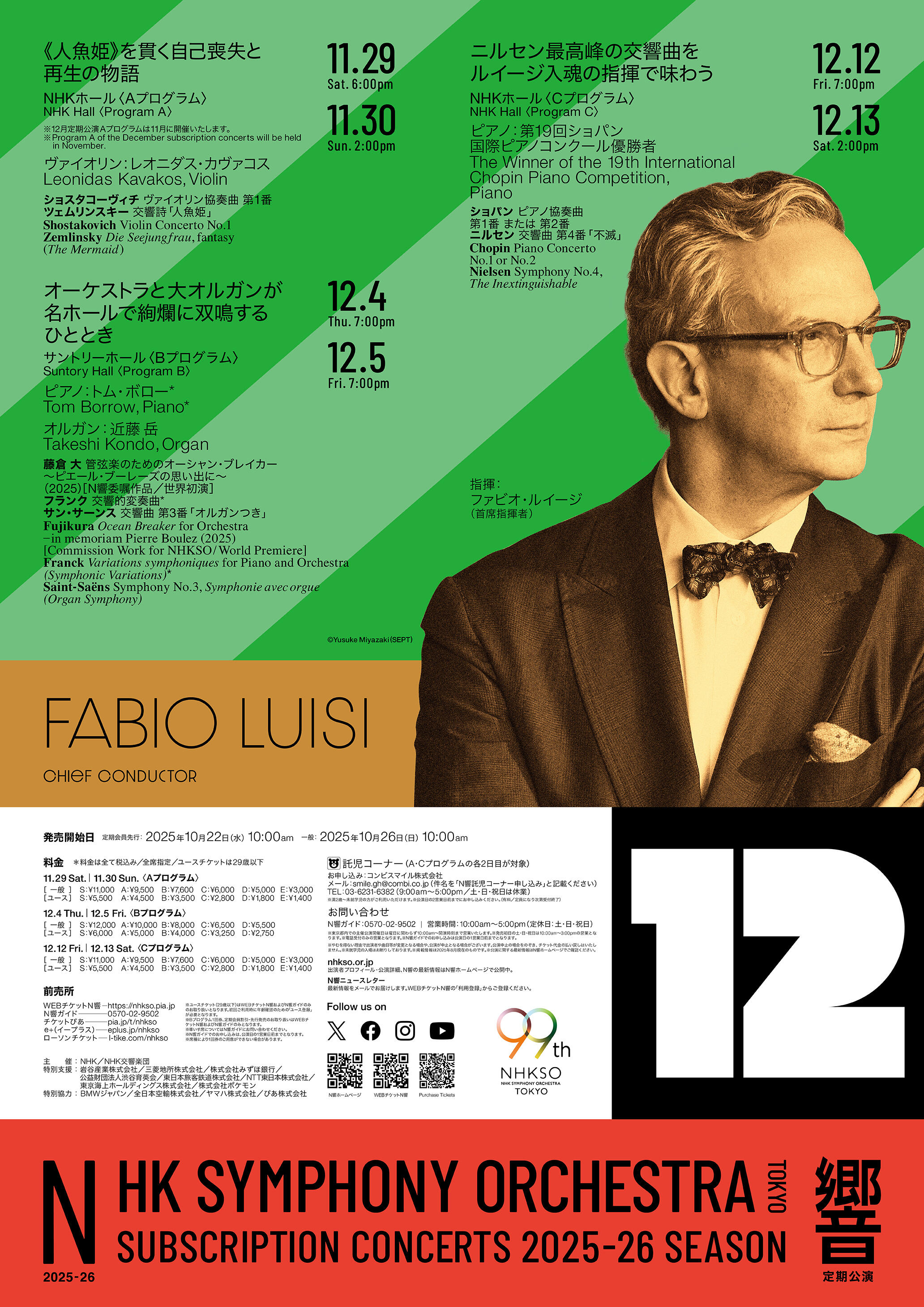

Ticket
Single Tickets Release Date
Pre-sales for Subscribers:Wednesday, October 22, 2025 10:00am
*about subscribers
Sale to General Public:Sunday, October 26, 2025 10:00am
Price
| S | A | B | C | D | E | |
|---|---|---|---|---|---|---|
| Ordinary Ticket | 11,000 | 9,500 | 7,600 | 6,000 | 5,000 | 3,000 |
| Youth Ticket | 5,500 | 4,500 | 3,500 | 2,800 | 1,800 | 1,400 |
*tax included
*Subscribers receive a 10% discount (Available at NHKSO WEB Ticket and N-Kyo Guide)
*For wheelchair-accessible seats, please refer to the N-Kyo Guide
*Please note that single tickets may not be available depending on ticket price range
Youth Tickets
Youth Tickets are great options for those of 29 years old and younger
Subscription tickets
Release Date
ANNUAL SUBSCRIPTION TICKETS
Sun., July 13, 2025 10:00am
[For Subscribers: Sun., July 6, 2025 10:00am]
SEASONAL SUBSCRIPTION TICKETS (WINTER)
Fri., October 17, 2025 10:00am
[For Subscribers: Tue., October 14, 2025 10:00am]
Where to buy
NHKSO WEB Ticket | Fri., December 12 (In English / Seats not selectable on the English site)
NHKSO WEB Ticket | Sat., December 13 (In English / Seats not selectable on the English site)
NHKSO WEB Ticket (In Japanese / Seats selectable)
N-Kyo Guide (Purchase by telephone only)
Other Ticket Agents
Organized by: NHK (Japan Broadcasting Corporation) / NHK Symphony Orchestra, Tokyo
*Repertoire, conductor, soloists and program order are subject to change without notice.
*Pre-school children are not allowed in the concert hall.
