
- Home
- Concerts
- Subscription Concerts
- Program B
- No. 2052 Subscription (Program B)
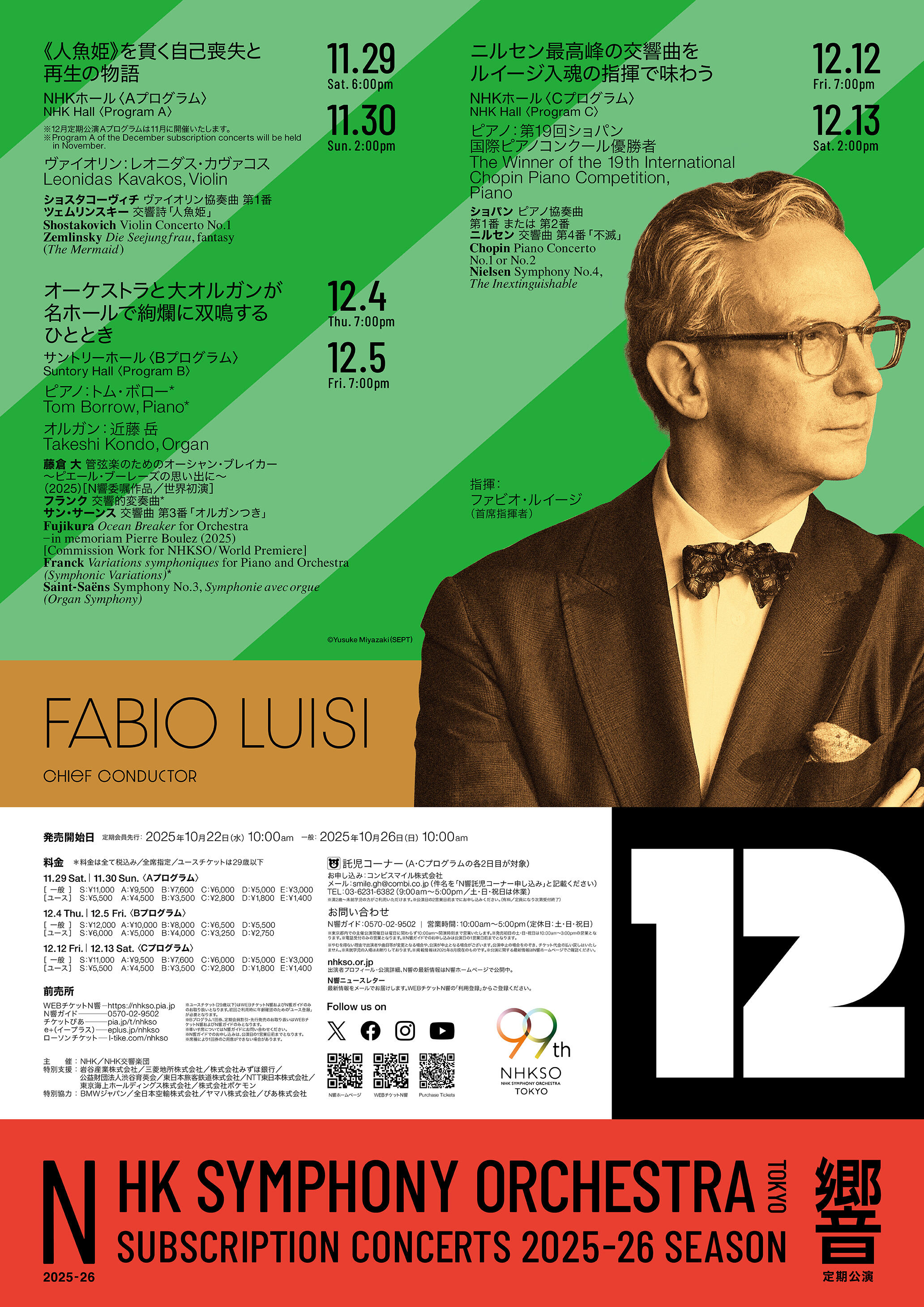
No. 2052 Subscription (Program B)
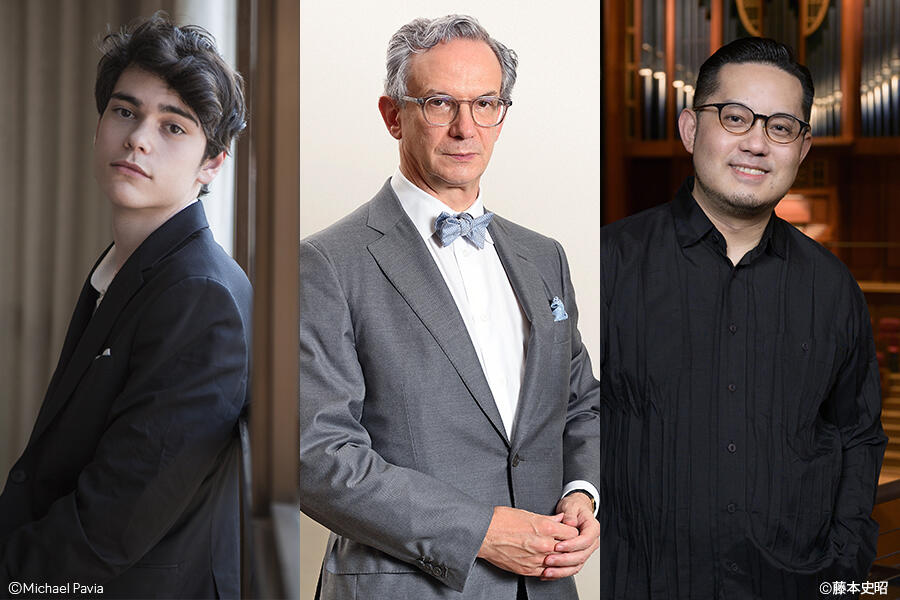


Program
Fujikura / Ocean Breaker for Orchestra - in memoriam Pierre Boulez (2025)[Commission Work for NHK Symphony Orchestra / World Premiere]
Born in Osaka, Japan, Dai Fujikura (1977–) started piano at age 5, and soon began to compose, being “sick of faithfully interpreting the notes written by others.” He has since cultivated this daring and free spirit, which makes him nowadays one of the world’s most original and sought-after composers.
At age 15, he moved alone to the UK, his base today, where he studied under George Benjamin (1960–). One of his breakthroughs emerged at the Lucerne Festival when he was 26: his talent was spotted by French composer and conductor Pierre Boulez (1925–2016) who soon became his mentor and champion. In August 2025, Fujikura’s Ritual for chamber orchestra and electronics was premiered alongside Boulez’s Répons at the Lucerne Festival’s concert honoring the 100th anniversary of Boulez’s birth.
The NHK Symphony Orchestra has long had a close relationship with Fujikura and, most recently, performed his Shakuhachi Concerto in 2023. Back in 2010, the orchestra’s six cellists gave the Japanese premiere of Fujikura’s Mirrors penned for the 85th birthday of Boulez, whose memory the present work Ocean Breaker for Orchestra is dedicated to.
Written as a concerto for an entire orchestra, it is marked by a gravity-free fluid nature, one of Fujikura’s musical fingerprints.
[Kumiko Nishi]
Franck / Variations symphoniques for Piano and Orchestra (Symphonic Variations)
César Franck (1822–1890) led the French musical scene alongside his thirteen-year junior Saint-Saëns during the mid-to-late 19th century. His disciples (mostly his students at the Paris Conservatoire) reverently called him “Père Franck (Father Franck)”, admiring his sublime artistry and sincere personality. In Paris, these loyal “Franckist” composers including Vincent d’Indy (1851–1931) and Ernest Chausson (1855–1899) will be as influential as their opponent Claude Debussy (1862–1918), a pioneer of the 20th-century bold explorations in music.
Having said that, Franck was not originally from France but Belgium. He was born in Liège to a German/Walloon couple to be active in Paris later. Franck’s style full of lyricism is indeed readily differentiated from the typical French composers’. On the model of Bach, Beethoven, Liszt and Wagner, Franck acquired a mastery of counterpoint as well as a sort of Austro-Germanic rigor and formal logic to gain his individual style. Moreover, his expertise as a church organist—namely as an improviser—is definitely connected with his wide range of tonal textures and ingenious harmonic change.
Most of Franck’s piano works were written during his earliest years (when he was a child piano prodigy promoted by his ambitious father) and his concluding years. A trigger which revived his passion for piano composition was the symphonic poem Les Djinns (1884) for piano and orchestra that he wrote for a commission. Deeply impressed and inspired by the piano virtuoso Louis Diémer who premiered it in March 1885, Franck soon wrote for the pianist, Variations symphoniques (Symphonic Variations) for piano and orchestra. The work was first heard in Paris with Diémer as soloist and Franck conducting in May 1886.
Symphonic Variations is performed seamlessly without pause. It first introduces the three main themes: the strings resolutely give the dotted first theme at the outset, immediately before the piano calmly states the descending second theme, and then sings the more melodious third element. Their following variations move from a lyrically dark atmosphere to a radiantly joyous one before the march-inflected finale triumphantly closes the work in F-sharp major.
[Kumiko Nishi]
Saint-Saëns / Symphony No. 3 C Minor Op. 78, Symphonie avec orgue (Organ Symphony)
Born in Paris, Camille Saint-Saëns (1835–1921) was a genuine musical prodigy. He made his official pianist debut at age 10 composing his own cadenza for a Mozart concerto he programmed for the concert. Then the precocious thirteen-year-old entered the Paris Conservatoire to study organ and composition. Later he was made organist of the Madeleine, one of Paris’s important Catholic churches, to remain in the post for twenty years. Franz Liszt (1811–1886) who recognized Saint-Saëns’s talent as a pianist and composer hailed him “the greatest organist in the world” as well. Furthermore, Saint-Saëns, a reputable conductor as well, was an enthusiastic supporter of other contemporary composers, conducting Liszt’s symphonic poems and defending music of Richard Wagner (1813–1883) in France.
Through his own experiences as an interpreter, Saint-Saëns strongly sensed the necessity of an effort to boost his country’s instrumental music repertoire. In fact, operas, ballets and Austro-German music dominated the French classical music life until then. That was a reason why he founded the Société nationale de musique in Paris in 1871 together with musicians such as Franck and Gabriel Fauré (1845–1924). Amid the rising nationalism after Prussia defeated France at the war of 1870–1871, this patriotic association aimed to encourage French composers to write more orchestral and chamber music. It gave the first performances of, besides Franck’s above-mentioned Symphonic Variations, important works by Debussy, Paul Dukas (1865–1935), Maurice Ravel (1875–1937) and the “Franckists,” among others. Saint-Saëns himself penned various instrumental pieces as well.
The Symphony No. 3 Organ Symphony is tied to these efforts, but it came from a different background. Considered then one of the best living French composers in England, Saint-Saëns was commissioned to write a work for London’s Philharmonic Society. Possibly inspired by Liszt’s Hunnenschlacht (The Battle of the Huns)(1857) for orchestra including an organ, Saint-Saëns composed the Organ Symphony in 1886. Two months after the premiere in London in May 1886 with Saint-Saëns himself conducting, Liszt passed away. The work was dedicated to the memory of the Hungarian giant.
The entire Organ Symphony is unified by the Lisztian transformation of a theme. The wiggling theme is given by the violins after the short slow introduction. The first notes of this theme correspond to the beginning of the Dies Irae (Day of Wrath) melody from the Catholic Mass for the Dead. This is highly likely linked with this symphony’s bright, optimistic ending in C major.
Overall, the work has a clear but unique structure, having four sections (after the conventional symphony format) being encased two by two in two movements. Symmetrically, the organ opens the second sections of each movement respectively evoking the instrument’s introspective and magnificent characters. The symphony also includes virtuosic piano passages for two and four hands, reminding us of the composer’s considerable reputation as a pianist.
[Kumiko Nishi]
[Encore]
J. S. Bach (arr. by Rakhmaninov) / Partita for Solo Violin No. 3 E Major BWV1006 (Piano Ver.) - "Gavotte"
Piano: Tom Borrow
Artists
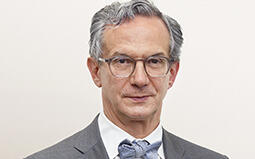 ConductorFabio Luisi
Fabio Luisi hails from Genoa. He first conducted the NHK Symphony Orchestra in 2001 and became its Chief Conductor in September 2022. He performed Verdi’s Requiem to celebrate his appointment, and Mahler’s Symphonie der Tausend for the orchestra’s 2000th subscription concert in 2023. In 2024, he led the orchestra’s Taiwanese tour, and then in May 2025, he successfully led its European tour scheduled in conjunction with Amsterdam’s Mahler Festival at The Concertgebouw, the Prague Spring Festival and the Dresdner Musikfestspiele: the NHK Symphony Orchestra was the first Asian orchestra to appear at the Mahler Festival, performing the composer’s Symphonies No. 3 and No. 4 to critical praise.
Currently the Principal Conductor of the Danish National Symphony Orchestra and the Music Director of the Dallas Symphony Orchestra, he was General Music Director of the Opernhaus Zürich, Principal Conductor of New York’s Metropolitan Opera, Chief Conductor of the Wiener Symphoniker, General Music Director of the Staatskapelle Dresden and the Sächsische Staatsoper, Principal Conductor and Chief Conductor of the MDR-Sinfonieorchester, Artistic Director of the Orchestre de la Suisse Romande, Chief Conductor of the Tonkünstler Orchester and Artistic Director of the Grazer Symphonisches Orchester. He is also Music Director of Puglia’s Festival della Valle d’Itria Martina Franca and Emeritus Conductor of Orchestra Sinfonica Nazionale della Rai. He is a frequent guest of leading orchestras including the Berliner Philharmoniker, the Royal Concertgebouw Orchestra and the Saito Kinen Orchestra, opera houses and festivals worldwide.
In recording, his complete Nielsen symphonic cycle with the Danish National Symphony Orchestra was recognized with Limelight and Abbiati Awards in 2023, while its first volume was named Recording of the Year by Gramophone. He received a Grammy Award for his leadership of the last two operas of Wagner’s Ring cycle at the Metropolitan Opera, as released on DVD. His first CD with the NHK Symphony Orchestra, Bruckner: Symphony No. 8 (1st version) was released in May 2025.
He is an accomplished composer and maker of perfumes.
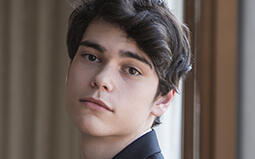 PianoTom Borrow
Born in Tel Aviv in 2000, Tom Borrow is one of the fastest-rising young musicians of his generation. He has been regularly mentored by Murray Perahia through the Jerusalem Music Centre’s program for outstanding young musicians. He also participated in masterclasses of András Schiff and Menahem Pressler, among many others.
In 2019, he was called on to replace Khatia Buniatishvili in a series of twelve concerts with the Israel Philharmonic Orchestra. At only 36 hours’ notice, he performed Ravel’s Concerto in G Major to sensational acclaim. He has since been invited by major orchestras around the world such as the Cleveland Orchestra, London Philharmonic Orchestra, BBC Symphony Orchestra, Konzerthausorchester Berlin, Czech Philharmonic and Danish National Symphony Orchestra, under the baton of leading conductors including Fabio Luisi, Semyon Bychkov, Vasily Petrenko, Christoph Eschenbach, Sakari Oramo, Thierry Fischer and Masaaki Suzuki.
A former BBC New Generation Artist, he is a recipient of the Alte Oper Frankfurt’s Young Artist Prize and the Terence Judd-Hallé Award. Currently, he has served as the Artist-
In-Residence at the São Paulo Symphony Orchestra and the Soloist-In-Residence at the Filarmonica Arturo Toscanini.
This is his highly anticipated first collaboration with the NHK Symphony Orchestra.
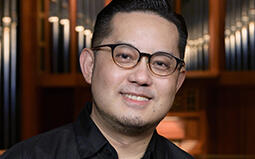 OrganTakeshi Kondo
Japanese organist, composer and arranger Takeshi Kondo has been the Hall Organist of the Yokohama Minato Mirai Hall since 2022. He held the same title at the MUZA Kawasaki Symphony Hall from 2004 to 2006 and from 2009 to 2018. He graduated from the Tokyo University of the Arts’ Composition Department and completed its Practical Music Course’s Organ Department, before obtaining his master’s degree in organ performance there. He was awarded the prestigious scholarship “The Program of Overseas Study for Upcoming Artists of Japan’s Agency for Cultural Affairs” to study in Paris.
He is a sought-after collaborator among Japan’s major orchestras and ensembles, while giving solo recitals both at home and abroad and premiering new works of his own and other Japanese composers. The Symphony No. 3 Organ Symphony was written by French composer Saint-Saëns who was an outstanding organist himself. No. 3 has nurtured a musical relationship between Kondo and the NHK Symphony Orchestra for over a decade, since the piece accompanied his debut with the orchestra in 2012 at its “Summer” Concert under the baton of John Axelrod. Most recently, Kondo and the orchestra led by Michiyoshi Inoue played No. 3 at the concert celebrating the renewal of the Yokohama Minato Mirai Hall in November 2022.
Download

Ticket
Program B
No. 2052 Subscription (Program B)
Suntory Hall
Google Map
Seating Chart
Single Tickets Release Date
Pre-sales for Subscribers:Wednesday, October 22, 2025 10:00am
*about subscribers
Sale to General Public:Sunday, October 26, 2025 10:00am
Price
| S | A | B | C | D | |
|---|---|---|---|---|---|
| Ordinary Ticket | 12,000 | 10,000 | 8,000 | 6,500 | 5,500 |
| Youth Ticket | 6,000 | 5,000 | 4,000 | 3,250 | 2,750 |
*tax included
*Subscribers receive a 10% discount (Available at NHKSO WEB Ticket and N-Kyo Guide)
*For wheelchair-accessible seats, please refer to the N-Kyo Guide
*Please note that single tickets may not be available depending on ticket price range
Youth Tickets
Youth Tickets are great options for those of 29 years old and younger
Subscription tickets
Release Date
ANNUAL SUBSCRIPTION TICKETS
Sun., July 13, 2025 10:00am
[For Subscribers: Sun., July 6, 2025 10:00am]
Where to buy
NHKSO WEB Ticket | Thu., December 4 (In English / Seats not selectable on the English site)
NHKSO WEB Ticket | Fri., December 5 (In English / Seats not selectable on the English site)
NHKSO WEB Ticket (In Japanese / Seats selectable)
N-Kyo Guide (Purchase by telephone only)
Organized by: NHK (Japan Broadcasting Corporation) / NHK Symphony Orchestra, Tokyo
*Repertoire, conductor, soloists and program order are subject to change without notice.
*Pre-school children are not allowed in the concert hall.
