
- Home
- Concerts
- Subscription Concerts
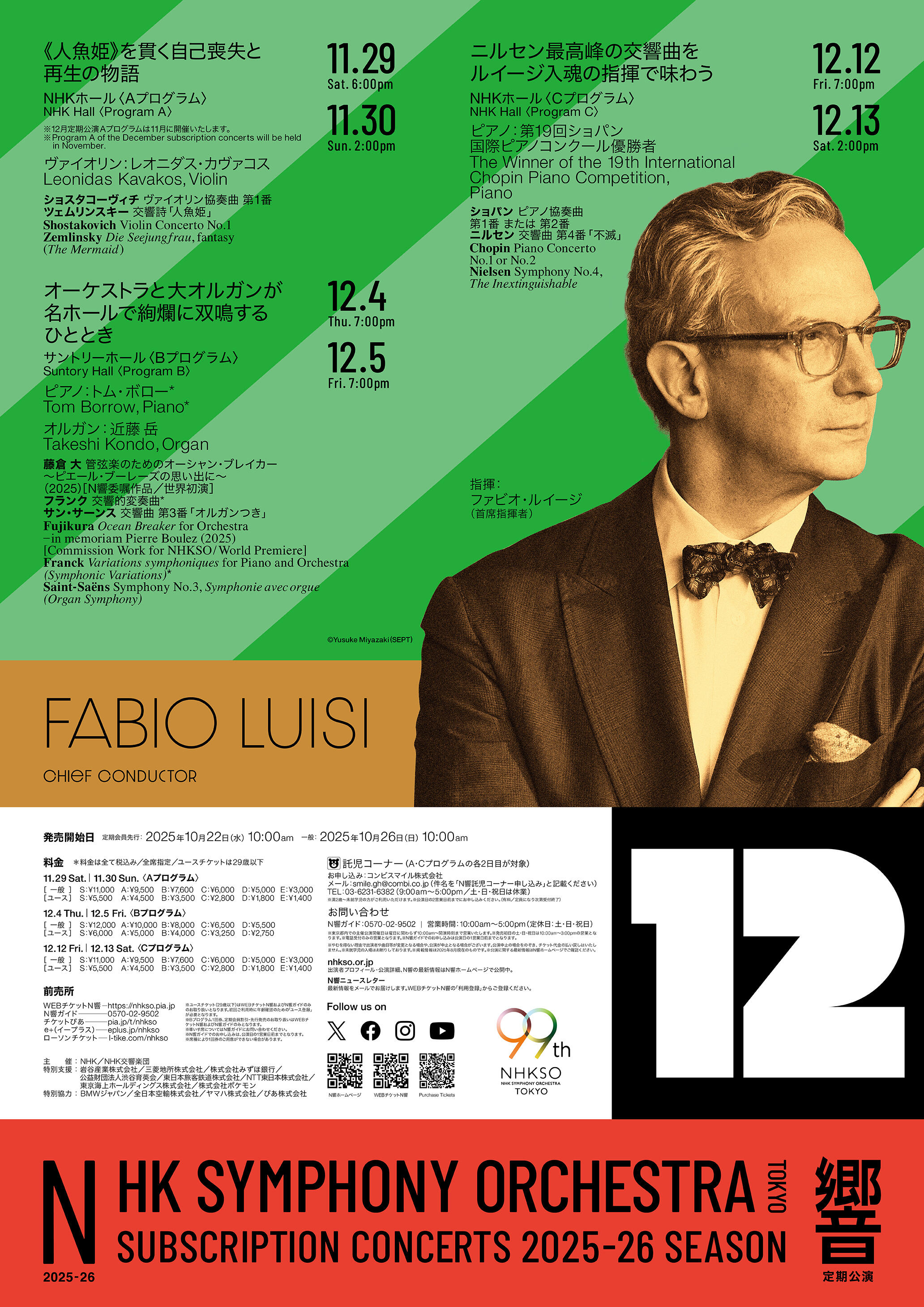
- Program A
- No. 2051 Subscription (Program A)
No. 2051 Subscription (Program A)


Program
Shostakovich / Violin Concerto No. 1 A Minor Op. 77
St. Petersburg-born Dmitry Shostakovich (1906–1975) mostly lived as a citizen of the Soviet Union where the communist regime utilized every art form as a vehicle for their propaganda. Especially during Stalin’s era (1924–1953), many artists who didn’t meet the official Soviet style called “Socialist realism” put their lives and careers in peril.
Shostakovich was subjected to the two infamous cultural purges in 1936 and 1948. He managed to “rehabilitate” himself writing propagandistic or non-modernist works to please the authorities. However, he openly hid politically rebellious messages in his music, while stashing several improper or artistically ambitious works “in his desk drawer” to avoid the government officials’ wrath.
One of his works put in his drawer is the Violin Concerto No. 1 penned between July 1947 and March 1948. Zhdanov, Stalin’s right-hand person, denounced Shostakovich and other Soviet composers for their modernist style in February 1948, which prevented the concerto from being made public. In 1955, two years after Stalin’s death, the first performance was given in Leningrad by David Oistrakh, the legendary Soviet violinist who inspired Shostakovich to compose both of his Violin Concertos Nos. 1–2 (1948/1967) and Violin Sonata (1968).
No. 1 is not in the conventional three-movement concerto form and has instead four independent movements. The dismal opening, Nocturne in A minor, is the only movement where a celesta and harps are called for. The violin solo’s extended chromatic monologue gives midway a theme equally utilizing all twelve notes of the chromatic scale, foretelling Shostakovich’s subsequent adoption of the avant-garde twelve-tone technique. Scherzo has some themes derived from the famous DSCH motif consisting of four notes D–E-flat–C–B (D–Es–C–H in German notation) after the German transliteration of his name (D. SCHostakowitsch). This motif will resound in the composer’s Symphony No. 10 which is supposedly linked with Stalin. The third movement is a Passacaglia, a form typical of the Baroque era of continuous variation on a given theme (usually a bass line). Here the theme is announced solemnly by low strings and timpani at the start. The grand cadenza (a highly virtuosic violin solo without orchestra) leads without pause to the frenzied Burleske in A minor.
[Kumiko Nishi]
Zemlinsky / Die Seejungfrau, fantasy (The Mermaid)
Late-Romantic Viennese composer Alexander von Zemlinsky (1871–1942) had long been overshadowed by his contemporaries who were active in Vienna at the turn of the century, such as Gustav Mahler (1860–1911) and Arnold Schönberg (1874–1951). However, Zemlinsky’s works including the Lyric Symphony (1923) have been performed more and more frequently in later days. Overall, his chromatically-expanded harmonic style follows Mahler and Richard Strauss without parting from the traditional tonal language. Unlike Schönberg, Zemlinsky’s composition pupil and brother-in-law (his sister married Schönberg in 1901), he never adopted the novel twelve-tone technique.
Die Seejungfrau (The Mermaid), a fantasy for large orchestra written in 1902–1903, is also Zemlinsky’s representative work. It was premiered at a concert in Vienna in 1905 where Schönberg’s Pelleas und Melisande was also first heard publicly. The Mermaid enjoyed a few more performances before Zemlinsky withdrew it. He then left the score of the first part in Vienna and brought only the second and third parts along when he fled to the US as a Jewish exile in 1938. It was four decades after his passing in New York, that the work was rescued from oblivion by a revival performance, thanks to researchers who had gathered the separate manuscripts together.
The Mermaid is after the fairy tale The Little Mermaid by Danish author Hans Christian Andersen (1805–1875). Many commentators have associated the choice of this world-famous love triangle story with the composer’s broken heart. Indeed, Zemlinsky was in love with his composition pupil, young and brilliant Alma Schindler (1879–1964) who got engaged to Mahler in 1901 and married him the next year.
The first part of The Mermaid begins with the description of unlit ocean floor: over a drone A note, contrabasses and a harp introduce the ascending theme before winds give the undulated theme, both of which will recur throughout the piece as unifying elements. Then a violin solo presents the heroine’s theme, probably after R. Strauss’s Ein Heldenleben (A Hero’s Life) (1898) that Zemlinsky said to have studied with absorbed interest. The subsequent music depicts a stormy sea, a shipwreck and the Mermaid rescuing the Prince. The scherzo-like middle part depicts a ball held in the underwater kingdom (we hear a splendid waltz) and the Mermaid trading her voice for a pair of legs at the Sea Witch’s. The final part, headed “mit schmerzvollem Ausdruck (with sorrowful expression)”, evokes ambivalent feelings and then despair of the mute heroine, now in human shape, at the castle of the Prince who decides to marry a neighboring princess. A quiet mournful music hints the Mermaid’s self-sacrificing death after refraining from taking the Prince’s life. The ethereal ending with a marked key shift from dark A minor to luminous E-flat major, suggests the Mermaid’s ascent to heaven and acquiring of an immortal soul.
[Kumiko Nishi]
[Encore]
November 29: J,S,Bach / Partita for Solo Violin No. 2 D Minor BWV1004 - "Sarabanda"
November 30: J,S,Bach / Partita for Solo Violin No. 1 B Minor BWV1002 - "Sarabande"
Leonidas Kavakos, violin
Artists
 ConductorFabio Luisi
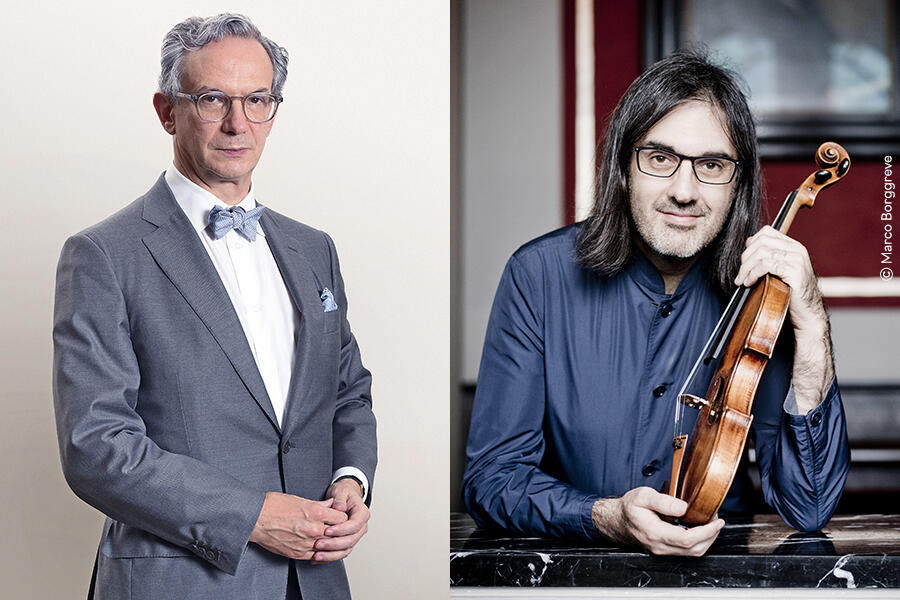
Fabio Luisi hails from Genoa. He first conducted the NHK Symphony Orchestra in 2001 and became its Chief Conductor in September 2022. He performed Verdi’s Requiem to celebrate his appointment, and Mahler’s Symphonie der Tausend for the orchestra’s 2000th subscription concert in 2023. In 2024, he led the orchestra’s Taiwanese tour, and then in May 2025, he successfully led its European tour scheduled in conjunction with Amsterdam’s Mahler Festival at The Concertgebouw, the Prague Spring Festival and the Dresdner Musikfestspiele: the NHK Symphony Orchestra was the first Asian orchestra to appear at the Mahler Festival, performing the composer’s Symphonies No. 3 and No. 4 to critical praise.
Currently the Principal Conductor of the Danish National Symphony Orchestra and the Music Director of the Dallas Symphony Orchestra, he was General Music Director of the Opernhaus Zürich, Principal Conductor of New York’s Metropolitan Opera, Chief Conductor of the Wiener Symphoniker, General Music Director of the Staatskapelle Dresden and the Sächsische Staatsoper, Principal Conductor and Chief Conductor of the MDR-Sinfonieorchester, Artistic Director of the Orchestre de la Suisse Romande, Chief Conductor of the Tonkünstler Orchester and Artistic Director of the Grazer Symphonisches Orchester. He is also Music Director of Puglia’s Festival della Valle d’Itria Martina Franca and Emeritus Conductor of Orchestra Sinfonica Nazionale della Rai. He is a frequent guest of leading orchestras including the Berliner Philharmoniker, the Royal Concertgebouw Orchestra and the Saito Kinen Orchestra, opera houses and festivals worldwide.
In recording, his complete Nielsen symphonic cycle with the Danish National Symphony Orchestra was recognized with Limelight and Abbiati Awards in 2023, while its first volume was named Recording of the Year by Gramophone. He received a Grammy Award for his leadership of the last two operas of Wagner’s Ring cycle at the Metropolitan Opera, as released on DVD. His first CD with the NHK Symphony Orchestra, Bruckner: Symphony No. 8 (1st version) was released in May 2025.
He is an accomplished composer and maker of perfumes.
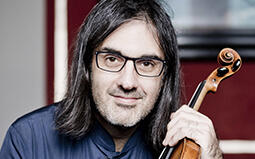 ViolinLeonidas Kavakos
Acclaimed for his captivating artistry, superb musicianship, matchless technique and the integrity of his playing, Leonidas Kavakos performs with the world’s leading orchestras as both soloist and conductor, and in recital at the world’s premier venues and festivals.
Highlights of his 2025/2026 season include performances with the Royal Concertgebouw Orchestra, Gewandhausorchester Leipzig, New York Philharmonic, San Francisco Symphony, hr-Sinfonieorchester Frankfurt, NDR Elbphilharmonie Orchester, Orchestra dell’Accademia Nazionale di Santa Cecilia, Orchestre Philharmonique de Radio France and conducting engagements with Czech Philharmonic, Philharmonia Orchestra, Barcelona Symphony and Minnesota orchestras.
An enthusiastic chamber musician as well, he has released a series of trio recordings with Yo-Yo Ma and Emanuel Ax to the highest critical acclaim.
He was born and brought up in Athens, Greece, where he curates an annual violin and chamber music masterclass which attracts violinists and ensembles from all over the world. In 2022, he founded the ApollΩn Ensemble, a chamber group of elite Greek musicians.
He made his debut with the NHK Symphony Orchestra in 2000 performing Tchaikovsky’s Violin Concerto alongside Charles Dutoit. This is his first collaboration with the orchestra since he played Brahms’s Violin Concerto in 2021 under the baton of Herbert Blomstedt.
He plays the ‘Willemotte’ Stradivarius violin of 1734.
Download

Ticket
Single Tickets Release Date
Pre-sales for Subscribers:Wednesday, October 22, 2025 10:00am
*about subscribers
Sale to General Public:Sunday, October 26, 2025 10:00am
Price
| S | A | B | C | D | E | |
|---|---|---|---|---|---|---|
| Ordinary Ticket | 11,000 | 9,500 | 7,600 | 6,000 | 5,000 | 3,000 |
| Youth Ticket | 5,500 | 4,500 | 3,500 | 2,800 | 1,800 | 1,400 |
*tax included
*Subscribers receive a 10% discount (Available at NHKSO WEB Ticket and N-Kyo Guide)
*For wheelchair-accessible seats, please refer to the N-Kyo Guide
*Please note that single tickets may not be available depending on ticket price range
Youth Tickets
Youth Tickets are great options for those of 29 years old and younger
Subscription tickets
Release Date
ANNUAL SUBSCRIPTION TICKETS
Sun., July 13, 2025 10:00am
[For Subscribers: Sun., July 6, 2025 10:00am]
SEASONAL SUBSCRIPTION TICKETS (WINTER)
Fri., October 17, 2025 10:00am
[For Subscribers: Tue., October 14, 2025 10:00am]
Where to buy
NHKSO WEB Ticket | Sat., November 29 (In English / Seats not selectable on the English site)
NHKSO WEB Ticket | Sun., November 30 (In English / Seats not selectable on the English site)
NHKSO WEB Ticket (In Japanese / Seats selectable)
N-Kyo Guide (Purchase by telephone only)
Other Ticket Agents
Organized by: NHK (Japan Broadcasting Corporation) / NHK Symphony Orchestra, Tokyo
*Repertoire, conductor, soloists and program order are subject to change without notice.
*Pre-school children are not allowed in the concert hall.
