- Home
- Concerts
- Subscription Concerts
- Program B
- No. 2079 Subscription (Program B)
No. 2079 Subscription (Program B)


Program
Mozart / Die Zauberflöte, opera K. 620 – Overture (The Magic Flute)
This year, the world celebrates the 270th anniversary of the birth of Austrian composer Wolfgang Amadeus Mozart (1756–1791). Die Zauberflöte (The Magic Flute) was completed in 1791, almost two months before he passed away in Vienna. It is a Singspiel (meaning a sung play), a popular form of German-language opera with spoken dialogues. He composed it for the theatrical troupe of Emanuel Schikaneder who wrote the libretto and also played the buffoonish and lovable role of Papageno at the premiere in Vienna. As is well known, both Mozart and Schikaneder were members of the Freemasons, and the influence of this fraternal brotherhood has frequently been pointed out in the music and the intricate plot.
Indeed, the story starts with Prince Tamino’s rescue mission to save Princess Pamina at the request of her mother, The Queen of the Night, as Pamina is held captive by the devilish high priest Sarastro. A magic flute is handed to Tamino for his protection when he sets out for Sarastro’s temple. However, as the narrative develops, it is revealed that The Queen is actually wicked and Sarastro is benevolent.
The home key of the opera is E-flat major, which has three flats in its key signature suggesting the most sacred number for Freemasons, three. The overture opens with solemn three E-flat-major chords, symbolically. The faster lively section in sonata form has the tuneful second theme introduced by a flute, evoking Tamino’s magical attribute.
[Kumiko Nishi]
Srnka / Smoke for Cello and Orchestra (2025 / 2026) [NHKSO 100th Anniversary Commissioned Work / Co-commission with the Czech Philharmonic / World Premiere]
One of today’s most sought-after composers, Miroslav Srnka (1975–) was born in Prague, a city that loved and was loved by above-mentioned Mozart. The Czech composer studied musicology at Charles University in Prague and composition at the Prague Academy of Performing Arts. The recipient of the Ernst von Siemens Music Foundation Composer’s Prize 2009, he cemented his international reputation in 2016 when his opera South Pole was premiered at the Bayerische Staatsoper in Munich under Kirill Petrenko, featuring Rolando Villazón and Thomas Hampson in the title roles.
Srnka’s works have been performed by the world’s leading interpreters and orchestras under conductors such as Peter Eötvös, Jakub Hrůša, Susanna Mälkki, David Robertson and Klaus Mäkelä. Last year, Klangforum Wien and the Arnold Schönberg Choir gave the world premiere of his new opera Voice Killer at the MusikTheater an der Wien.
In June 2023, the NHK Symphony Orchestra, Tokyo (NHKSO) presented the world premiere of his Superorganisms (2022), a work for large orchestra co-commissioned by the NHKSO, Berliner Philharmoniker, Los Angeles Philharmonic, Orchestre de Paris and the Czech Philharmonic. The piece was first performed in his home country at the Prague Spring Festival’s closing concert. His program notes for Smoke for Cello and Orchestra, newly composed to mark the NHKSO’s 100th anniversary, are available on this page.
[Kumiko Nishi]
Mendelssohn / Symphony No. 3 A Minor Op. 56, Scottish
Born into a wealthy and cultured family, Felix Mendelssohn Bartholdy (1809–1847) loved to travel. One of his representative works, the Scottish Symphony was a child of this habit. However, the gestation took over ten years from conception, a rare delay for the German composer known to be a rapid writer. The story goes back to the spring of 1829 when he, then twenty years old, set off on his first visit to England. He was welcomed by Londoners as a composer, conductor and soloist giving piano concerts and conducting his own orchestral works, and he then enjoyed his summer vacation touring Scotland.
Having a gift for painting, he sketched diverse scenery in his journal during this journey. Scotland’s nature stimulated his musical talent too, so he would soon compose the concert overture The Hebrides in 1830. During the trip, he wrote to his family enclosing the opening bars of “my Scottish Symphony” (his own words) he conceived while visiting the Holyrood Palace in Edinburgh where Queen Mary once lived. According to the letter, the ruins of the chapel beside the palace inspired the young man, and this musical embryo would give its first cry in 1842 as the introduction of his Scottish Symphony, the last work he completed in the genre. It was premiered the same year in Leipzig and dedicated to Queen Victoria of Great Britain and Ireland.
All four movements are continuously performed without pause. The pensive melody heard during the overcast introduction is associated with several important elements of the whole symphony (such as the first themes of the opening and second movements, the second theme of the final movement), which was progressive at the time. The first theme of the scherzo-like second movement particularly deserves special attention, as this merry tune sung by the clarinet is written in a pentatonic (five-note) scale with lively dotted rhythm reminding us of Scottish folksongs. The intense final movement in 2/2 meter has an unexpected A-major coda in 6/8 with a new melodic idea which is also derived from the introduction’s theme. That’s how the composer rounds off the organic structure of this masterly symphony.
[Kumiko Nishi]
Artists
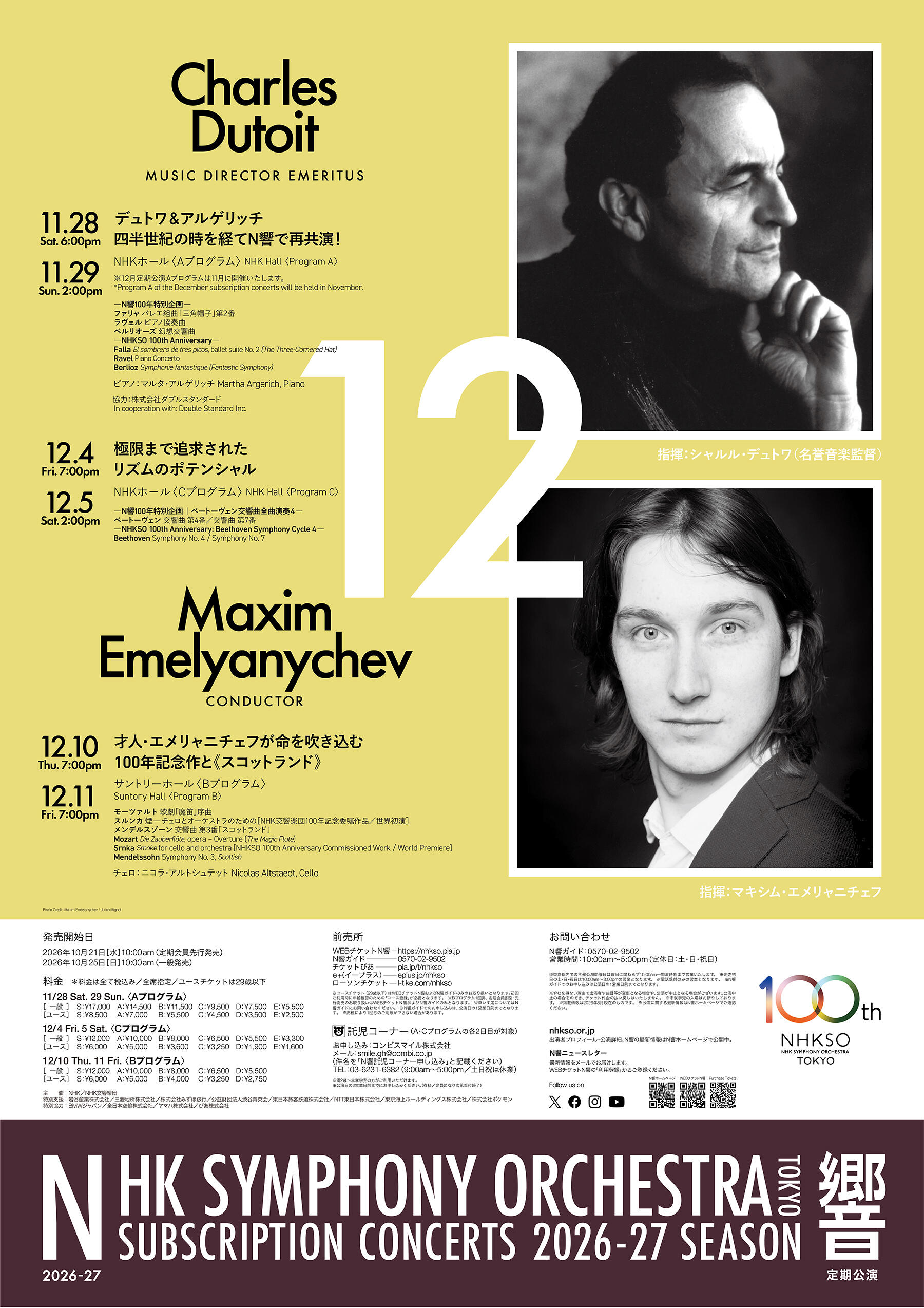
 ConductorMaxim Emelyanychev
The recipient of the highly prestigious Herbert von Karajan Prize, Russian conductor Maxim Emelyanychev inspires a true spirit of adventure among his collaborators. Born in 1988 in Nizhny Novgorod, he made his conducting debut at age 12 and studied under Gennady Rozhdestvensky at the Moscow Tchaikovsky Conservatoire.
He has been Principal Conductor of the Scottish Chamber Orchestra (SCO) since 2019, with his contract being extended through 2031. With the SCO, he has appeared at the BBC Proms and toured across Europe. At the Edinburgh International Festival, he led widely acclaimed concert performances of Mozart’s Die Zauberflöte and Così fan tutte.
He leads the period-instrument ensemble Il Pomo d’Oro from the harpsichord. Since his appointment as Principal Conductor in 2013, he, now Chief Conductor, has undertaken numerous international concert tours and recordings with the ensemble, including high-profile collaborations with artists such as mezzo soprano Joyce DiDonato and countertenor Jakub Józef Orliński.
Principal Guest Conductor of the Swedish Radio Symphony Orchestra as well, he enjoys guest-conducting top orchestras, including the Berliner Philharmoniker, Royal Concertgebouw Orchestra, London Philharmonic Orchestra, and the Orchestra of the Age of Enlightenment to name a few.
Alongside his conducting career, playing keyboard instruments—harpsichord, fortepiano, and modern piano—remains a central part of his musical life.
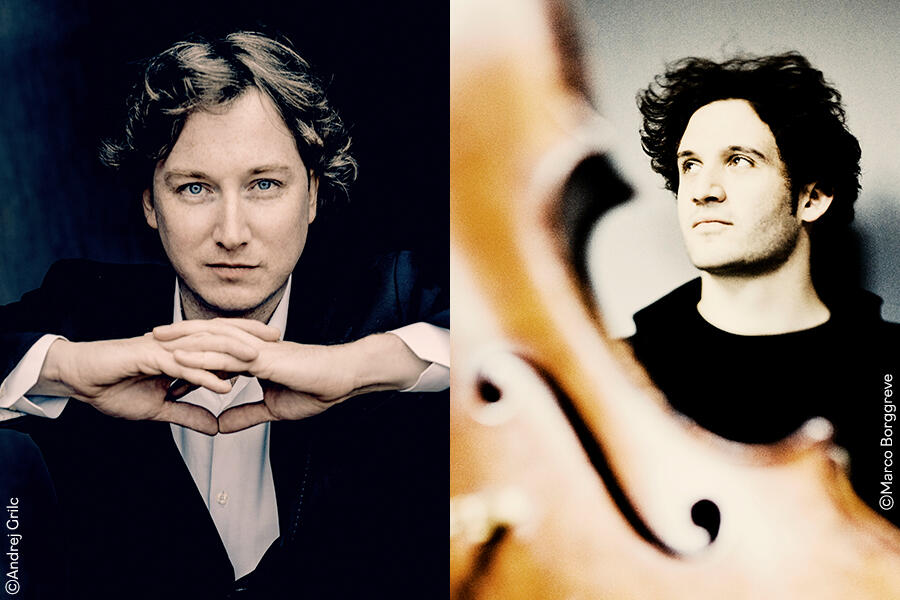
This is his debut with the NHK Symphony Orchestra. He will be entrusted to give the world premiere of Miroslav Srnka’s concerto commissioned by the orchestra to celebrate its 100th anniversary. The program will include the overture of Die Zauberflöte, the opera that Emelyanychev successfully conducted at London’s Covent Garden, and Mendelssohn’s Symphony No. 3 Scottish that he recorded with SCO to critical praise.
[Kumiko Nishi]
 CelloNicolas Altstaedt
The recipient of the Beethoven-Ring Bonn 2015 and a 2010–12 BBC New Generation Artist, German-French cellist and conductor Nicolas Altstaedt is one of the most sought after and versatile artists today.
Since his highly acclaimed debut with the Wiener Philharmoniker and Gustavo Dudamel at the Lucerne Festival, recent collaborations as a soloist include the Swedish Radio Symphony Orchestra with Maxim Emelyanychev, Royal Concertgebouw Orchestra with Matthias Pintscher and the Philharmonia Orchestra with Paavo Järvi. He also regularly performs on period instruments.
As a conductor he has forged close partnerships with the Orchestre Philharmonique de Radio France, Münchener Kammerorchester and the Scottish Chamber Orchestra, and is Artist in Association with Tapiola Sinfonietta.
Collaborations with composers such as Wolfgang Rihm, Thomas Adès, Jörg Widmann, Fazıl Say and Sofia Gubaidulina consolidate his reputation as an outstanding interpreter of contemporary music.
In 2012, he became Artistic Director of the Lockenhaus Chamber Music Festival succeeding Gidon Kremer. In 2014 he was chosen by Ádám Fischer to be Artistic Director of the Haydn Philharmonie until 2021.
At this second appearance with the NHK Symphony Orchestra since 2019, he will give the world premiere of Miroslav Srnka’s new Cello Concerto, honoring the composer’s recommendation for the soloist, under the baton of Maxim Emelyanychev with whom the cellist regularly shares the stage.
[Kumiko Nishi]
Ticket
Program B
No. 2079 Subscription (Program B)
Suntory Hall
Google Map
Seating Chart
Single Tickets Release Date
Pre-sales for Subscribers:Wednesday, October 21, 2026 10:00am
*about subscribers
Sale to General Public:Sunday, October 25, 2026 10:00am
Price
| S | A | B | C | D | |
|---|---|---|---|---|---|
| Ordinary Ticket | 12,000 | 10,000 | 8,000 | 6,500 | 5,500 |
| Youth Ticket | 6,000 | 5,000 | 4,000 | 3,250 | 2,750 |
*Tax included
*Subscribers receive a 10% discount (Available at NHKSO WEB Ticket in Japanese and N-Kyo Guide)
*Pre-sales for subscribers are only available at NHKSO WEB Ticket (In Japanese) and N-Kyo Guide
*For wheelchair-accessible seats, please refer to the N-Kyo Guide
*Please note that single tickets may not be available depending on ticket price range
Youth Tickets
Youth Tickets are great options for those of 29 years old and younger
Subscription tickets
Release Date
ANNUAL SUBSCRIPTION TICKETS
Sun., July 12, 2026 10:00am
[For Subscribers: Sun., July 5, 2026 10:00am]
Where to buy
NHKSO WEB Ticket | Thu., December 10 (In English / Seats not selectable on the English site)
NHKSO WEB Ticket | Fri., December 11 (In English / Seats not selectable on the English site)
NHKSO WEB Ticket (In Japanese / Seats selectable)
N-Kyo Guide (Purchase by telephone only)
Organized by: NHK (Japan Broadcasting Corporation) / NHK Symphony Orchestra, Tokyo
*Repertoire, conductor, soloists and program order are subject to change without notice.
*Pre-school children are not allowed in the concert hall.
