- Home
- Concerts
- Subscription Concerts
- Program B
- No. 2076 Subscription (Program B)
No. 2076 Subscription (Program B)


Program
Rakhmaninov / Piano Concerto No. 2 C Minor Op. 18
Born into a Russian noble family, Sergei Rakhmaninov (1873–1943) received training as a piano prodigy in Saint Petersburg, before studying piano and composition in Moscow. After leaving his beloved native land ruled by the Soviets following the 1917 Russian Revolution, he spent the rest of his days in exile and passed away in the USA.
A key work of his pre-exile period, Piano Concerto No. 2 was composed in 1900–1901. Its successful first performance was for him the exit of a long tunnel, for he had suffered from a loss of self-confidence and writer’s block since the fiasco of the 1897 premiere of his Symphony No. 1. He dedicated the Concerto to the physician and hypnotist Nikolai Dahl who treated him to restore his confidence.
The Concerto is an eloquent witness of Rakhmaninov’s reliance on the Western 19th-century Romantic idioms. This was unswerving during his long life treading in the footsteps of his idol Peter Ilich Tchaikovsky (discussed below) who trained Anton Arensky (1861–1906), Rakhmaninov’s harmony teacher. The Concerto is known as a tremendously difficult piece for pianists, as Rakhmaninov wrote it for himself who was a top piano virtuoso with phenomenally large hands.
The opening movement is in sonata form. Piano solo prefaces it with a solemn eight bars showing how deeply Russian church bells were engraved in Rakhmaninov’s mind. Then strings state the first weighty, wavy theme in the home key. The E-flat-major second theme introduced by piano is a tenderer and more lyrical nature. The middle movement has also a brief preamble followed by A–B–A form. Flute and then clarinet give the mellifluous main tune for the A section. As if breaking a stillness, the next movement begins with a march-like brilliant introduction. In this finale, two opposed moods alternate due to two main elements recurring: the effervescent first theme with staccato is launched immediately by piano, and later the placid second theme appears on oboe and violas before being sung by piano with a resounding voice. The concerto heads toward an exultant C-major conclusion.
[Kumiko Nishi]
Tchaikovsky / The Nutcracker, ballet Op. 71 (Selected by Tugan Sokhiev)
At the forefront of Russian Romanticism, Peter Ilich Tchaikovsky (1840–1893) is well-known for his innate good sense of melody writing and his style deeply rooted in the Western, European tradition. He achieved lasting fame particularly with his three ballet scores, Swan Lake, The Sleeping Beauty and The Nutcracker.
The year 1886 was definitely a crucial one for Tchaikovsky and Russian ballet history, as Ivan Vsevolozhsky, then the director of the Imperial Theatres in Saint Petersburg, took two drastic measures. One was relocating the Imperial Ballet from the aging Bolshoi Kamenny Theatre to the newer Mariinsky Theatre. The other, was putting an end to the post of principal composer at the Imperial Ballet aiming at diversifying ballet music. This would give birth to The Sleeping Beauty and The Nutcracker (premiered respectively in 1890 and 1892 at the Mariinsky Theatre) of which Vsevolozhsky commissioned Tchaikovsky to compose the scores. More than a decade had passed then, since the composer suffered a bitter experience at the 1877 premiere of Swan Lake in Moscow with his music being treated disrespectfully.
The first half (Act 1) of the fairy-ballet The Nutcracker is set in a house where the family of young Clara hosts a gathering around a beautiful Christmas tree. Clara’s godfather gives her a nutcracker doll as a present. In the middle of the night, after the guests have left and everyone but Clara has fallen asleep, the Nutcracker, now life size and joined by gingerbread soldiers, begins the battle against the mice led by their King. Clara rescues the Nutcracker from a life-threatening situation, so he defeats the Mouse King. The Nutcracker transforms into a human prince and, in gratitude, invites Clara to the Land of Sweets ruled by the Sugar Plum Fairy.
For today’s concert, our conductor Tugan Sokhiev selected some numbers from the second half (Act 2) of the ballet. They will be preceded by the ballet’s famous, fairytale-like Overture calling for only high-pitched instruments. Sokhiev’s idea is to immediately invite his audience to a party to welcome Clara in the Land of Sweets where a succession of musically inventive, captivating, and at times exotic dances unfolds. Following the Overture, the entrance of Clara and the Nutcracker Prince into the Land of Sweets is informed with sparkling In the Magic Castle on the Sugar Mountain (No. 10 Scene) where a celesta (bell-piano) representing the Sugar Plum Fairy and harps play prominent roles. The highlights of this Sokhiev Selections are two pieces performed towards the end: Waltz of the Flowers (No. 13), opened with an enchanting tonal cascade on a harp, has tuneful string melodies, while Variation II: Dance of the Sugar Plum Fairy (No. 14 Pas de deux) showcasing the dreamlike, metallic timbre of a celesta is a fine example of Tchaikovsky’s boundless musical imagination.
[Kumiko Nishi]
Artists
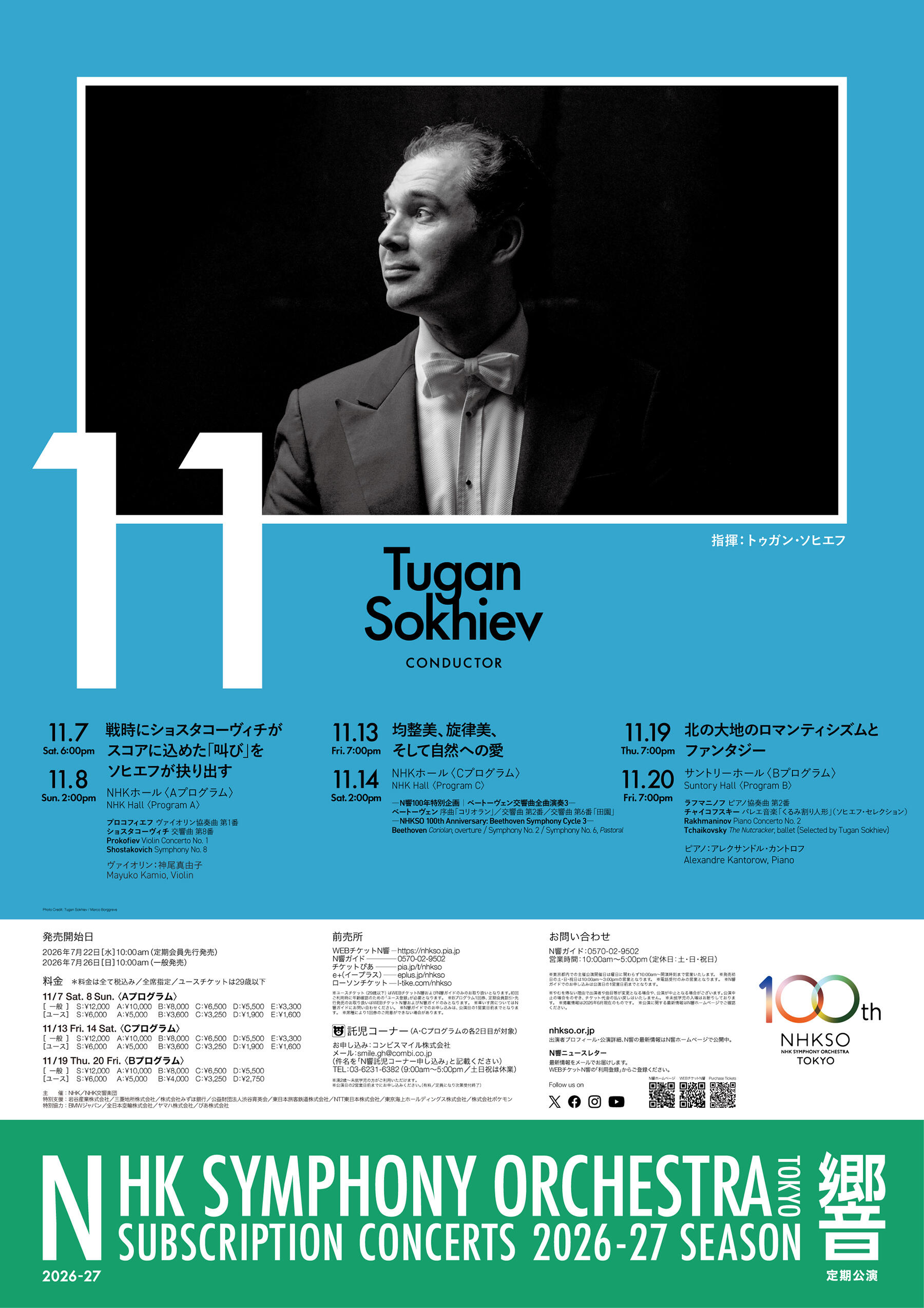
 ConductorTugan Sokhiev
Internationally renowned conductor Tugan Sokhiev, one of the last students of legendary teacher Ilya Musin at the St. Petersburg Conservatory, divides his time between the symphonic and operatic repertoire. He was newly appointed Principal Conductor and Artistic Advisor of the Orchestre de la Suisse Romande beginning with this season.
A former Music Director of the Orchestre national du Capitole de Toulouse, he enjoys close and privileged relationships with orchestras such as the Wiener, Berliner and Münchner Philharmoniker orchestras, Symphonieorchester des Bayerischen Rundfunks and Gewandhausorchester Leipzig. Outside Europe, he is invited to conduct the finest U.S. orchestras including the Boston and Chicago Symphony Orchestras. Passionate about his work with singers, he was Music Director and Chief Conductor of the Bolshoi Theatre in Moscow from 2014 to 2022. Recently, he conducted a new production of Iolanta at the Wiener Staatsoper and gave tours with the Wiener Philharmoniker (Asia), the Münchner Philharmoniker (Asia and Europe) and the Staatskapelle Dresden (Europe), conducting the Wiener Philharmoniker’s celebrated Sommernachtskonzert in the Schönbrunn Palace.
Highlights of the last season include his collaborations with the Wiener Philharmoniker for their gala concert celebrating Johann Strauss II’s 200th birthday, with the Berliner Philharmoniker at the Osterfestspiele Salzburg, his Cleveland Orchestra debut, and his conducting of a new production of Tannhäuser at the Opernhaus Zürich.
He made his NHK Symphony Orchestra debut in 2008 conducting Shostakovich’s Symphony No. 5. Since his first appearance at their subscription concerts in 2013, he has spent several weeks almost every year with the orchestra. This time, he programed orchestral works by Beethoven and Russian composers, coupling them with Prokofiev’s and Rachmaninov’s concertos to collaborate with soloists Mayuko Kamio and Alexandre Kantorow, both the International Tchaikovsky Competition winners.
[Kumiko Nishi]
 PianoAlexandre Kantorow
In 2019, aged 22, Alexandre Kantorow became the first French pianist to win the Gold Medal at the International Tchaikovsky Competition, along with the rarely awarded Grand Prix, granted only three times in the competition’s history. In 2024, he received the esteemed Gilmore Artist Award, solidifying his place as one of the world’s leading pianists. A former student of Pierre-Alain Volondat, Igor Lazko, Frank Braley, and Rena Shereshevskaya, he is in demand today at the highest level across the globe, performing in the world’s finest halls both in recital and with the most renowned orchestras and conductors.
Highlights of the last season include a tour of Japan with the Royal Concertgebouw Orchestra under Klaus Mäkelä, European tours with the Filarmonica della Scala under Riccardo Chailly and the London Philharmonic Orchestra under Paavo Järvi, and a tour to the U.S. with the Philharmonia and Marin Alsop including a performance at Carnegie Hall. In July 2024, he performed Ravel’s Jeux d’eau at the opening ceremony of the Paris Olympic Games.
This is his first collaboration with the NHK Symphony Orchestra. Conductor Tugan Sokhiev, whom he has frequently co-starred with, was on the podium when the pianist made his sensational Berliner Philharmoniker debut in 2023.
[Kumiko Nishi]

Ticket
Program B
No. 2076 Subscription (Program B)
Suntory Hall
Google Map
Seating Chart
Single Tickets Release Date
Pre-sales for Subscribers:Wednesday, July 22, 2026 10:00am
*about subscribers
Sale to General Public:Sunday, July 26, 2026 10:00am
Price
| S | A | B | C | D | |
|---|---|---|---|---|---|
| Ordinary Ticket | 12,000 | 10,000 | 8,000 | 6,500 | 5,500 |
| Youth Ticket | 6,000 | 5,000 | 4,000 | 3,250 | 2,750 |
*Tax included
*Subscribers receive a 10% discount (Available at NHKSO WEB Ticket in Japanese and N-Kyo Guide)
*Pre-sales for subscribers are only available at NHKSO WEB Ticket (In Japanese) and N-Kyo Guide
*For wheelchair-accessible seats, please refer to the N-Kyo Guide
*Please note that single tickets may not be available depending on ticket price range
Youth Tickets
Youth Tickets are great options for those of 29 years old and younger
Subscription tickets
Release Date
ANNUAL SUBSCRIPTION TICKETS
Sun., July 12, 2026 10:00am
[For Subscribers: Sun., July 5, 2026 10:00am]
Where to buy
NHKSO WEB Ticket | Thu., November 19 (In English / Seats not selectable on the English site)
NHKSO WEB Ticket | Fri., November 20 (In English / Seats not selectable on the English site)
NHKSO WEB Ticket (In Japanese / Seats selectable)
N-Kyo Guide (Purchase by telephone only)
Organized by: NHK (Japan Broadcasting Corporation) / NHK Symphony Orchestra, Tokyo
*Repertoire, conductor, soloists and program order are subject to change without notice.
*Pre-school children are not allowed in the concert hall.
