
- Home
- Concerts
- Subscription Concerts
- Program B
- No. 2070 Subscription (Program B)
No. 2070 Subscription (Program B)


Program
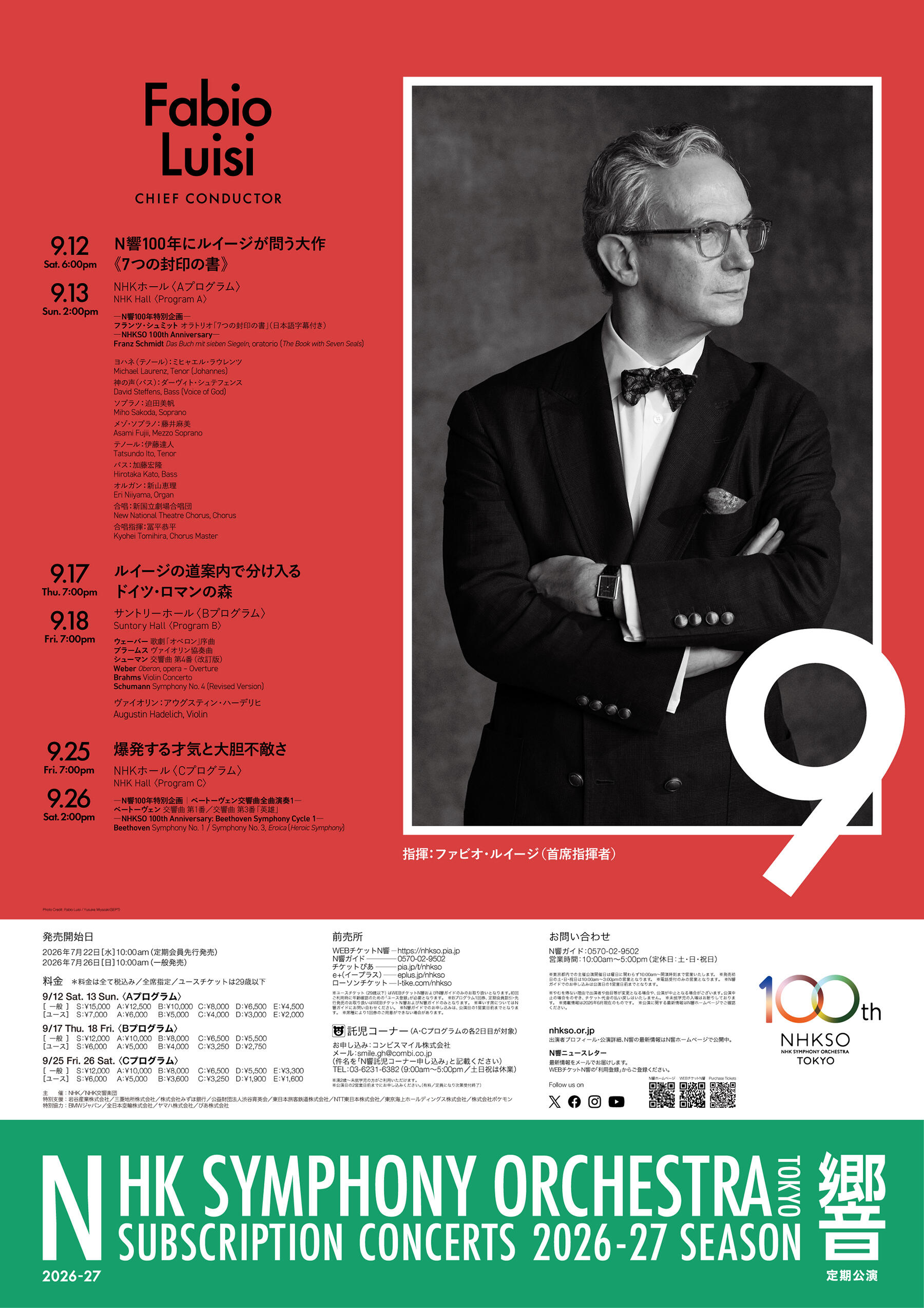
Weber / Oberon, opera – Overture
This year marks the 240th year since birth and 200th year since death for German composer Carl Maria von Weber (1786–1826). He is especially remembered today for raising German opera’s status, in the times when Italian opera was predominant in Europe.
Weber cultivated a flair for theater from an early age. He moved from place to place with his father’s touring theater company while studying music, and later held key positions such as music director at opera theaters in Prague and Dresden. Premiered in Berlin in 1821 to rave reviews, his German opera Der Freischütz (The Free-Shooter) established German Romanticism in opera and had a great influence on later generations including Richard Wagner (1813–1883).
Oberon (Oberon, or The Elf King’s Oath 1826) was completed a few months before Weber’s premature death. His only English-language opera, it was written at the request of the Covent Garden in London where his popularity was rising rapidly. He, having learned Czech in Prague and taken Italian lessons in Dresden, hurriedly mastered English to compose this fantastical and at-times exotic opera set in the medieval time. The overture immediately invites listeners to King Oberon’s forest fairy realm with the calls of his magic horn. We will then hear some highlights of the opera, including the dramatic aria “Ocean, thou mighty monster” (Act 2) sung by the heroine Reiza (the daughter of the Caliph of Baghdad) after being shipwrecked in a violent storm and washed ashore.
[Kumiko Nishi]
Brahms / Violin Concerto D Major Op. 77
Johannes Brahms (1833–1897) is one of the most important composers of the German mid-Romantic era. Unlike above-mentioned Weber, he did not write operas, instead leaving a significant mark in the fields of instrumental and choral/vocal music.
Born in Hamburg, Germany to a double bassist father, Brahms displayed precocious piano talent in his early childhood, before starting to compose around the age of 10. After his potential as a pianist and composer began to be regarded, he experienced several encounters in the early 1850s that were significant to his life. Particularly noteworthy among these were his meeting with Hungarian violinist Joseph Joachim (1831–1907) who became his close friend, and his introduction through Joachim to Robert Schumann. “Neue Bahnen (New Paths)” was the title given by composer and critic Schumann in his October 1853 article to extoll Brahms. In this sensational text, Schumann foretold that if the twenty-year-old pianist-composer were to wave his magic wand so the power of the orchestra lends him its force, further wonderful glimpses into the mysteries of the spirit world would be revealed.
Facing Beethoven’s symphonic legacies, however, self-critical Brahms completed his First Symphony only in 1876 at age 43. Following its successful premiere, he, freed from the immense pressure, wrote the sunny Second Symphony in D major in just a few months in 1877. The Violin Concerto, again in D major, was one of the several works Brahms set out to compose next during the summer of 1878 in Pörtschach, a scenic lakeside town in southern Austria.
Premiered in January 1879 by Joachim, this virtuosic Violin Concerto reflects various pieces of advice from him. Of a symphonic scoring, the opening sonata movement gives the magnificent first theme on violas, cellos and bassoons at the outset, before the soloist enters in D minor brimming with a dark passion. The slow middle movement is known for its unexpected start with an oboe taking the lead role over the silent violin solo, while the influence of Joachim’s native Hungary can be glimpsed in the rhythmical, energetic and danceable third movement.
[Kumiko Nishi]
Schumann / Symphony No. 4 D Minor Op. 120 (Revised Version)
Robert Schumann (1810–1856) was born in Zwickau, Germany, the same year as Frédéric Chopin (1810–1849). Both inventive men played a leading role in musical Romanticism, albeit with different approaches. While the Polish composer’s works are mostly piano music, Schumann’s span virtually every musical genre and, whether instrumental or vocal, they are imbued with a free, Romantic spirit coupled with a deep literary sensibility inherited from his bookseller-author father. Incidentally, Schumann fostered the development of musical Romanticism also as a critic and brought to public attention the talents of Chopin and Brahms.
Venturing into a wide range of genres, Schumann tended to focus on composing in a specific genre for a certain period. The year 1840, for example, was his “Year of Song” where his stimulated creativity produced over 120 songs. The next year 1841, his “Symphonic Year”, was instead the phase when he worked intensively on orchestral works partly at his wife and pianist Clara’s suggestion. The Symphony No. 1 Frühling (Spring) heralded the beginning of this year, followed by Ouvertüre, Scherzo und Finale (Overture, Scherzo and Finale) for orchestra and Phantasie (Fantasy) for piano and orchestra (which was later expanded into the Piano Concerto).
Schumann then gave his next symphony, written as his No. 2 but known today as the first version of No. 4, as a birthday present to Clara who turned 22 on September 13, 1841 (She had given birth to the couple’s first child two weeks earlier). When this new piece was first performed three months later in Leipzig, it didn’t attract much attention, partly because the program that day was overly long. On top of that, Clara and Franz Liszt—two of the star pianists of the time—performed a piano duet, which overshadowed the new symphony. Schumann didn’t aim to publish it and put it away in a drawer for a decade. In December 1851 he extensively revised it in just one week, ten months after the premiere of the Symphony No. 3 Rheinische (Rhenish). This revised version, published as No. 4 during Schumann’s lifetime, met with great acclaim at the 1853 premiere under his own baton in Düsseldorf, where he was the music director in charge of the municipal orchestra and choir.
The most distinctive feature of No. 4 is that the four movements are played continuously without a break. The utilization of shared musical materials across the movements ensures the unity of the work resembling a single-movement symphonic fantasy. The slow introduction of the opening movement introduces right away an essential wavering motif on violins, violas and bassoons, before the lively main section begins. The final movement has also a slow introduction. It gradually builds in intensity bolstered by majestic brass, which is followed by the heart-lifting main section and a faster joyous conclusion.
[Kumiko Nishi]
Artists
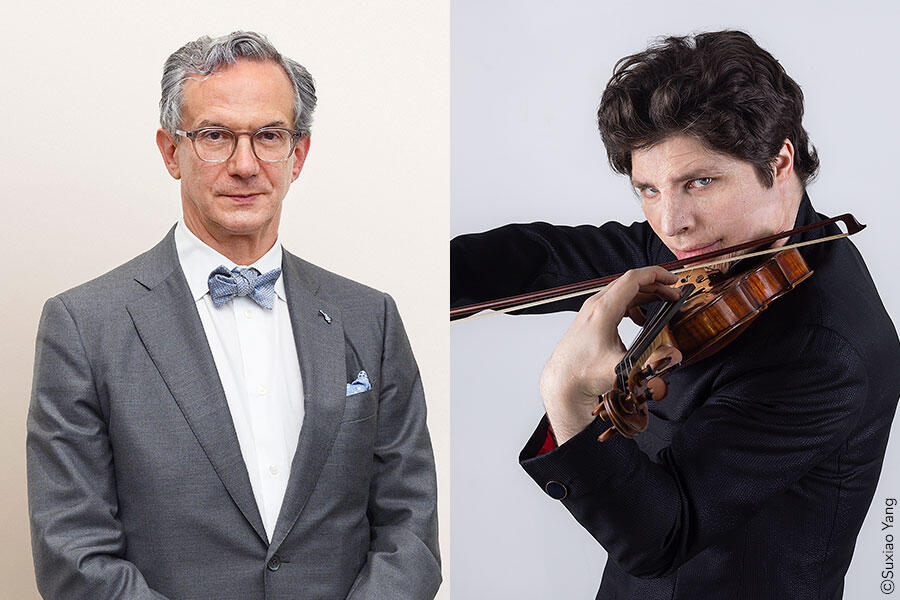
 ConductorFabio Luisi
Fabio Luisi hails from Genoa. He first conducted the NHK Symphony Orchestra in 2001 and became its Chief Conductor in September 2022. He performed Verdi’s Requiem to celebrate his appointment, and Mahler’s Symphonie der Tausend for the orchestra’s 2000th subscription concert in 2023. In 2024, he led the orchestra’s Taiwanese tour, and then in May 2025, he successfully led its European tour scheduled in conjunction with Amsterdam’s Mahler Festival at The Concertgebouw, the Prague Spring Festival and the Dresdner Musikfestspiele: the NHK Symphony Orchestra was the first Asian orchestra to appear at the Mahler Festival, performing the composer’s Symphonies No. 3 and No. 4 to critical praise. In September 2028, he will become Honorary Conductor Laureate of the NHK Symphony Orchestra.
Currently he serves as the Principal Conductor of the Danish National Symphony Orchestra and the Music Director of the Dallas Symphony Orchestra, and previously he was General Music Director of the Opernhaus Zürich, Principal Conductor of New York’s Metropolitan Opera, Chief Conductor of the Wiener Symphoniker, General Music Director of the Staatskapelle Dresden and the Sächsische Staatsoper, Principal Conductor and Chief Conductor of the MDR-Sinfonieorchester, Artistic Director of the Orchestre de la Suisse Romande, Chief Conductor of the Tonkünstler Orchester and Artistic Director of the Grazer Symphonisches Orchester. He is also Music Director of Puglia’s Festival della Valle d’Itria Martina Franca and Emeritus Conductor of Orchestra Sinfonica Nazionale della Rai. He is a frequent guest of leading orchestras including the Berliner Philharmoniker, the Royal Concertgebouw Orchestra and the Saito Kinen Orchestra, opera houses and festivals worldwide.
In recording, his complete Nielsen symphonic cycle with the Danish National Symphony Orchestra was recognized with Limelight and Abbiati Awards in 2023, while its first volume was named Recording of the Year by Gramophone. He received a Grammy Award for his leadership of the last two operas of Wagner’s Ring cycle at the Metropolitan Opera, as released on DVD. His second CD with the NHK Symphony Orchestra, Mahler: Symphony No. 5 will be released in September 2026.
He is an accomplished composer and maker of perfumes.
[Kumiko Nishi]
 ViolinAugustin Hadelich
Grammy Award winning violinist Augustin Hadelich is known for his phenomenal technique, insightful and persuasive interpretations, and ravishing tone. He has performed with all the major American orchestras as well as the Berliner Philharmoniker, Wiener Philharmoniker, Royal Concertgebouw Orchestra, Symphonieorchester des Bayerischen Rundfunks, London Philharmonic, among others, alongside such renowned conductors as Herbert Blomstedt, Neville Marriner, Fabio Luisi and Andris Nelsons.
A dual American-German citizen born in Italy to German parents, he studied with Joel Smirnoff at The Juilliard School. He rose to fame when he won the Gold Medal at the 2006 International Violin Competition of Indianapolis, before receiving the Avery Fisher Career Grant in 2009.
Recent highlights include his collaborations with the Boston Symphony Orchestra (he served as its Artist in Residence in the 2025/26 season), Chicago Symphony Orchestra, New York Philharmonic, Gewandhausorchester Leipzig and the Staatskapelle Dresden, as well as his appearances at the Lucerne Festival and London’s BBC Proms.
For his first reunion with the NHK Symphony Orchestra since February 2024, he will perform Brahms’s Violin Concerto, the piece he played under Fabio Luisi in Europe and the United States alike.
He plays a 1744 violin by Giuseppe Guarneri del Gesù, known as ‘Leduc, ex Szeryng’, on loan from the Tarisio Trust.
[Kumiko Nishi]

Ticket
Program B
No. 2070 Subscription (Program B)
Suntory Hall
Google Map
Seating Chart
Single Tickets Release Date
Pre-sales for Subscribers:Wednesday, July 22, 2026 10:00am
*about subscribers
Sale to General Public:Sunday, July 26, 2026 10:00am
Price
| S | A | B | C | D | |
|---|---|---|---|---|---|
| Ordinary Ticket | 12,000 | 10,000 | 8,000 | 6,500 | 5,500 |
| Youth Ticket | 6,000 | 5,000 | 4,000 | 3,250 | 2,750 |
*Tax included
*Subscribers receive a 10% discount (Available at NHKSO WEB Ticket in Japanese and N-Kyo Guide)
*Pre-sales for subscribers are only available at NHKSO WEB Ticket (In Japanese) and N-Kyo Guide
*For wheelchair-accessible seats, please refer to the N-Kyo Guide
*Please note that single tickets may not be available depending on ticket price range
Youth Tickets
Youth Tickets are great options for those of 29 years old and younger
Subscription tickets
Release Date
ANNUAL SUBSCRIPTION TICKETS
Sun., July 12, 2026 10:00am
[For Subscribers: Sun., July 5, 2026 10:00am]
Where to buy
NHKSO WEB Ticket | Thu., September 17 (In English / Seats not selectable on the English site)
NHKSO WEB Ticket | Fri., September 18 (In English / Seats not selectable on the English site)
NHKSO WEB Ticket (In Japanese / Seats selectable)
N-Kyo Guide (Purchase by telephone only)
Organized by: NHK (Japan Broadcasting Corporation) / NHK Symphony Orchestra, Tokyo
*Repertoire, conductor, soloists and program order are subject to change without notice.
*Pre-school children are not allowed in the concert hall.
