
- Home
- Concerts
- Subscription Concerts
- Program C
- No. 2065 Subscription (Program C)
No. 2065 Subscription (Program C)
NHK Hall
Google Map Seating Chart


Program
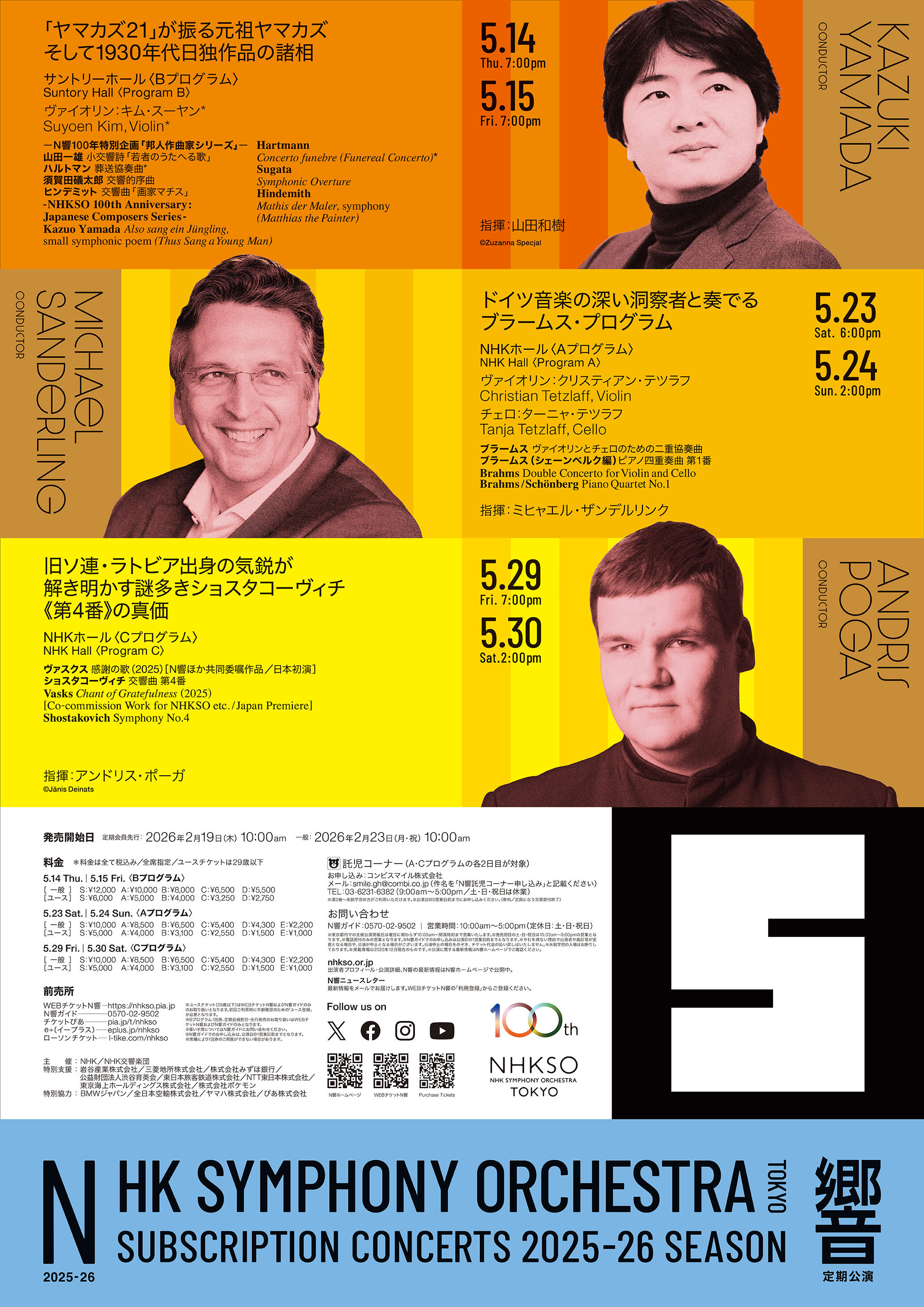
Vasks / Chant of Gratefulness (2026) [Co-commission Work for NHK Symphony Orchestra, Latvian National Symphony Orchestra, Münchener Kammerorchester and Australian Chamber Orchestra / Japan Premiere]
The most important aspect of the music of Pēteris Vasks (1946–), who celebrates his 80th birthday this year, is its distinctive spiritual quality. He has said that “for me, music exists only if it has spiritual content” and such sentiment is reflected in his Chant of Gratefulness which receives its Japanese premiere today.
Vasks was born in Aizpute in Latvia in 1946, when the country was a part of the Soviet Union. He studied the double bass at the Lithuanian Conservatory in Vilnius, and he played in various symphonic and chamber orchestras in Lithuania and Latvia before studying composition at the Latvian Academy of Music in Riga.
Stylistically, Vasks’ compositions incorporate elements of Latvian folk music and contemporary European musical language. His work spans many genres and includes 3 symphonies, various works for solo instrument and orchestra, 6 string quartets, and choral works. In particular, his violin concerto Distant Light, premiered in 1997 by his compatriot Gidon Kremer, has seen numerous performances around the world and has received the Latvian Grand Music Award. Other important works include Musica dolorosa (1983, Painful Music), The Fruit of Silence (2014) and the Cello Concerto Klātbūtne (2011–2012, Presence). Chant of Gratefulness is the first work of Vasks to be performed by the NHKSO.
[Nahoko Gotoh]
Shostakovich / Symphony No. 4 C Minor Op. 43
Born in St. Petersburg in 1906, composer Dmitry Shostakovich (1906–1975)’s life was deeply shaped by the Soviet regime under Joseph Stalin. His Symphony No. 4, performed today, was one of the works directly affected by the regime’s repression.
Having studied piano and composition at the Petrograd Conservatory (now St. Petersburg State Conservatory) from the age of thirteen, Shostakovich showed his musical talent early on. His Symphony No.1, which received its premiere in 1926, was a major public and professional success. In the 1930s, he composed music for the theater and film, including the opera Lady Macbeth of Mtsensk (premiered in 1934) which became a hit but also caused controversy. In January 1936, Stalin came to see a performance in Moscow, which displeased him greatly, and the opera was immediately condemned by the authorities as “muddle instead of music.” This came as a huge shock to the composer and was a major setback in his career. It was precisely at this time that he was working on his fourth symphony.
Thereafter Shostakovich was forced to tread a fine line with the authorities, and his compositions shifted to mainly instrumental music where he could keep his thoughts private. He composed a total of 15 symphonies during his lifetime, as well as two concertos each for piano, violin, and cello, 15 string quartets, and some music for piano.
Shostakovich had set out to compose his fourth symphony in September 1935. He had completed the first two movements of the symphony when the condemnation of his opera happened. Still, Shostakovich kept a low profile and continued with his fourth symphony, which he had intended to be the “credo” of his creative work and an important statement in this genre. Having completed it in the spring of 1936, the premiere was scheduled for December 11, 1936; however, the performance didn’t take place. An announcement was made in a newspaper that Shostakovich withdrew the symphony because he acknowledged its flaws; but it’s more likely that he was coerced into withdrawing it. When it was finally premiered in 1961 by Kirill Kondrashin and the Moscow Philharmonic Orchestra, he did not change a single note.
Symphony No. 4 in C minor is an ambitious and monumental symphony, requiring the largest orchestra of any of his symphonies. It is in three movements. The Allegro poco moderato first movement has a huge exposition centering around two contrasting themes, which appear in reverse order in the recapitulation. The second movement, Moderato con moto, is a darkly humorous scherzo, at times reminiscent of Mahler. The finale is framed by a slow funeral march, another reference to Mahler. In between, the Allegro section, which begins energetically, soon veers into a bizarre medley of dances (waltz, polka, gallop). The work ends quietly and enigmatically.
[Nahoko Gotoh]
Artists
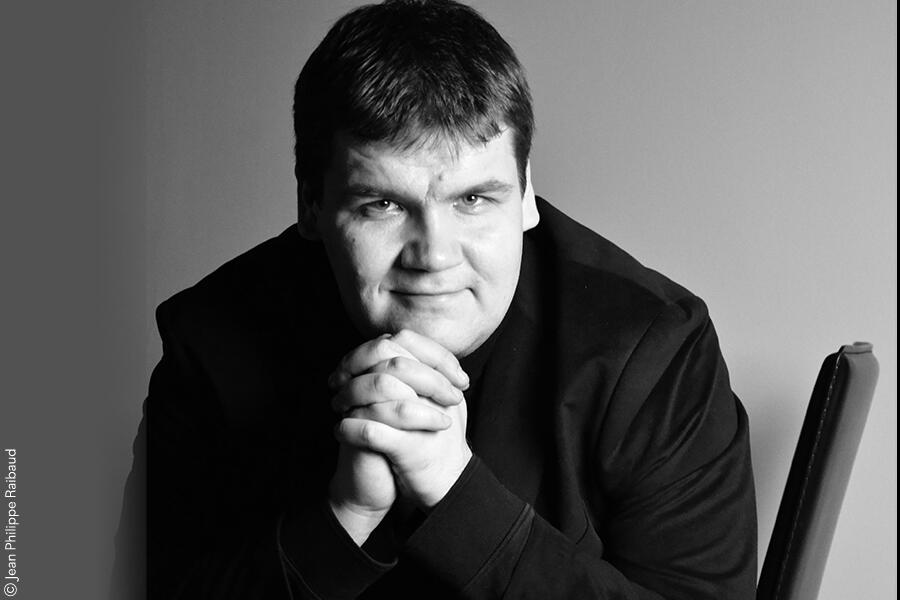
 ConductorAndris Poga
Andris Poga is currently Chief Conductor of the Stavanger Symphony Orchestra in Norway. He was the Music Director of the Latvian National Symphony Orchestra from 2013 till 2021 and continues to collaborate with the LNSO as its Artistic Advisor.
Highlights of recent years have included concerts with the leading orchestras of Germany, France, Italy, Japan and Scandinavia. After the first successful collaborations he has become a regular guest at the NDR Elbphilharmonie Orchester, WDR Sinfonieorchester, Deutsches Symphonie-Orchester Berlin, NHK Symphony Orchestra and many others. He has also conducted the Tonhalle-Orchester Zürich, Gewandhausorchester Leipzig, dell’ Accademia Nazionale di Santa Cecilia, Royal Philharmonic Orchestra, Hong Kong Philharmonic Orchestra, Sydney Symphony Orchestra, and Dallas Symphony Orchestra.
This season he returns to the WDR Sinfonieorchester, NDR Elbphilharmonie Orchester, NHK Symphony Orchestra, Royal Liverpool Philharmonic Orchestra, Bergen Philharmonic Orchestra, and Mozarteumorchester Salzburg amongst others, and makes his debuts with the Rotterdam Philharmonic Orchestra, Belgian National Orchestra, and the Prague Radio Symphony Orchestra. A passionate champion of the music of his homeland, he will conduct the world premiere of Pēteris Vasks’ Chant of Gratefulness in Latvia, which he then brings to Tokyo.
Following his studies in Riga and in Vienna, Andris Poga first burst on the international scene in 2010 when he took First Prize at the Evgeny Svetlanov International Conducting Competition, Montpellier. He went on to become an assistant to Paavo Järvi at the Orchestre de Paris and he also served as the assistant conductor for the Boston Symphony Orchestra.
He first collaborated with the NHK Symphony Orchestra in June 2013 and has since returned regularly. Most recently, he led them on a tour of Hokkaido in 2023 with an all-Tchaikovsky program.
Download

Ticket
Single Tickets Release Date
Pre-sales for Subscribers:Thursday, February 19, 2026 10:00am
*about subscribers
Sale to General Public:Monday, February 23, 2026 10:00am
Price
| S | A | B | C | D | E | |
|---|---|---|---|---|---|---|
| Ordinary Ticket | 10,000 | 8,500 | 6,500 | 5,400 | 4,300 | 2,200 |
| Youth Ticket | 5,000 | 4,000 | 3,100 | 2,550 | 1,500 | 1,000 |
*tax included
*Subscribers receive a 10% discount (Available at NHKSO WEB Ticket and N-Kyo Guide)
*For wheelchair-accessible seats, please refer to the N-Kyo Guide
*Please note that single tickets may not be available depending on ticket price range
Youth Tickets
Youth Tickets are great options for those of 29 years old and younger
Subscription tickets
Release Date
ANNUAL SUBSCRIPTION TICKETS
Sun., July 13, 2025 10:00am
[For Subscribers: Sun., July 6, 2025 10:00am]
SEASONAL SUBSCRIPTION TICKETS (SPRING)
Sat., February 14, 2026 10:00am
[For Subscribers: Tue., February 10, 2026 10:00am]
Where to buy
NHKSO WEB Ticket | Fri., May 29 (In English / Seats not selectable on the English site)
NHKSO WEB Ticket | Sat., May 30 (In English / Seats not selectable on the English site)
NHKSO WEB Ticket (In Japanese / Seats selectable)
N-Kyo Guide (Purchase by telephone only)
Other Ticket Agents
Broadcast
 NHK Educational TVClassical Concert Hall
No. 2065 Subscription (Program C)
Sunday, Jun 21, 2026 9:00PM - 11:00PM
Program:
Vasks / Chant of Gratefulness (2026) [Co-commission Work for NHK Symphony Orchestra, Latvian National Symphony Orchestra, Münchener Kammerorchester and Australian Chamber Orchestra / Japan Premiere]
Shostakovich / Symphony No. 4 C Minor Op. 43
Conductor:Andris Poga
Recorded:May 29, 2026 NHK Hall
To watch a concert,
(accessible only from inside Japan)
Organized by: NHK (Japan Broadcasting Corporation) / NHK Symphony Orchestra, Tokyo
*Repertoire, conductor, soloists and program order are subject to change without notice.
*Pre-school children are not allowed in the concert hall.
