
- Home
- Concerts
- Subscription Concerts
- Program A
- No. 2064 Subscription (Program A)
No. 2064 Subscription (Program A)
NHK Hall
Google Map Seating Chart


Program
Brahms / Double Concerto for Violin and Cello, A Minor Op. 102
German composer Johannes Brahms (1833–1897) was born in Hamburg in 1833 and brought up in a working-class background. He was given lessons on the piano, cello, and horn as a young boy and later studied piano and composition with Eduard Marxsen, who instilled in him a love of Bach and the Viennese Classical composers. After leaving school, he earned his living as a pianist and conducting amateur choirs to help his family, while aspiring to be a composer. The first turning point came in 1853 when he met Robert Schumann (1810–1856) and Clara Schumann (1819–1896) in Düsseldorf and played to them his piano sonata, which Robert praised enthusiastically. His international reputation came with the success of his Ein deutsches Requiem (A German Requiem) in Bremen in 1868. In 1872, he became the director of concerts of the Gesellschaft der Musikfreunde and settled permanently in Vienna. From then on, he could concentrate more on composition, although he continued to tour as pianist and conductor, performing not only his own compositions but a wide range of works consisting of contemporary as well as earlier repertoire. His compositions include 4 symphonies, 4 concertos, piano works, chamber music for various forces, choral works, and songs.
His Double Concerto for Violin and Cello, Op. 102, was composed in the summer of 1887 at Lake Thun, a picturesque holiday resort in Switzerland. Written two years after his Symphony No. 4 (1885), it was to become his last work for orchestra. The impetus for composing this Double Concerto seems to have come from the cellist Robert Hausmann, who had asked Brahms for a cello concerto. But instead, the composer came up with a concerto for two soloists, which had precedents in the 18th century, but quite unusual for the time. The violin part of the Double Concerto was intended for the renowned Austro-Hungarian violinist, Joseph Joachim, for whom Brahms had composed his Violin Concerto in 1878. Although Brahms had fallen out with Joachim for some years, this concerto resulted in a reconciliation.
The concerto was premiered in Cologne in October 1887 with Joachim and Hausmann as soloists and the composer conducting. At first, his friends, including Clara Schumann, were somewhat skeptical about the work, but despite the initial cool reception, it went on to be highly regarded by musicians and audiences alike.
The main theme of the Allegro first movement is introduced by the orchestra but is interrupted by an extended cello solo followed a cadenza by the two soloists, before the main theme returns in the orchestra. The cello then introduces the gentle second theme. The lyrical second movement (Andante) opens with the two instruments presenting the rapturous melody in D major in octave unison. The rondo finale (Vivace non troppo) pays tribute to Joachim’s Hungarian roots with its lively gypsy-style theme.
[Nahoko Gotoh]
Brahms / Schönberg / Piano Quartet No. 1 G Minor Op. 25
Arnold Schönberg (1874–1951), known as the composer who revolutionized 20th century music with his 12-tone technique (serialism), was a great admirer of Johannes Brahms (1833–1897). In his essay Brahms the Progressive, Schönberg said that Brahms “was a great innovator in the realm of musical language...in fact, he was a great progressive.” Schönberg particularly admired Brahms’s technique of the “developing variation” and utilized this in his own works. A work he was fond of was Brahms’s Piano Quartet No.1 in G minor, which Schönberg orchestrated in 1937 for the Los Angeles Philharmonic.
Brahms had composed the work, the first of three piano quartets, in 1861 when he was in his late twenties. Around this time, he produced several chamber music works including his string sextets, piano quintet, and the first cello sonata. He was quite proud of the quartet and the following year he chose it in the program of his first concert in Vienna as pianist and composer. The quartet is in four movements. The Allegro first movement opens with a four-note motive, which becomes the basis of the whole movement and undergoes numerous transformations. The second movement, titled Intermezzo, is a scherzo in all but name. The restless Allegro ma non troppo sections frame the trio (Animato). The third movement is a ravishing lyrical slow movement that Brahms excelled in. The finale is a Rondo alla zingarese (gypsy-style rondo), which we also heard earlier in the Double Concerto, but this finale is more youthful and exuberant.
Schönberg arranged this quartet for a huge orchestra that features abundant percussion, used to great effect in the gypsy-style finale. He explained that one of the reasons he orchestrated the work was that often the piano part is played too loudly and one can’t hear the strings. “I wanted for once to hear everything and this I achieved.”
If you enjoy this orchestral performance and you are not familiar with the original piano quartet, it is well worth seeking out and comparing the two versions.
[Nahoko Gotoh]
[Encore]
Kodaly / Duo for violin and cello, Op. 7 - 3rd mov. (excerpt)
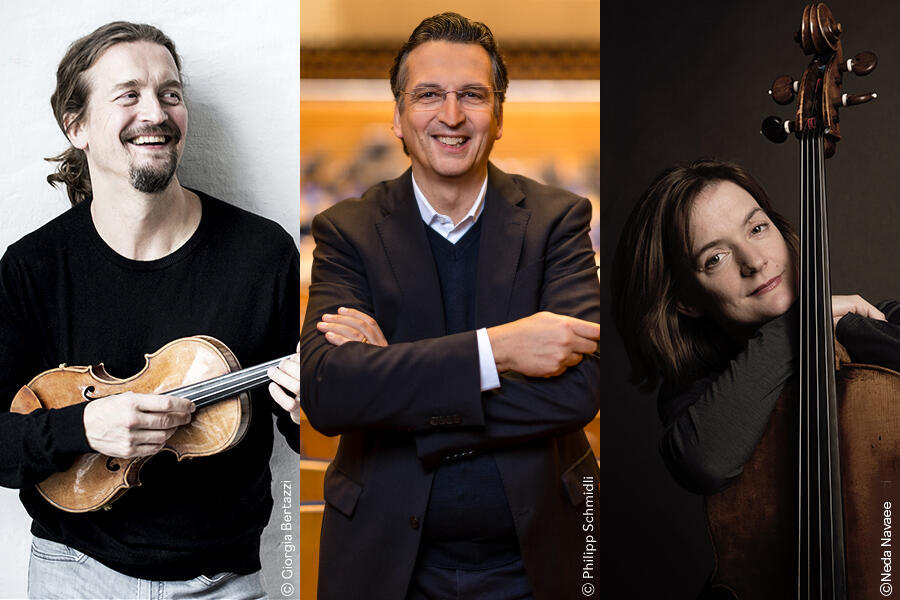
Violin: Christian Tetzlaff
Cello: Tanja Tetzlaff
Artists
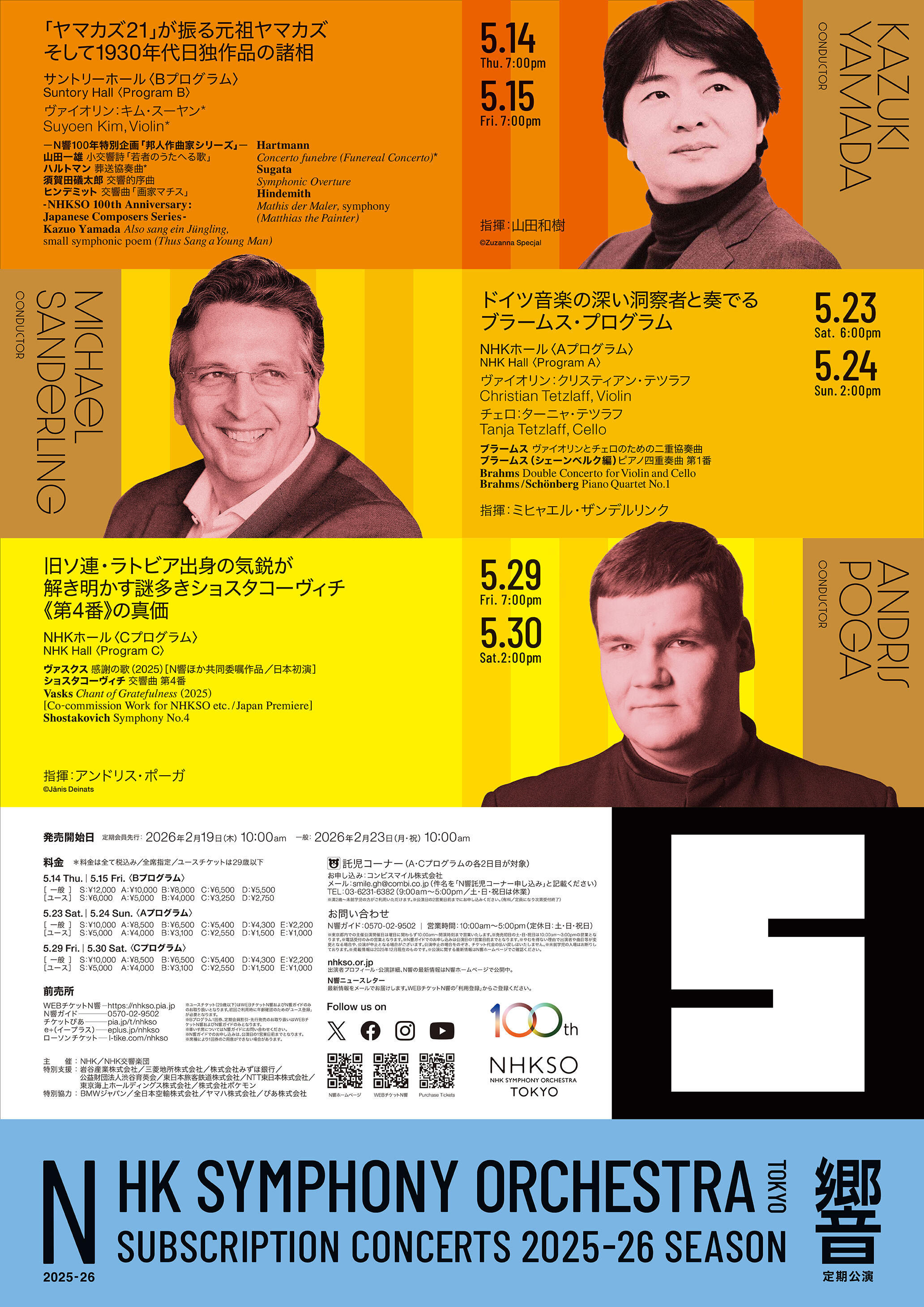
 ConductorMichael Sanderling
Michael Sanderling has been Chief Conductor of the Lucerne Symphony Orchestra since 2021, leading the orchestra on tours across Asia, South America, and Europe. Since the start of his tenure, several acclaimed recordings have been released, notably a Brahms cycle in 2023 featuring the four symphonies and the piano quartet orchestrated by Arnold Schönberg, which he will conduct with the NHK Symphony Orchestra in this concert.
As guest conductor, Michael Sanderling leads renowned orchestras worldwide, including the Berliner Philharmoniker, the Gewandhausorchester Leipzig, the Royal Concertgebouw Orchestra, the Orchestre de Paris, the NHK Symphony Orchestra, the Hong Kong Philharmonic Orchestra, the Philharmonia Orchestra in London, the Tonhalle-Orchester Zürich, the Wiener Symphoniker, and the Helsinki Philharmonic Orchestra.
From 2011 to 2019, he was Chief Conductor of the Dresdner Philharmonie, elevating the orchestra’s profile through performances in Dresden and international tours. Prior to this, he served as Chief Conductor of the Kammerakademie Potsdam from 2006 to 2011.
His extensive discography includes the complete symphonies of Beethoven and Shostakovich with the Dresdner Philharmonie, as well as major works by Dvořák, Schumann, Prokofiev and Tchaikovsky. In 2011, he conducted a new production of Sergei Prokofiev’s War and Peace at the Oper Köln, earning him the title of “Conductor of the Year” from Opernwelt magazine.
Michael Sanderling is deeply committed to nurturing young musical talent. He teaches at the Frankfurt University of Music and Performing Arts and also works regularly with the Schleswig-Holstein Festival Orchestra.
His previous appearance with the NHK Symphony Orchestra was in April 2015 when he conducted a program that included Bruckner’s Fourth Symphony.
 ViolinChristian Tetzlaff
Violinist Christian Tetzlaff is highly acclaimed for his expressive, insightful and personal interpretations. His individual approach to the score, always searching for the emotional and structural depth of the composition, has built a loyal following over time who often describe his performance as an existential experience.
He has appeared with major orchestras of the highest calibre such as Berliner and Wiener Philharmonikers, New York Philharmonic, the Boston and Chicago Symphony Orchestras, the Royal Concertgebouw Orchestra, London Symphony Orchestra and many others, collaborating with many of today’s leading conductors. He performs an extensive repertoire ranging from Bach’s solo sonatas and partitas to contemporary works by György Ligeti, Jörg Widmann and Thomas Adès. In 2023 he took over the artistic direction of the Spannungen Festival in Heimbach, Germany.
In the 2025–26 season, Christian Tetzlaff features as Artist-in-Residence of the Rundfunk-Sinfonieorchester Berlin and performs concertos by Berg, Suk and Dvořák as well as chamber music with Vladimir Jurowski. Further highlights include duo recitals with Leif Ove Andsnes, solo violin recitals in Berlin, Oslo and London, and concerts with the BBC Symphony Orchestra, Deutsche Kammerphilharmonie Bremen, Wiener Symphoniker, and the Helsinki Philharmonic Orchestra.
Since his debut with the NHK Symphony Orchestra in 1993, he has collaborated regularly both in Tokyo and on tour.
 CelloTanja Tetzlaff
Tanja Tetzlaff is recognized as one of the most influential cellists of her generation, both as a soloist and chamber musician. Her playing is distinguished by a uniquely refined, powerful and nuanced tone, always shaped by cultivated musicality. She is committed to going beyond traditional concert formats, integrating other art forms and engaging with social and ecological issues. In recognition of both her artistic work and her strong advocacy for climate protection, she was awarded the Duisburg Music Prize in 2024.
Over the course of her international career, she has appeared with leading orchestras across Europe, Asia and North America, and works with conductors such as Alan Gilbert, Daniel Harding, Philippe Herreweghe, Karina Canellakis, Heinz Holliger, Paavo Järvi, Roger Norrington and Robin Ticciati.
Chamber music is a hallmark of her artistic life. A founding member of the Tetzlaff Quartett, she has performed with the ensemble worldwide since 1994. She also appears internationally in duo and trio formations with Florian Donderer. In addition, she is a member of the acclaimed Tetzlaff Trio with her brother Christian Tetzlaff and pianist Kiveli Dörken, who succeeded the late founding member Lars Vogt.
She previously appeared with the NHK Symphony Orchestra in 2017, performing Schumann’s cello concerto under Paavo Järvi.
Download
Ticket
Single Tickets Release Date
Pre-sales for Subscribers:Thursday, February 19, 2026 10:00am
*about subscribers
Sale to General Public:Monday, February 23, 2026 10:00am
Price
| S | A | B | C | D | E | |
|---|---|---|---|---|---|---|
| Ordinary Ticket | 10,000 | 8,500 | 6,500 | 5,400 | 4,300 | 2,200 |
| Youth Ticket | 5,000 | 4,000 | 3,100 | 2,550 | 1,500 | 1,000 |
*tax included
*Subscribers receive a 10% discount (Available at NHKSO WEB Ticket and N-Kyo Guide)
*For wheelchair-accessible seats, please refer to the N-Kyo Guide
*Please note that single tickets may not be available depending on ticket price range
Youth Tickets
Youth Tickets are great options for those of 29 years old and younger
Subscription tickets
Release Date
ANNUAL SUBSCRIPTION TICKETS
Sun., July 13, 2025 10:00am
[For Subscribers: Sun., July 6, 2025 10:00am]
SEASONAL SUBSCRIPTION TICKETS (SPRING)
Sat., February 14, 2026 10:00am
[For Subscribers: Tue., February 10, 2026 10:00am]
Where to buy
NHKSO WEB Ticket | Sat., May 23 (In English / Seats not selectable on the English site)
NHKSO WEB Ticket | Sun., May 24 (In English / Seats not selectable on the English site)
NHKSO WEB Ticket (In Japanese / Seats selectable)
N-Kyo Guide (Purchase by telephone only)
Other Ticket Agents
Organized by: NHK (Japan Broadcasting Corporation) / NHK Symphony Orchestra, Tokyo
*Repertoire, conductor, soloists and program order are subject to change without notice.
*Pre-school children are not allowed in the concert hall.
