
- Home
- Concerts
- Subscription Concerts
- Program C
- No. 2062 Subscription (Program C)
No. 2062 Subscription (Program C)
NHK Hall
Google Map Seating Chart
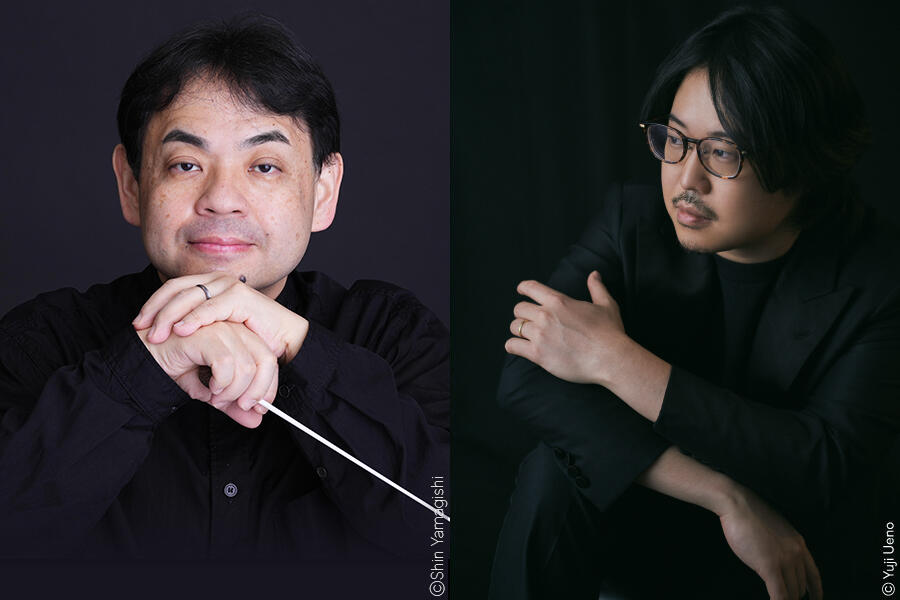


Program
- NHKSO 100th Anniversary: Japanese Composers Series -
Toyama / Divertimento for Orchestra
To commemorate its 100th anniversary since its 1926 foundation, the NHK Symphony Orchestra (hereafter NHKSO) has given the Japanese Composer Series with three unique programs this year. Among them is today’s featuring two Japanese composers whom the NHKSO had a close relationship with.
Yuzo Toyama (1931–2023) led Japan’s post-war classical music scene. He studied composition in Tokyo with Kanichi Shimoosa (1898–1962), a pupil of Paul Hindemith, before honing his musical skills in Vienna. Toyama first joined the NHKSO as a Percussion Trainee in 1952 and became their Assistant Conductor two years later. Since his official conducting debut with the NHKSO in 1956 at age 25, he regularly led it both inside and outside the country. In 1979, the NHKSO appointed him Permanent Conductor, the post he held until his passing.
Toyama as a composer left us numerous works across a variety of genres. As with his representative work Rhapsody for Orchestra (1960), Divertimento for Orchestra (1961) is a treasure chest of folk melodies from various parts of Japan. The NHKSO assumed the Japanese premiere in 1963.
The opening movement evokes the country’s cheery folk music world with high notes from the flutes and steady timpani beats. The first theme given at the outset by horns and cellos is a take on the folk song Donpan-bushi from Akita (bushi means tune), while the calmer second theme introduced by an oboe is after Kiso-bushi from Nagano. The dreamy middle movement is based on the folk songs Aizu Bandaisan (Mount Bandai) from Fukushima and Hietsuki-bushi from Miyazaki. The rhythmic impetus of the finale, a rondo, drives this festive movement to the frenetic ending.
[Kumiko Nishi]
Prokofiev / Piano Concerto No. 3 C Major Op. 26
Born in Imperial Russia (today in Donetsk Oblast, Ukraine), Sergei Prokofiev (1891–1953) lived overseas for eighteen years following the Bolshevik Revolution. He left Petrograd (St. Petersburg) in May 1918 by permission of the Soviet authorities and, avoiding western disasters of war, headed east for America via Vladivostok. This four-month voyage let him stop by Japan for two months giving three piano recitals in Yokohama and Tokyo before he reached New York in September 1918. Interestingly, he told his diary what he experienced on the Land of the Rising Sun during the summer.
The globe-trotter composer set to work on the Piano Concerto No. 3 in 1917 before leaving his homeland, continued penning it while traveling, and completed it in the summer of 1921 in France. The same year, he served as the soloist at the world premiere with the Chicago Symphony Orchestra in the USA. While the Chicagoan audience didn’t receive it enthusiastically, the 1922 successful French premiere in Paris under the baton of his compatriot Sergei Koussevitzky set the work’s unwavering popularity off.
Composer Akira Ifukube (discussed below) wrote that this concerto is “a masterpiece” that “fully demonstrates his [Prokofiev’s] preference for clear lines.” A clarinet duet opens the brief melodious introduction, before the energetic first movement, a sonata, begins to rush like the wind. The middle movement first presents a rather sarcastic theme, which is followed by its five variations. The final movement is a rondo (A–B–A′–C–A″–coda). The rondo (recurrent) theme given by bassoons and strings at the start, is written in the Japanese pentatonic (five-note) Miyako-bushi scale aside from whether the composer intended it or not. And the melody is often said in Japan to be inspired by the country’s traditional music Echigo Jishi (Lion), although the theory remains without foundation. Regardless, the theme makes the piano and orchestra get into a heated discussion without delay, so they can head for the highly determined conclusion in C major.
[Kumiko Nishi]
Ifukube / Ballata Sinfonica (Symphonic Ballad)
A herald of Japan’s classical music, Akira Ifukube (1914–2006) beat a path for younger composers such as Toru Takemitsu (1930–1996) and afore-mentioned Yuzo Toyama. Born in the country’s northern island Hokkaido, Ifukube spent his childhood surrounded by folk tunes sung by different settlers and music of the Ainu, the local ingenious population. He took up playing violin before beginning to teach himself composition as a teenager. He would remain self-taught except for about a month of instruction he received in 1936 from Alexander Tcherepnin (whose father Nikolai Tcherepnin taught Prokofiev).
Ifukube’s style is characterized by folk colors and powerful rhythms which he expressed precisely by his skillful orchestration. Also, he often made use of ostinato, technique of repeating persistently a rhythmic and/or melodic pattern. These features are even found in the main theme he wrote for the 1954 movie Godzilla. While the soundtrack has brought his name to wide audience, he composed a number of classical works including Ballata Sinfonica (1943).
Dedicated to the memory of his brother who died in 1942, Ballata Sinfonica consists of two “ballads.” According to Ifukube, ballad is “an ancient form in which dance and music blended into one another.” Both the kaleidoscopic First Ballad and the slow Second Ballad are marked by the economical orchestration (due to the wartime premiere) and the use of pentatonic (five-tone) and hexatonic (six-tone) scales. The work ends disappearing into the silence, reminding us one last time that this is a mourning music.
[Kumiko Nishi]
Britten / Peter Grimes, opera - Four Sea Interludes Op. 33a
One of the most remarkable English composers, Benjamin Britten (1913–1976) kept his distance from avant-garde and experimental pursuits unlike Arnold Schönberg (1874–1951) and John Cage (1912–1992). He instead updated the conventional tonal language relying often on traditional forms, to leave us truly original and important works.
Most notably, he contributed to the revival of English opera, starting with his successful Peter Grimes (1945) followed by The Turn of the Screw (1954), A Midsummer Night’s Dream (1960), Curlew River (1964) and others. Set in an imaginary Suffolk coastal town around 1830, Peter Grimes features a lone-wolf-fisherman, the title role, living in a closed community. The four orchestral interludes, readjusted by Britten for concert as Four Sea Interludes, play important parts in the drama. Born and died himself in port towns in Suffolk, the composer masterfully draws diverse tone-scapes by the North Sea.
Describing a sunrise with the brass, I Dawn hints at Peter’s loneliness with an unquiet melody. During scherzo-like II Sunday Morning, horns and then actual bells evoke the church and the lively town life around it. Slow and static, III Moonlight bridges the scene of the death of Peter’s apprentice who accidentally slides off the cliff into the sea and the scene when the town people accuse missing Peter of murder. Although from Act 1, the hair-raising IV Storm foretells the opera’s tragic ending where Peter, shattered by the incident and losing his mind, drowns himself in his sinking boat.
[Kumiko Nishi]
[Encore]
April 24: Moszkowski / 15 Études de Virtuosité, Op. 72 - No.6
April 25: Chopin / 12 Études Op. 25 - No.12 C Minor, L'océan
Piano: Kyohei Sorita
Artists
 ConductorTatsuya Shimono
One of Japan’s leading conductors, Tatsuya Shimono has been Permanent Conductor of the NHK Symphony Orchestra since 2023. He is currently Principal Guest Conductor of the Sapporo Symphony Orchestra and Conductor Laureate of the Hiroshima Symphony Orchestra after having served as its General Music Director for seven years. He has also been Music Director of the Hiroshima Wind Orchestra since 2011.
Trained in orchestral conducting at the Toho Gakuen School of Music, Japan, and at the Accademia Musicale Chigiana, Italy, he attracted much attention by winning the First Prize and the Hideo Saito Award at the Tokyo International Music Competition for Conducting in 2000 and the First Prize at the Besançon International Competition in 2001. He has since been a much-sought-after conductor among Japan’s major orchestras and has guest conducted renowned orchestras around the world such as the Orchestra dell’Accademia Nazionale di Santa Cecilia, Orchestra Sinfonica di Milano Giuseppe Verdi, Radio-Sinfonieorchester Stuttgart des SWR, Südwestdeutsche Philharmonie Konstanz, Czech Philharmonic, Orchestre national Bordeaux-Aquitaine, Orchestre philharmonique de Strasbourg, Orquestra Simfònica de Barcelona i Nacional de Catalunya, Sinfonia Varsovia and the Wiener KammerOrchester.
Since his debut with the NHK Symphony Orchestra performing Beethoven’s Symphony No. 7 in 2005, he has conducted them on many occasions including their subscription concerts and tours. This time, he will collaborate with them for a unique program featuring four composers including two Japanese as part of the projects marking the orchestra’s 100th anniversary year. Furthermore, he will soon lead the orchestra joined by pianist Kyohei Sorita in Singapore to give a special concert commemorating the 60th anniversary of diplomatic relations between Singapore and Japan.
 PianoKyohei Sorita
The winner of the silver medal at Warsaw’s 2021 International Chopin Piano Competition, Japanese pianist Kyohei Sorita is a favorite on the international classical music scene today.
After winning the First Prize at the Music Competition of Japan in 2012, he pursued advanced studies at the Tchaikovsky Conservatory in Moscow and the Chopin University of Music in Warsaw. His international career gained momentum in 2023 with a lauded debut with the Münchner Philharmoniker, followed by his dazzling 2024 performance with the Mozarteumorchester Salzburg as both pianist and conductor. In 2025, he made his highly anticipated debut at the Salzburger Festspiele alongside the Mozarteumorchester, becoming the first Japanese artist to perform in the dual role of soloist and conductor at this prestigious festival.
Multitalented, he is also the founder, producer and conductor of the Japan National Orchestra and operates his own record label.
He made his NHK Symphony Orchestra debut in 2017 and most recently, in 2024, he collaborated with them playing Scriabin’s Piano Concerto with Keitaro Harada conducting. This time, he will perform Prokofiev’s Piano Concerto No. 3 with Tatsuya Shimono leading the orchestra, before departing for Singapore together with them for their concert commemorating the 60th anniversary of diplomatic relations between Singapore and Japan.
Download

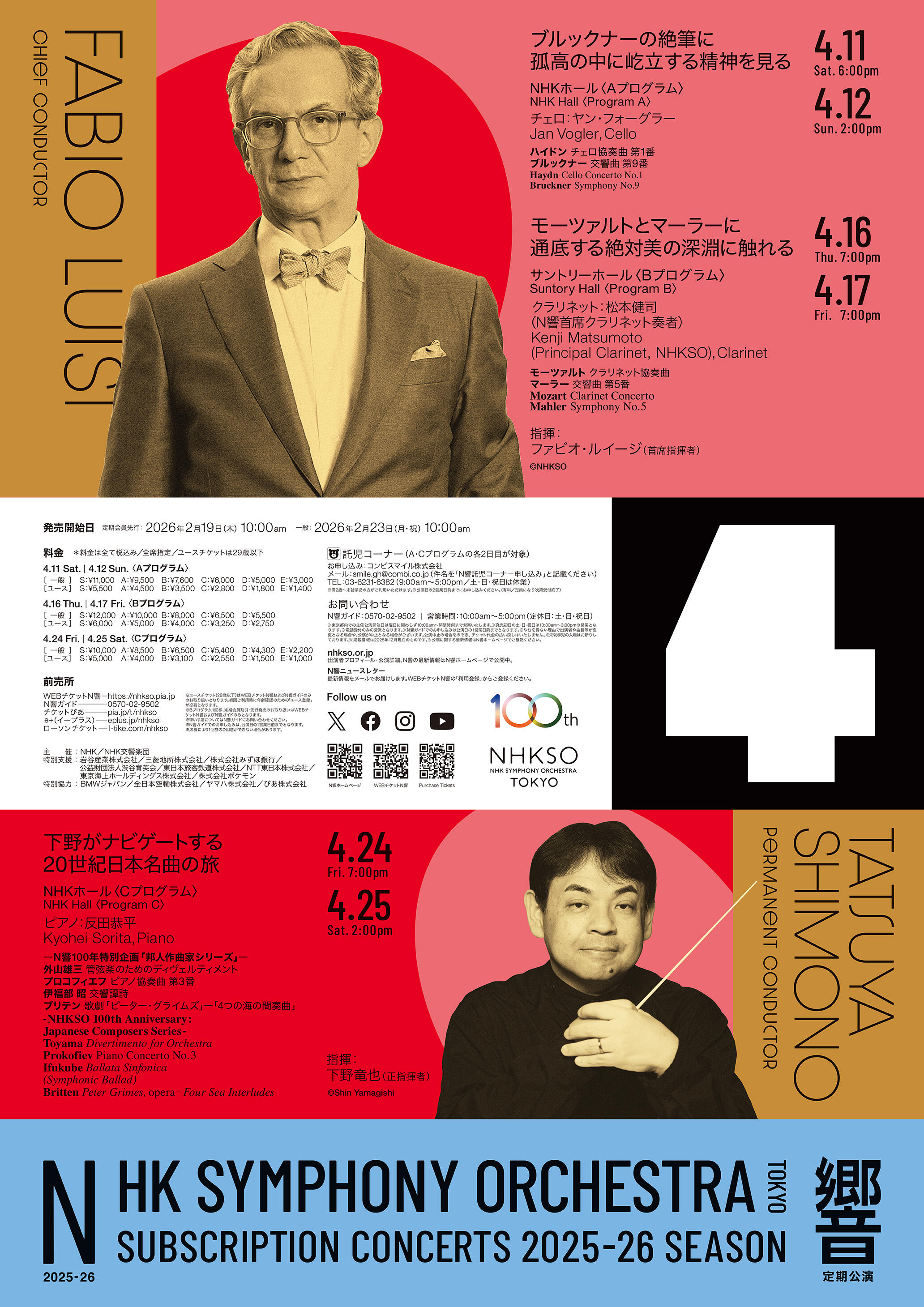

Ticket
Single Tickets Release Date
Pre-sales for Subscribers:Thursday, February 19, 2026 10:00am
*about subscribers
Sale to General Public:Monday, February 23, 2026 10:00am
Price
| S | A | B | C | D | E | |
|---|---|---|---|---|---|---|
| Ordinary Ticket | 10,000 | 8,500 | 6,500 | 5,400 | 4,300 | 2,200 |
| Youth Ticket | 5,000 | 4,000 | 3,100 | 2,550 | 1,500 | 1,000 |
*tax included
*Subscribers receive a 10% discount (Available at NHKSO WEB Ticket and N-Kyo Guide)
*For wheelchair-accessible seats, please refer to the N-Kyo Guide
*Please note that single tickets may not be available depending on ticket price range
Youth Tickets
Youth Tickets are great options for those of 29 years old and younger
Subscription tickets
Release Date
ANNUAL SUBSCRIPTION TICKETS
Sun., July 13, 2025 10:00am
[For Subscribers: Sun., July 6, 2025 10:00am]
SEASONAL SUBSCRIPTION TICKETS (SPRING)
Sat., February 14, 2026 10:00am
[For Subscribers: Tue., February 10, 2026 10:00am]
Where to buy
NHKSO WEB Ticket | Fri., April 24 (In English / Seats not selectable on the English site)
NHKSO WEB Ticket | Sat., April 25 (In English / Seats not selectable on the English site)
NHKSO WEB Ticket (In Japanese / Seats selectable)
N-Kyo Guide (Purchase by telephone only)
Other Ticket Agents
Broadcast
 NHK Educational TVClassical Concert Hall
No. 2062 Subscription (Program C)
Sunday, May 24, 2026 9:00PM - 11:00PM
Program:
- NHKSO 100th Anniversary: Japanese Composers Series -
Toyama / Divertimento for Orchestra
Prokofiev / Piano Concerto No. 3 C Major Op. 26
Ifukube / Ballata Sinfonica (Symphonic Ballad)
Britten / Peter Grimes, opera - Four Sea Interludes Op. 33a
Conductor:Tatsuya Shimono
Piano:Kyohei Sorita
Recorded:April 24, 2026 NHK Hall
To watch a concert,
(accessible only from inside Japan)
Organized by: NHK (Japan Broadcasting Corporation) / NHK Symphony Orchestra, Tokyo
*Repertoire, conductor, soloists and program order are subject to change without notice.
*Pre-school children are not allowed in the concert hall.
