
- Home
- Concerts
- Subscription Concerts
- Program B
- No. 2061 Subscription (Program B)
No. 2061 Subscription (Program B)
Suntory Hall
Google Map Seating Chart


Program
Mozart / Clarinet Concerto A Major K. 622
This year, the world has celebrated the 270th anniversary of the birth of Austrian composer Wolfgang Amadeus Mozart (1756–1791) who led a short but dense artistic life. He left us two genuine masterpieces for clarinet, the Clarinet Quintet K. 581 (1789) and today’s Clarinet Concerto K. 622 (1791) both written in A major. They were born during his productive final years in Vienna where he, now a freelance musician, earned his daily bread by composing, performing concerts, giving private lessons and having his works published.
When composing the two works, Mozart derived inspiration from his close friend and Austrian clarinet player Anton Stadler (1753–1812). The latter was then active as a member of Vienna’s court orchestra but also as a first-rate soloist, while his instrument hadn’t played a major part yet in the classical music scene of the time. Stadler is said to have liked playing the second (lower) clarinet part in orchestra, and he is also known as the inventor of the basset clarinet (manufactured by Theodor Lotz in 1787) which was an extended instrument providing some additional lower notes than the standard clarinet. In fact, Mozart originally wrote the Quintet K. 581 and the Concerto K. 622 for Stadler to perform with his basset clarinet. Although it didn’t come into common use (nowadays the two works are usually performed on a clarinet in A), we must be grateful to Stadler for his invention and friendship with Mozart which resulted in such important repertories.
The Clarinet Concerto was completed in early October 1791, two months before Mozart passed away, to be his last concerto. Stadler is believed to have given its first performance in Prague while the composer was still alive. The work is in the traditional three-movement form but without any cadenza (a soloist’s customary solo without orchestra). The clarinet part, sometimes virtuosic and sometimes serenely lyrical, makes us easily picture Stadler’s “soft tone and his ability to change registers quickly and with remarkable ease,” as reported by contemporary newspapers.
[Kumiko Nishi]
Mahler / Symphony No. 5 C-sharp Minor
Born in Kalischt, Bohemia (in the Austrian Empire) in 1860, Gustav Mahler (1860–1911) is considered a late-Romantic titan for his expressive and deeply reflective symphonies of great length. His writing is influenced by Richard Wagner (1813–1883) when it comes to rich harmonies, extreme chromaticism, long-stretched melodies and colossal orchestration.
Mahler combined orchestral and vocal music in his Symphonies No. 2 Auferstehung (Resurrection) (1894: with vocal soloists and a mixed chorus), No. 3 (1896: with a vocal soloist, a children’s choir and a female chorus) and No. 4 (1900: with a vocal soloist). No. 5 was a major turning point for the composer’s output in that it parted from voices/lyrics and thus returned to a purely instrumental symphony. The composition took place mainly at the Austrian lakeside resort Maiernigg during the summers of 1901 and 1902. One of the best conductors of all time, Mahler himself led the Gürzenich-Orchester Köln for its world premiere held in 1904.
No. 5 includes “Adagietto,” his best-known movement for the public through Luchino Visconti’s movie Death in Venice (1971) where we hear this serene, longing-like music. One of the biographical anecdotes regarding this movement concerns his wife Alma, whom Mahler met and married during the period he was writing this symphony. According to a note by the conductor Willem Mengelberg who was champion of Mahler’s music and close to the couple, “Adagietto” was the composer’s declaration of love to her.
Mahler groups five movements into three parts to create a symmetrical structure around the central third movement. Its overall design starting in a minor key and ending in major evokes the dramatic tonal catharsis (C minor to C major) that Ludwig van Beethoven (1770–1827)’s Symphony No. 5 (1808) has.
[Part 1] The symphony begins in C-sharp minor as a funeral march. The opening gloomy fanfare by trumpet solo reminds us of, again, Beethoven’s No. 5, more precisely its famous “fate” motto (brief theme) with four notes. Mahler indicates that the second movement, still in dismal tone (A minor), should be “Stürmisch bewegt, mit größter Vehemenz (Moving stormily, with the greatest vehemence).” The brass chorale appearing for an instance at its closing phase foretells the bright conclusion of this symphony.
[Part 2] The third movement, the longest one in this symphony, is a pleasant D-major scherzo where French horns play a vital role from the very outset. The soloistic obbligato horn part in particular makes this movement resemble a horn concerto.
[Part 3] There is no pause between the fourth movement “Adagietto,” performed only by harp and strings, and the merry fifth movement in rondo form. Following a pastoral introduction, this polyphonic finale in D major, often compared with the one from Mozart’s last Symphony No. 41 Jupiter, comes to a triumphant denouement looking back forcefully on the brass chorale of the second movement.
[Kumiko Nishi]
[Encore]
Mozart / Clarinet Quintet A Major K. 581 - 2nd mov. (excerpt)
Clarinet: Kenji Matsumoto
Violin: Sunao Goko, Masahiro Morita
Viola: Shotaro Nakamura
Cello: Ryoichi Fujimori
Artists
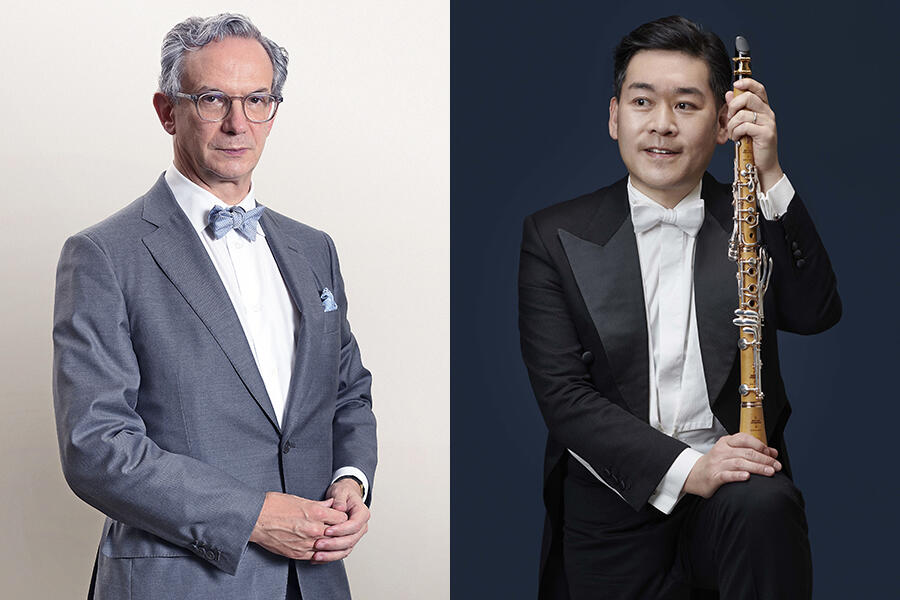
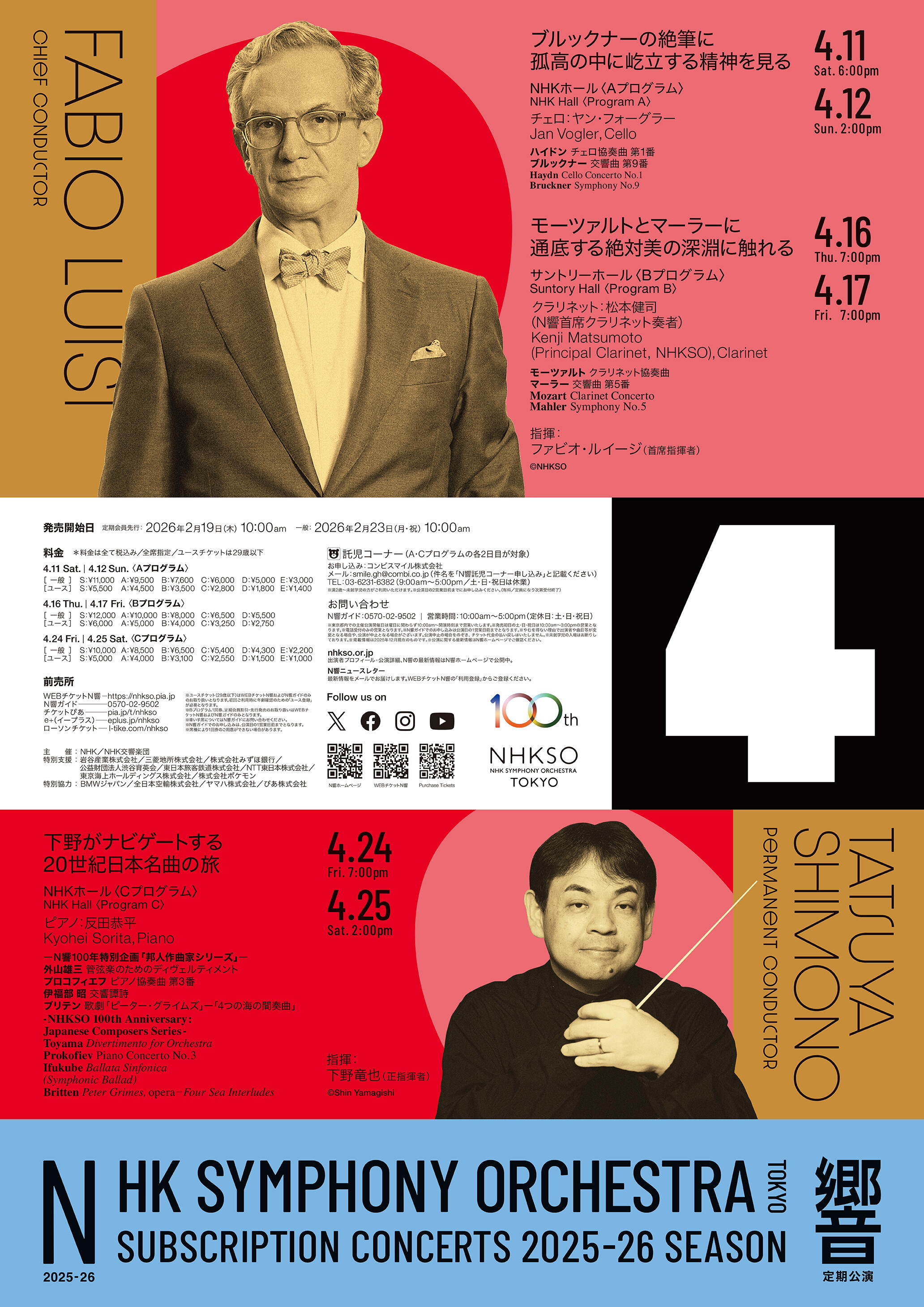
 ConductorFabio Luisi
Fabio Luisi hails from Genoa. He first conducted the NHK Symphony Orchestra in 2001 and became its Chief Conductor in September 2022. He performed Verdi’s Requiem to celebrate his appointment, and Mahler’s Symphonie der Tausend for the orchestra’s 2000th subscription concert in 2023. In 2024, he led the orchestra’s Taiwanese tour, and then in May 2025, he successfully led its European tour scheduled in conjunction with Amsterdam’s Mahler Festival at The Concertgebouw, the Prague Spring Festival and the Dresdner Musikfestspiele: the NHK Symphony Orchestra was the first Asian orchestra to appear at the Mahler Festival, performing the composer’s Symphonies No. 3 and No. 4 to critical praise. In September 2028, he will become Honorary Conductor Laureate of the NHK Symphony Orchestra.
Currently he serves as the Principal Conductor of the Danish National Symphony Orchestra and the Music Director of the Dallas Symphony Orchestra, and previously he was General Music Director of the Opernhaus Zürich, Principal Conductor of New York’s Metropolitan Opera, Chief Conductor of the Wiener Symphoniker, General Music Director of the Staatskapelle Dresden and the Sächsische Staatsoper, Principal Conductor and Chief Conductor of the MDR-Sinfonieorchester, Artistic Director of the Orchestre de la Suisse Romande, Chief Conductor of the Tonkünstler Orchester and Artistic Director of the Grazer Symphonisches Orchester. He is also Music Director of Puglia’s Festival della Valle d’Itria Martina Franca and Emeritus Conductor of Orchestra Sinfonica Nazionale della Rai. He is a frequent guest of leading orchestras including the Berliner Philharmoniker, the Royal Concertgebouw Orchestra and the Saito Kinen Orchestra, opera houses and festivals worldwide. In recording, his complete Nielsen symphonic cycle with the Danish National Symphony Orchestra was recognized with Limelight and Abbiati Awards in 2023, while its first volume was named Recording of the Year by Gramophone. He received a Grammy Award for his leadership of the last two operas of Wagner’s Ring cycle at the Metropolitan Opera, as released on DVD. His first CD with the NHK Symphony Orchestra, Bruckner: Symphony No. 8 (1st version) was released in May 2025.
He is an accomplished composer and maker of perfumes.
 ClarinetKenji Matsumoto (Principal Clarinet, NHKSO)
One of Japan’s foremost clarinetists, Kenji Matsumoto joined the NHK Symphony Orchestra in 2002 and became its Principal Clarinet in 2011. He debuted at the orchestra as a concerto soloist performing Paul Hindemith’s Concerto for Woodwinds, Harp and Orchestra under the baton of Marek Janowski in 2017.
After being trained in Japan, he was accepted into the Conservatoire national supérieur de musique de Paris in 1993. He graduated from the clarinet course in 1997 receiving the Léon Leblanc Special Award, and from the chamber music course the following year.
A top prize winner at the 6th Japan Woodwind Competition, the 4th Japan Clarinet Competition and the 22nd Toulon International Music Competition (France), he studied clarinet with Akira Tsunoda, Koichi Hamanaka, Kazuko Ninomiya, Kahori Takemori, Michel Arrignon, Jérôme Julien-Laferrière and Alain Damiens, and chamber music under Daria Hovora, Pierre-Laurent Aimard and Jean-Guihen Queyras.
An enthusiastic music educator and chamber musician as well, he is a member of the chamber orchestra ARCUS and the Trio Cinq Anches.
This is his solo concerto debut at the NHK Symphony Orchestra’s subscription concerts. Led by their Chief Conductor Fabio Luisi, they will play Mozart’s popular Clarinet Concerto that the composer wrote for his friend and clarinet virtuoso Anton Stadler.
Download


Ticket
Program B
No. 2061 Subscription (Program B)
Suntory Hall
Google Map
Seating Chart
Single Tickets Release Date
Pre-sales for Subscribers:Thursday, February 19, 2026 10:00am
*about subscribers
Sale to General Public:Monday, February 23, 2026 10:00am
Price
| S | A | B | C | D | |
|---|---|---|---|---|---|
| Ordinary Ticket | 12,000 | 10,000 | 8,000 | 6,500 | 5,500 |
| Youth Ticket | 6,000 | 5,000 | 4,000 | 3,250 | 2,750 |
*tax included
*Subscribers receive a 10% discount (Available at NHKSO WEB Ticket and N-Kyo Guide)
*For wheelchair-accessible seats, please refer to the N-Kyo Guide
*Please note that single tickets may not be available depending on ticket price range
Youth Tickets
Youth Tickets are great options for those of 29 years old and younger
Subscription tickets
Release Date
ANNUAL SUBSCRIPTION TICKETS
Sun., July 13, 2025 10:00am
[For Subscribers: Sun., July 6, 2025 10:00am]
Where to buy
NHKSO WEB Ticket | Thu., April 16 (In English / Seats not selectable on the English site)
NHKSO WEB Ticket | Fri., April 17 (In English / Seats not selectable on the English site)
NHKSO WEB Ticket (In Japanese / Seats selectable)
N-Kyo Guide (Purchase by telephone only)
Organized by: NHK (Japan Broadcasting Corporation) / NHK Symphony Orchestra, Tokyo
*Repertoire, conductor, soloists and program order are subject to change without notice.
*Pre-school children are not allowed in the concert hall.
