
- Home
- Concerts
- Subscription Concerts
- Program A
- No. 2060 Subscription (Program A)
No. 2060 Subscription (Program A)
NHK Hall
Google Map Seating Chart


Program
Haydn / Cello Concerto No. 1 C Major Hob. VIIb-1
Given the deserved title “Father of Symphony” today, Austrian composer Franz Joseph Haydn (1732–1809) established the First Viennese School which was further developed and led to perfection by Wolfgang Amadeus Mozart (1756–1791) and Ludwig van Beethoven (1770–1827). Highly respected already while he was alive, Haydn left us an enormous number of masterful vocal and instrumental works.
For a large part of his artistic life, Haydn served the wealthy Esterházy family. His main workplace was the court of this Hungarian noble family in Eisenstadt, Austria, not far from the Hungarian border. Around the time when they hired Haydn on May 1st, 1761 as their Vice-Kapellmeister (vice-music director), their orchestra was small. It had not more than fifteen members, all of whom, however, were excellently skilled (it gradually extended to around twenty-three at its height). During his earliest years at the court from 1761 until 1766 when he was promoted to Kapellmeister, Haydn was a uniquely prolific composer of concertos and symphonies. They were dotted with unusually virtuosic passages for these musicians to play, as represented by the famous Symphonies No. 6 Morning, No. 7 Noon and No. 8 Evening (1761).
One of these elites was cellist Joseph Franz Weigl (1740–1820) who joined the Esterházy orchestra on June 1st, 1761 on Haydn’s suggestion. It is believed that the Cello Concerto No. 1 in C major was written in around 1762–1765 for Weigl to serve as the soloist. At the premiere, he was possibly the only cellist who also played the orchestral cello part.
The opening movement in sonata form shows a remnant of the Baroque concerto, or more specifically, its ritornello form which vividly contrasts tutti (full orchestra) with solo. The winds (oboes and horns) are absent during the calm middle movement, which is followed by the finale, a brisk sonata-allegro. Throughout the concerto, the cello solo fully maximizes the instrument’s technical and expressive potential playing multiple stops (producing several notes simultaneously), speedily repeating notes, quickly moving from a register to another and lyrically singing.
[Kumiko Nishi]
Bruckner / Symphony No. 9 D Minor
As with Mozart’s Requiem K. 626, Anton Bruckner (1824–1896)’s Symphony No. 9 was left unfinished in 1896 when he passed away at age 72. According to his maid, he was working on the incomplete final (fourth) movement on the day he breathed his last. Dedication “to the beloved God,” No. 9 has been often linked with this deeply religious composer facing the final phase of his life in this world.
Born near Linz, Bruckner, as a boy, was led to his Catholic beliefs at the church where his father was a music director. The child subsequently became a chorister at St. Florian Monastery where he deepened his faith. He later made a living as a church organist prior to moving to Vienna in 1868 in his mid-forties. The late bloomer had to long put up with the cold treatment of his works, until the successful premiere in Leipzig of the Symphony No. 7 spread his fame far and wide in 1884 when he was sixty. The work’s ensuing Viennese premiere in 1886 won a rave review, before he received the Order of Franz Joseph from the Emperor and an honorary doctorate from the University of Vienna.
Bruckner set to work on No. 9 in 1887. The reason why his last nine years were not enough for him to finish it was his intense urge to retouch his earlier works. The composition of No. 9 was interrupted by his absorption in revising works including No. 8, after the rejection of its first version by the conductor Hermann Levi, a champion of Bruckner’s music, had injured the latter’s pride. Meanwhile, Bruckner’s health gradually worsened after 1891, which depleted his time, leaving us the finished three movements and the unfinished finale of No. 9. The symphony has since been programmed without the finale customarily, which is the case in today’s concert using the score edited by Leopold Nowak.
Bruckner’s No. 9 clearly follows Beethoven’s Symphony No. 9 (1824) in terms of tonality (D minor) and structure with the Scherzo movement preceding the Adagio (slow) movement. That said, Bruckner’s last tonal cathedral—his symphonies are often called so due to their large scale, massive sound, meditative moments and frequent general (long) pauses evoking a cathedral’s long reverberation—is one of a kind. Headed “solemn, mysteriously,” the opening movement is written as a freely designed three-theme sonata (instead of the traditional two-theme), Bruckner’s favorite form. The Scherzo in D minor, started with a dissonant Tristan chord (after Richard Wagner whom Bruckner worshiped), has an unusually rapid trio (central) section. The awe-inspiring Adagio in E major is concluded tranquilly after quoting Bruckner’s different own music including the finale of No. 5, the beginning of No. 7 and the Adagio of No. 8, as if they were flashbacks.
[Kumiko Nishi]
Artists
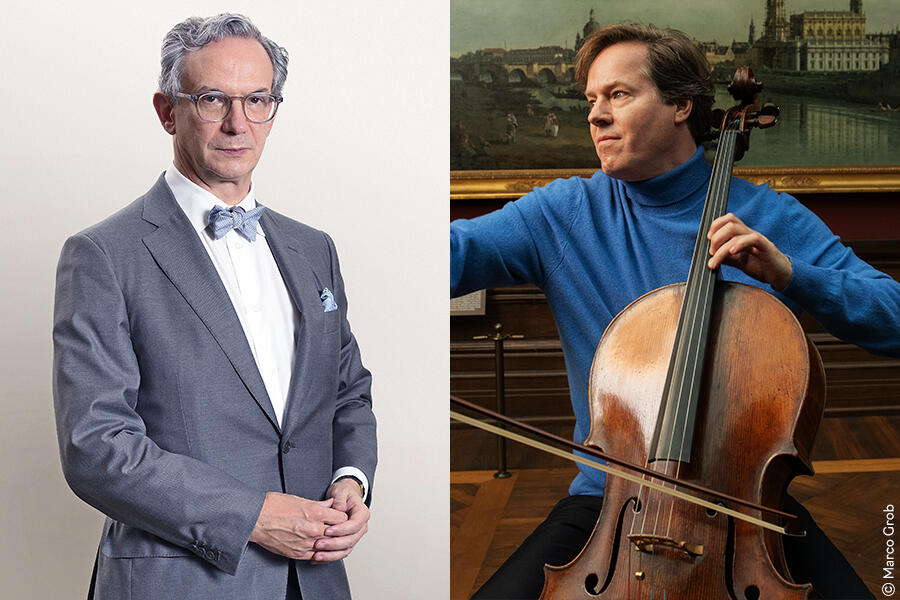
 ConductorFabio Luisi
Fabio Luisi hails from Genoa. He first conducted the NHK Symphony Orchestra in 2001 and became its Chief Conductor in September 2022. He performed Verdi’s Requiem to celebrate his appointment, and Mahler’s Symphonie der Tausend for the orchestra’s 2000th subscription concert in 2023. In 2024, he led the orchestra’s Taiwanese tour, and then in May 2025, he successfully led its European tour scheduled in conjunction with Amsterdam’s Mahler Festival at The Concertgebouw, the Prague Spring Festival and the Dresdner Musikfestspiele: the NHK Symphony Orchestra was the first Asian orchestra to appear at the Mahler Festival, performing the composer’s Symphonies No. 3 and No. 4 to critical praise. In September 2028, he will become Honorary Conductor Laureate of the NHK Symphony Orchestra.
Currently he serves as the Principal Conductor of the Danish National Symphony Orchestra and the Music Director of the Dallas Symphony Orchestra, and previously he was General Music Director of the Opernhaus Zürich, Principal Conductor of New York’s Metropolitan Opera, Chief Conductor of the Wiener Symphoniker, General Music Director of the Staatskapelle Dresden and the Sächsische Staatsoper, Principal Conductor and Chief Conductor of the MDR-Sinfonieorchester, Artistic Director of the Orchestre de la Suisse Romande, Chief Conductor of the Tonkünstler Orchester and Artistic Director of the Grazer Symphonisches Orchester. He is also Music Director of Puglia’s Festival della Valle d’Itria Martina Franca and Emeritus Conductor of Orchestra Sinfonica Nazionale della Rai. He is a frequent guest of leading orchestras including the Berliner Philharmoniker, the Royal Concertgebouw Orchestra and the Saito Kinen Orchestra, opera houses and festivals worldwide. In recording, his complete Nielsen symphonic cycle with the Danish National Symphony Orchestra was recognized with Limelight and Abbiati Awards in 2023, while its first volume was named Recording of the Year by Gramophone. He received a Grammy Award for his leadership of the last two operas of Wagner’s Ring cycle at the Metropolitan Opera, as released on DVD. His first CD with the NHK Symphony Orchestra, Bruckner: Symphony No. 8 (1st version) was released in May 2025.
He is an accomplished composer and maker of perfumes.
 CelloJan Vogler
Berlin-born world-renowned cellist Jan Vogler is praised by The New York Times for his “soulful, richly hued playing,” and the Frankfurter Allgemeine Zeitung touts his ability “to make his cello speak like a singing voice.”
His distinguished career as soloist has brought him together with internationally acclaimed orchestras, such as the New York Philharmonic, Chicago, Boston and Pittsburgh Symphony Orchestras, Orchestre symphonique de Montréal, London Philharmonic Orchestra, Deutsches Symphonie-Orchester Berlin, Gewandhausorchester Leipzig, Symphonieorchester des Bayerischen Rundfunks, Wiener Symphoniker, Münchner Philharmoniker and the Orchestra dell’Accademia Nazionale di Santa Cecilia alongside renowned conductors including Fabio Luisi, Lorin Maazel, Andris Nelsons, Antonio Pappano and Kent Nagano.
He has been Intendant of the renowned Dresdner Musikfestspiele since October 2008 as well as Artistic Director of the Moritzburg Festival since 2001. He is constantly looking for new ways to combine music with other arts as well. In 2024, he gave a highly acclaimed concert with inaugural-poet Amanda Gorman in Carnegie Hall. He has also collaborated with actor Bill Murray for their joint musical-literary project “Bill Murray, Jan Vogler & Friends – New Worlds.”
For his first appearances in the NHK Symphony Orchestra’s subscription series, he will serve as the soloist for Haydn’s Cello Concerto No. 1 under the direction of Fabio Luisi. In May 2025 Vogler made his debut with the orchestra, conducted by Luisi, performing the same work in Dresden as part of the orchestra’s European tour.
Awarded the Order of Merit of the Federal Republic of Germany, he plays the Stradivari ‘Ex Castelbarco/Fau’ 1707 cello.
Download


Ticket
Single Tickets Release Date
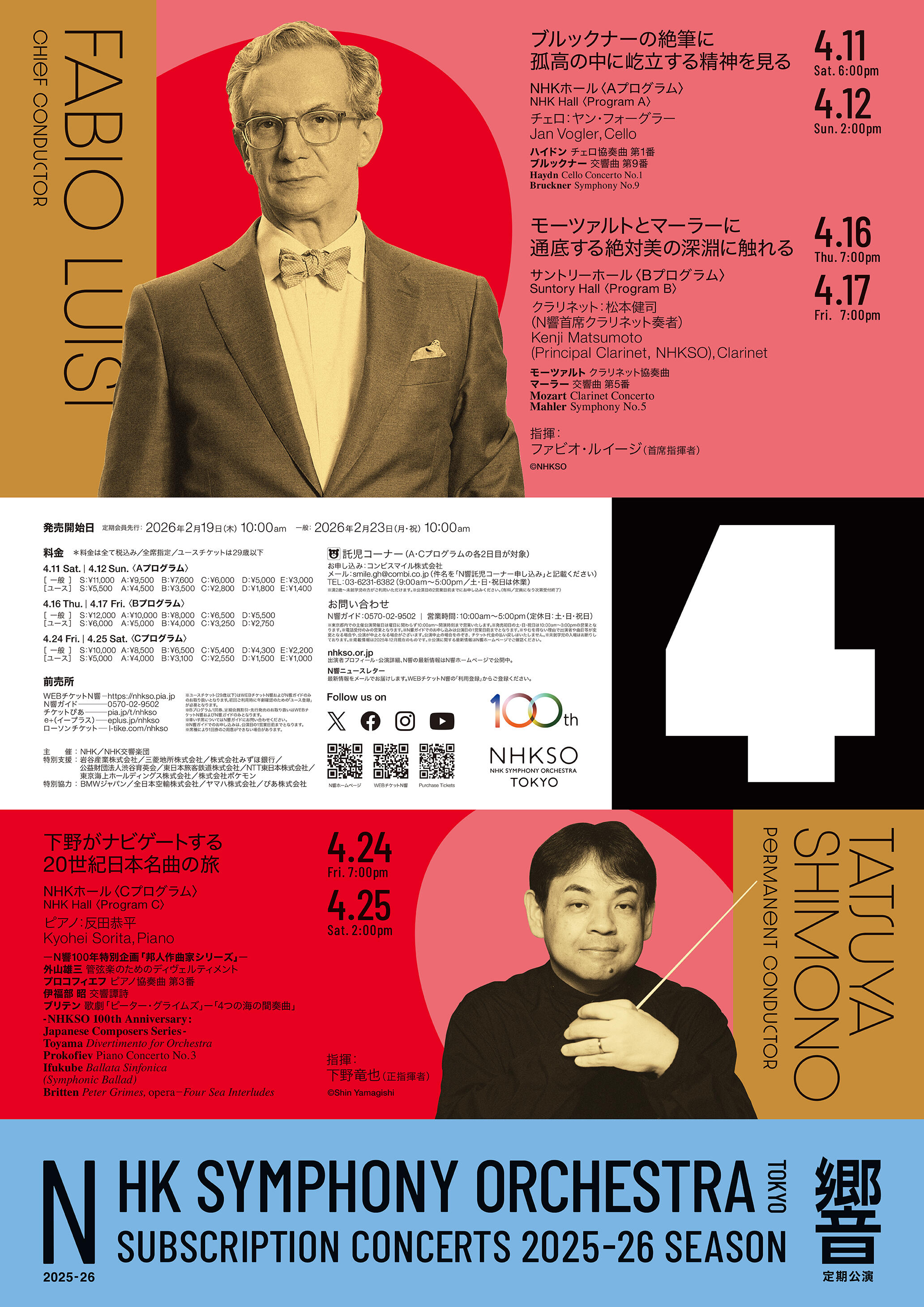
Pre-sales for Subscribers:Thursday, February 19, 2026 10:00am
*about subscribers
Sale to General Public:Monday, February 23, 2026 10:00am
Price
| S | A | B | C | D | E | |
|---|---|---|---|---|---|---|
| Ordinary Ticket | 11,000 | 9,500 | 7,600 | 6,000 | 5,000 | 3,000 |
| Youth Ticket | 5,500 | 4,500 | 3,500 | 2,800 | 1,800 | 1,400 |
*tax included
*Subscribers receive a 10% discount (Available at NHKSO WEB Ticket and N-Kyo Guide)
*For wheelchair-accessible seats, please refer to the N-Kyo Guide
*Please note that single tickets may not be available depending on ticket price range
Youth Tickets
Youth Tickets are great options for those of 29 years old and younger
Subscription tickets
Release Date
ANNUAL SUBSCRIPTION TICKETS
Sun., July 13, 2025 10:00am
[For Subscribers: Sun., July 6, 2025 10:00am]
SEASONAL SUBSCRIPTION TICKETS (SPRING)
Sat., February 14, 2026 10:00am
[For Subscribers: Tue., February 10, 2026 10:00am]
Where to buy
NHKSO WEB Ticket | Sat., April 11 (In English / Seats not selectable on the English site)
NHKSO WEB Ticket | Sun., April 12 (In English / Seats not selectable on the English site)
NHKSO WEB Ticket (In Japanese / Seats selectable)
N-Kyo Guide (Purchase by telephone only)
Other Ticket Agents
Broadcast
 NHK-FMBest of Classic
No. 2060 Subscription (Program A)
Thursday, Apr 30, 2026 7:35PM - 9:15PM
Program:
Haydn / Cello Concerto No. 1 C Major Hob. VIIb-1
Bruckner / Symphony No. 9 D Minor
Conductor:Fabio Luisi
Cello:Jan Vogler
Recorded:April 11, 2026 NHK Hall
Organized by: NHK (Japan Broadcasting Corporation) / NHK Symphony Orchestra, Tokyo
*Repertoire, conductor, soloists and program order are subject to change without notice.
*Pre-school children are not allowed in the concert hall.
