
- Home
- Concerts
- Subscription Concerts
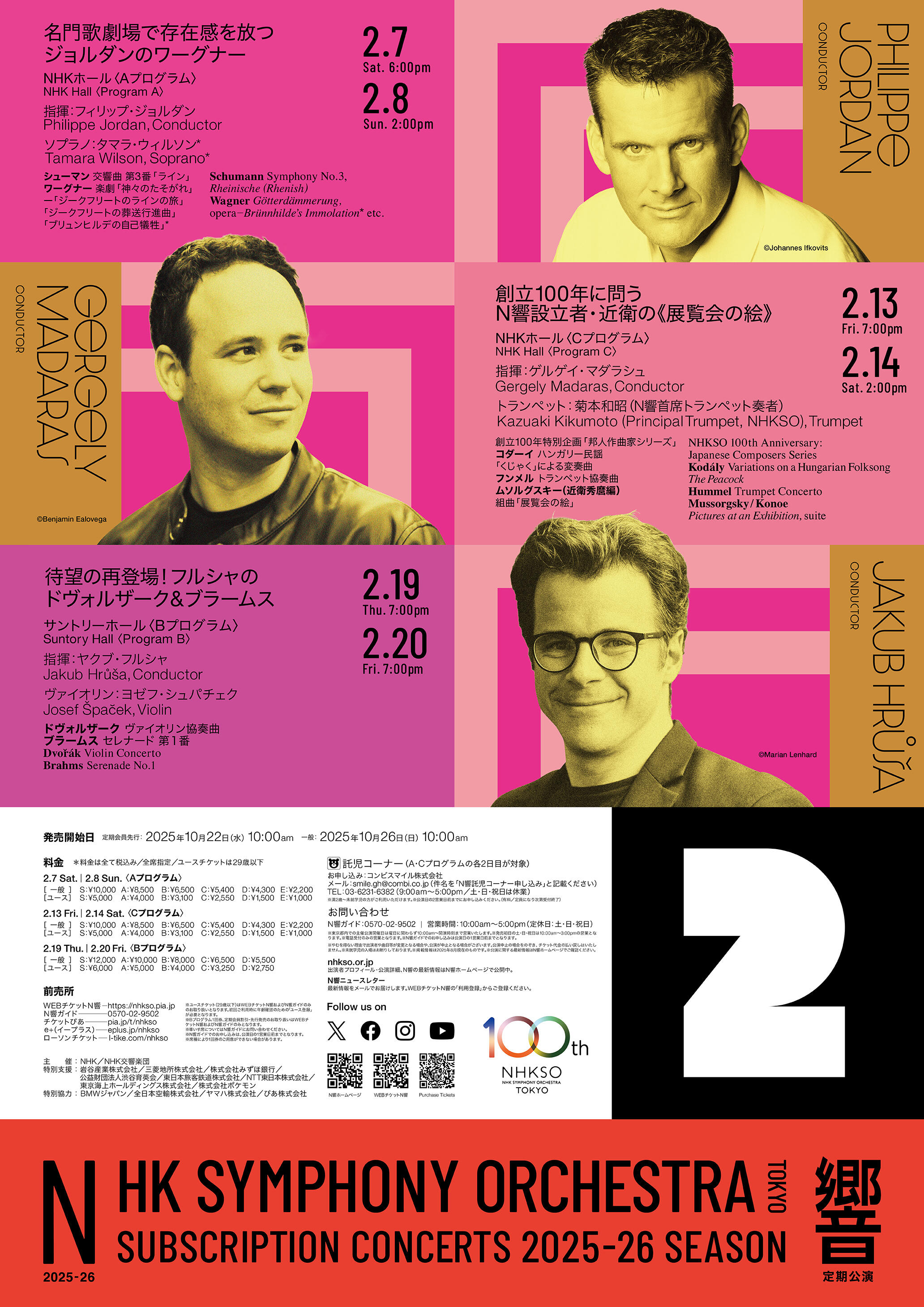
- Program C
- No. 2058 Subscription (Program C)
No. 2058 Subscription (Program C)


Program
- NHKSO 100th Anniversary: Japanese Composers Series -
Kodály / Variations on a Hungarian Folksong The Peacock
Hungarian composer and educator Zoltán Kodály (1882–1967) was also a forefather of ethnomusicology long before the term was created. In his childhood, the learner of piano and strings enjoyed playing chamber music at home and orchestral music at school, while singing in the church choir. He obtained a diploma in composition in 1904 at Budapest’s Academy of Music under János Koessler who also trained Béla Bartók (1881–1945). Kodály developed an interest in the nation’s traditional music, which was coupled with a rising Hungarian nationalism of the time. In 1905, he started to travel with wax cylinders in his hand to collect and study folksongs, some fruits of which were instantly reflected in his PhD thesis The stanzaic structure of Hungarian folksong (1906). His decades-long fieldwork as well as analysis and arrangement of folksongs were to bring richness and uniqueness to his own creations.
Variations on a Hungarian Folksong (1939) is based on the theme from the old tune Fölszállott a páva (Fly, Peacock). This orchestral work was a commission celebrating the 50th anniversary of Amsterdam’s Concertgebouw Orchestra who premiered it in November 1939 immediately after the outbreak of World War II. The lyrics of the original folksong urges the peacock representing freedom and hope, to fly over where poor prisoners are. For Kodály, the text also meant a protest against the fascism’s rise at the time. In this context, he had the work published by the British firm Boosey & Hawkes instead of the Austrian Universal Edition (which had published his music since 1921) because of the Anschluss (1938).
The theme, using a pentatonic (five-note) scale like many folk melodies, is given solemnly by cellos and contrabasses at the beginning. The introduction is followed by sixteen variations which are sometimes performed seamlessly without pause. The thirteenth variation, a funeral march with the brass mourning over gloomily repetitive rhythm by timpani and low instruments, is especially in stark contrast to the buoyant grand finale where the theme is brightly sung by the orchestra.
[Kumiko Nishi]
Hummel / Trumpet Concerto E Major
Johann Nepomuk Hummel (1778–1837) was regarded as one of Europe’s greatest composers and pianists during his lifetime. Born in the capital of the Kingdom of Hungary (now Bratislava, Slovakia), the musical prodigy moved to Vienna at age 8 and became a live-in piano apprentice of Wolfgang Amadeus Mozart (1756–1791). He later studied organ with Joseph Haydn (1732–1809) and vocal composition under Antonio Salieri (1750–1825).
Hummel’s Trumpet Concerto (1803), as with Haydn’s famous one (1796), was written for the innovative keyed trumpet promoted by Vienna’s first-rate trumpeter Anton Weidinger. Unlike the older natural trumpet producing limited notes, this instrument with key-covered tone holes made it possible to play all the halftones, which explains Hummel’s solo part abundant in chromatic intervals. In spite of these efforts, the keyed trumpet would soon give way to the modern valve trumpet during the early 19th century.
The Trumpet Concerto was premiered on New Year’s Day 1804 by Weidinger and Prince Esterházy (Nikolaus II)’s musicians, three months before Hummel was made the Esterházy family’s effective Kapellmeister succeeding Haydn. The march-like opening movement reminds us of the trumpet’s heroic side. The lyrical middle movement evoking an operatic aria is followed without break by the virtuosic, festive finale in rondo form. While the work is performed in E-flat major at times for B-flat trumpets to play easily, today’s concert will present it in E major, the original key, on an E trumpet.
[Kumiko Nishi]
Mussorgsky / Konoe / Pictures at an Exhibition, suite
Russian composer Modest Mussorgsky (1839–1881) originally wrote Pictures at an Exhibition for piano solo in 1874, shortly after visiting the memorial exhibition of the late architectural designer and painter Victor Hartmann, his close friend. In fact, this suite consists of several short movements evoking different pictures, with the recurring Promenade movement inserted between them. This structure makes us feel as if someone—or we—meandered through a gallery and stopped in front of each work of art.
This masterwork-to-be was unknown to the public during the composer’s lifetime. Though there exist numerous orchestral arrangements of it, the ingeniously colorful one by Ravel surely provided it with a high popularity. Today’s concert will deliver a rarely-performed arrangement by Japanese conductor and composer Hidemaro Konoe (1898–1973) who used, as a base, Ravel’s orchestration and its source Mikhail Tushmalov’s. Trained mostly in Tokyo and Berlin, Konoe is known as a major contributor to the development of his country’s orchestral culture in its early days. The 1926 foundation on his initiative of the New Symphony Orchestra (later renamed NHK Symphony Orchestra) is a turning point of Japan’s classical music performance history.
Konoe’s activities went across borders: in 1931, he conducted the Russian premiere of Ravel’s version of Pictures at an Exhibition in Moscow. Some locals in attendance suggested to Konoe he should revise it to “wash Parisian cosmetics out from Ravel’s modern touch and recover Mussorgsky’s image as a suntanned, soil-scented Slav.” The result—“Ravel’s version revised by Konoe” in his words—was first heard in Berlin before the New Symphony Orchestra played it in Tokyo in 1934. During today’s concert, the same orchestra will perform it for the first time in ninety-two years, using the parts prepared under Konoe’s direction in 1950. For a long time, the Konoe family possessed only the 1934 manuscript score damaged by fire, and some parts from 1950, making it impossible for the arrangement to be performed. Only some years ago, the remaining parts from 1950 were found at their relative’s, which revealed to us the complete picture at last.
Unlike Ravel’s version entrusting the first statement of the opening Promenade to a trumpet solo, Konoe’s starts stately with strings, clarinets and bassoons, joined immediately by horns and a trumpet. The two versions instead let an alto saxophone sing a medieval troubadour’s song at II The Old Castle and make good use of flutes during the lilting V Ballet of Unhatched Chicks. As for VI Samuel Goldenberg and Schmuÿle, both these arrangers have forceful strings in unison embodying Samuel, rich and arrogant, and a muted trumpet representing Schmuÿle, poor and servile, while Konoe’s more dramatic scoring is thicker and weightier particularly through additional low brass parts. In both versions, the brass play an active part in the eerie VIII Catacombs: Roman Tomb, flowing seamlessly into With the Dead in a Dead Language, a variation of the Promenade. IX The Hut on Hen’s Legs: Baba Yaga with tic tac rhythms, describes a clock in the shape of the Russian witch Baba Yaga’s hut. X The Great Gate of Kiev is based on Hartmann’s design for Kiev’s city gates. In an almost sacred central part, church-like bells are heard and the Promenade’s theme is recalled, evoking Russian Orthodox hymns. This effectively prepares the majestic conclusion, backed by a piano in Konoe’s orchestration.
[Kumiko Nishi]
Artists
 ConductorGergely Madaras
Born in Budapest in 1984, Hungarian conductor Gergely Madaras was named 2025 “Conductor of the Year” at the Bartók Radio Music Awards. He served as Music Director of the Orchestre Philharmonique Royal de Liège from 2019 to 2025. His 2025/26 season includes a project with the Hungarian Radio Symphony celebrating the 100th birthday of György Kurtág.
In recent seasons, he has conducted critically-acclaimed productions at the Hungarian State Opera, La Monnaie, Grand Théâtre de Genève and the Dutch National Opera. Recent symphonic highlights include performances with the Oslo Philharmonic, London Philharmonic Orchestra, BBC Symphony Orchestra, Royal Philharmonic Orchestra, BBC Philharmonic Orchestra, Hallé Orchestra, City of Birmingham Symphony Orchestra, Orchestre Philharmonique de Radio France, and with Il Pomo d’Oro and Joyce DiDonato at the Concertgebouw Hall, as part of the “EDEN” tour. Whilst grounded in the core Classical and Romantic repertoire, he maintains a close relationship with new music collaborating with contemporary composers including George Benjamin and György Kurtág. For Pierre Boulez, he served as assistant conductor at the Lucerne Festival Academy between 2011 and 2013.
He first began studying folk music with the last generation of authentic Hungarian gipsy and peasant musicians at age 5. He went on to study classical flute, violin and composition, graduating from the flute faculty of the Liszt Academy in Budapest, as well as the conducting faculty of the Universität für Musik und darstellende Kunst Wien, where he studied with Mark Stringer.
He made his debut with the NHK Symphony Orchestra at their subscription concerts in 2023 performing an all-Hungarian program around Kodály’s Háry János suite. At his most recent collaboration with the orchestra in 2024, he conducted an all-Tchaikovsky program. Following these successes, he will lead today’s concert as part of the projects marking the orchestra’s 100th anniversary year, with a special program featuring Mussorgsky’s Pictures at an Exhibition arranged by the orchestra’s late founder Hidemaro Konoe.
 TrumpetKazuaki Kikumoto (Principal Trumpet, NHKSO)
One of Japan’s greatest trumpeters, Kazuaki Kikumoto became a Principal Trumpet at the NHK Symphony Orchestra in 2012. Four years later, he debuted at the orchestra as a concerto soloist performing Shostakovich’s Concerto in C minor for Piano, Trumpet and String Orchestra (known as Piano Concerto No. 1).
Born in 1980 in Hyogo, Japan, he graduated from the Kyoto City University of Arts before completing his master’s course there, both as a top student. Trained by Hiroaki Hayasaka and Sumiaki Arima (trumpet) as well as Shinichi Go (chamber music), he also studied in Germany with Anthony Plog at the Hochschule für Musik Freiburg and with Reinhold Friedrich and Edward H. Tarr at the Hochschule für Musik Karlsruhe.
The First Prize winner both at the 19th Japan Wind and Percussion Competition in 2002 and the 72nd Music Competition of Japan in 2003, he also was the Second Prize winner at the Ellsworth Smith International Trumpet Solo Competition held in 2008 in the USA, where he gave a recital at the Chosen Vale International Trumpet Seminar in 2009 and was invited by the International Trumpet Guild Conference to perform a recital and concerto in 2016.
Download

Ticket
Single Tickets Release Date
Pre-sales for Subscribers:Wednesday, October 22, 2025 10:00am
*about subscribers
Sale to General Public:Sunday, October 26, 2025 10:00am
Price
| S | A | B | C | D | E | |
|---|---|---|---|---|---|---|
| Ordinary Ticket | 10,000 | 8,500 | 6,500 | 5,400 | 4,300 | 2,200 |
| Youth Ticket | 5,000 | 4,000 | 3,100 | 2,550 | 1,500 | 1,000 |
*tax included
*Subscribers receive a 10% discount (Available at NHKSO WEB Ticket and N-Kyo Guide)
*For wheelchair-accessible seats, please refer to the N-Kyo Guide
*Please note that single tickets may not be available depending on ticket price range
Youth Tickets
Youth Tickets are great options for those of 29 years old and younger
Subscription tickets
Release Date
ANNUAL SUBSCRIPTION TICKETS
Sun., July 13, 2025 10:00am
[For Subscribers: Sun., July 6, 2025 10:00am]
SEASONAL SUBSCRIPTION TICKETS (WINTER)
Fri., October 17, 2025 10:00am
[For Subscribers: Tue., October 14, 2025 10:00am]
Where to buy
NHKSO WEB Ticket | Fri., February 13 (In English / Seats not selectable on the English site)
NHKSO WEB Ticket | Sat., February 14 (In English / Seats not selectable on the English site)
NHKSO WEB Ticket (In Japanese / Seats selectable)
N-Kyo Guide (Purchase by telephone only)
Other Ticket Agents
Organized by: NHK (Japan Broadcasting Corporation) / NHK Symphony Orchestra, Tokyo
*Repertoire, conductor, soloists and program order are subject to change without notice.
*Pre-school children are not allowed in the concert hall.
