
- Home
- Concerts
- Subscription Concerts
- Program B
- No. 2059 Subscription (Program B)
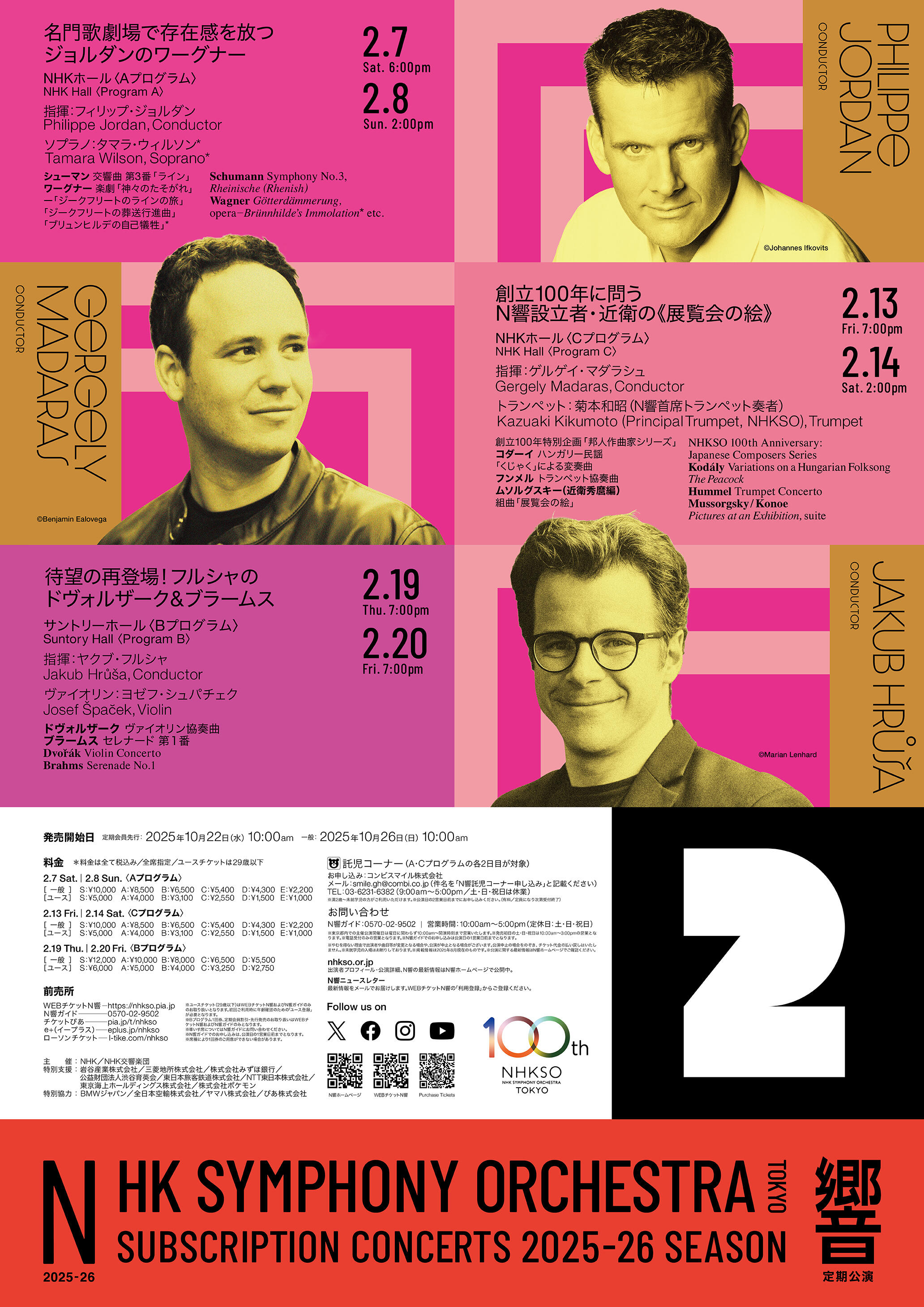
No. 2059 Subscription (Program B)


Program
Dvořák / Violin Concerto A Minor Op. 53
Antonín Dvořák (1841–1904) was born in Bohemia (modern day Czech Republic), then ruled by the Austrian Empire. As a boy, he received violin and vocal lessons before performing in the village band and church. After studying music in Prague, he made a living as a viola player while composing. 1875 marked a turning point in his life: the obscure musician in his mid-thirties in need won the Austrian State Grant for talented artists for five consecutive years starting then. On top of that, Brahms who served a jury spotted Dvořák’s originality. The former recommended his publisher issue works by this promising Czech man who, thanks to that, quickly earned fame throughout Europe with his printed Slavonic Dances (inspired by Brahms’s Hungarian Dances).
The Violin Concerto dates from Dvořák’s so-called Slavonic period when folkloric elements had a growing impact on his Austro-German-influenced compositions. He set to work on it in July 1879 for the Hungarian violinist Joseph Joachim (1831–1907), well-known today as Brahms’s lifelong friend. The Czech composer’s creativity was presumably ignited by Brahms’s Violin Concerto that Joachim had successfully premiered in January 1879. Dvořák’s concerto was not publicly heard until 1883 due to major and minor revisions he made following Joachim’s advice. For unknown reasons, the violinist didn’t give the first performance and likely never performed the work in public.
The Violin Concerto is cast in the classical three-movement structure, although its formal deviations from convention stand out. The first energetic movement in free sonata form skips the traditional orchestral exposition. It instead lets the soloist enter early in the opening few bars giving the first theme and then playing a brief cadenza-like passage. The recapitulation (an ending section where main themes are restated) and the soloist’s customary cadenza (improvisatory solo towards the end) are practically absent. More unexpectedly, the first movement turns smoothly without pause to the songful slow middle movement. The finale, a rondo, is highly folkloric: the joyful main section is a stylized furiant (a rapid Bohemian dance with frequent accent shifts), while a contrasting slower episode evokes dumka (a piece of Slavic music, usually pensive or melancholic).
[Kumiko Nishi]
Brahms / Serenade No. 1 D Major Op. 11
“Neue Bahnen (New Paths)” was the title given by composer and critic Robert Schumann (1810–1856) in his October 1853 article to extol a Hamburg-born unknown named Johannes Brahms (1833–1897). It was the above-mentioned violinist and conductor Joseph Joachim who had introduced Brahms to Schumann the previous month. In this sensational text, Schumann foretold that if the twenty-year-old pianist-composer were to wave his magic wand so the power of the orchestra lends him its force, further wonderful glimpses into the mysteries of the spirit world would be revealed.
Schumann’s expectations started to be lived up to four years later—unfortunately, after his tragic death—when Brahms set to work on the Serenade No. 1 which was later to be his first work for orchestra. It was originally a chamber piece (for winds and strings) he wrote in Detmold where he served the court as conductor, pianist and music teacher every autumn from 1857 to 1859. Brahms first rewrote the piece for small orchestra, before the present version for full orchestra was premiered with Joachim conducting in Hanover in March 1860.
During the 18th century, a serenade was a suite of multiple, relatively light pieces for large instrumental ensemble. In general, it was written for the upper class to be performed outdoors on certain occasions or festivities, and Wolfgang Amadeus Mozart (1756–1791) is particularly known for having brought its form to perfection. Brahms’s Serenade No. 1 is eloquent proof that he is a worthy successor to the First Viennese School trio Joseph Haydn (1732–1809), Mozart, and Ludwig van Beethoven (1770–1827). At the same time, Brahms blazed the trail of imaginative serenades as represented by Dvořák’s two works (1875 and 1878) and Tchaikovsky’s one (1880).
In accordance with the custom, the Serenade No. 1’s opening and final movements are in march rhythm, which is a remnant of traditional serenades where the musicians entered and exited while performing. The lively first movement has a Haydnesque pastoral beginning with French horn and clarinet solos over droning string chords. The serious second movement in D minor is a scherzo out of character, having the waltz-like trio (central) section in B-flat major. A climax of the work, the extended third movement is a slow sonata in B-flat major where the dignified atmosphere with dotted rhythms is alternated with expansive songfulness. The fourth movement in ternary form (Menuetto I in G major—Menuetto II in G minor—Menuetto I in G major) has a light chamber scoring. During the fifth movement, a scherzo in D major, French horns stand out suggesting a hunting scene where this instrument had been originally used. The finale in D major is in rondo-sonata form. The propulsive first theme in dotted rhythms will drive this serenade to a vigorous conclusion.
[Kumiko Nishi]
[Encore]
Dvořák (arr. by A. Rihm)/ Humoresque No. 7 G major Op.101-7
Violin: Josef Špaček, Sunao Goko
Viola: Junichiro Murakami
Cello: Ryoichi Fujimori
Artists
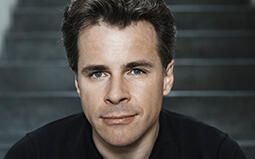 ConductorJakub Hrůša
Born in the Czech Republic, Jakub Hrůša is Chief Conductor of the Bamberger Symphoniker and Music Director of The Royal Opera, and will be Chief Conductor and Music Director of the Czech Philharmonic (from 2028).
He performs regularly with the world’s greatest orchestras including the Wiener and Berliner Philharmoniker, Gewandhausorchester Leipzig, Staatskapelle Dresden, Lucerne Festival Orchestra, Royal Concertgebouw Orchestra, Orchestre de Paris, Boston Symphony Orchestra, The Cleveland Orchestra and the New York Philharmonic. He has led opera productions for the Salzburger Festspiele (Kát’a Kabanová with the Wiener Philharmoniker), Wiener Staatsoper (The Makropulos Case), Opéra national de Paris (Rusalka) and Opernhaus Zürich (The Makropulos Case), among others.
He was a double winner at the 2024 Gramophone Awards for his recordings of Britten’s Violin Concerto with Isabelle Faust and Symphonieorchester des Bayerischen Rundfunks, and Kát’a Kabanová with the Wiener Philharmoniker. He was awarded the Preis der deutschen Schallplattenkritik for his recording of Mahler’s Symphony No. 4, and his album of Martinů and Bartók violin concertos with Frank Peter Zimmermann was nominated for BBC Music Magazine and Gramophone Awards. His disc of Dvořák’s Violin Concerto with the Symphonieorchester des Bayerischen Rundfunks and Augustin Hadelich was nominated for a Grammy Award.
He was the inaugural recipient of the Sir Charles Mackerras Prize, and has been awarded the Czech Academy of Classical Music’s Antonín Dvořák Prize and other prestigious prizes.
He made his NHK Symphony Orchestra debut in 2019 conducting works by Janáček, Berlioz and R. Strauss. Most recently, he and the orchestra collaborated in 2023 for the two programs respectively around Brahms’s Symphony No. 4 and Rakhmaninov’s Symphonic Dances. This time, he will co-star with his compatriot Josef Špaček for Dvořák’s Violin Concerto, whilst presenting us a great opportunity to hear Brahms’s rarely-performed Serenade No. 1 live.
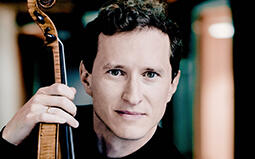 ViolinJosef Špaček
Praised for his remarkable range of colours, his confident and concentrated stage presence, his virtuosity and technical poise as well as the beauty of his tone, Czech artist Josef Špaček has emerged as one of the leading violinists of his generation.
Born in 1986 and currently based in Prague, he studied with Itzhak Perlman at The Juilliard School, Ida Kavafian and Jaime Laredo at the Curtis Institute of Music, and with Jaroslav Foltýn at the Prague Conservatory.
As a soloist, he has performed with the world’s renowned orchestras including the Gewandhausorchester Leipzig, Bamberger Symphoniker, Deutsches Symphonie-Orchester Berlin, Rundfunk-Sinfonieorchester Berlin, Orchestre de Paris and the Chicago Symphony Orchestra, alongside eminent conductors such as Jakub Hrůša, Jiří Bělohlávek, Thomas Adès, Semyon Bychkov, Manfred Honeck, Eliahu Inbal and Michael Sanderling.
This is his NHK Symphony Orchestra debut with Dvořák’s Violin Concerto. His album with the Czech Philharmonic including this piece was praised by The Sunday Times writing his “individual, deeply considered and virtuosic account of Dvořák’s solo part is the highlight of this keenly conceived programme,” adding that “in this repertoire, Špaček is second to none today.”
He performs on the ca. 1732 “LeBrun; Bouthillard” Guarneri del Gesù violin.
Download

Ticket
Program B
No. 2059 Subscription (Program B)
Suntory Hall
Google Map
Seating Chart
Single Tickets Release Date
Pre-sales for Subscribers:Wednesday, October 22, 2025 10:00am
*about subscribers
Sale to General Public:Sunday, October 26, 2025 10:00am
Price
| S | A | B | C | D | |
|---|---|---|---|---|---|
| Ordinary Ticket | 12,000 | 10,000 | 8,000 | 6,500 | 5,500 |
| Youth Ticket | 6,000 | 5,000 | 4,000 | 3,250 | 2,750 |
*tax included
*Subscribers receive a 10% discount (Available at NHKSO WEB Ticket and N-Kyo Guide)
*For wheelchair-accessible seats, please refer to the N-Kyo Guide
*Please note that single tickets may not be available depending on ticket price range
Youth Tickets
Youth Tickets are great options for those of 29 years old and younger
Subscription tickets
Release Date
ANNUAL SUBSCRIPTION TICKETS
Sun., July 13, 2025 10:00am
[For Subscribers: Sun., July 6, 2025 10:00am]
Where to buy
NHKSO WEB Ticket | Thu., February 19 (In English / Seats not selectable on the English site)
NHKSO WEB Ticket | Fri., February 20 (In English / Seats not selectable on the English site)
NHKSO WEB Ticket (In Japanese / Seats selectable)
N-Kyo Guide (Purchase by telephone only)
Broadcast
 NHK-FMBest of Classic
No. 2059 Subscription (Program B)
Friday, Feb 27, 2026 7:35PM - 9:15PM
Program:
Dvořák / Violin Concerto A Minor Op. 53
Brahms / Serenade No. 1 D Major Op. 11
Conductor:Jakub Hrůša
Violin:Josef Špaček
Recorded:February 19, 2026 Suntory Hall
Organized by: NHK (Japan Broadcasting Corporation) / NHK Symphony Orchestra, Tokyo
*Repertoire, conductor, soloists and program order are subject to change without notice.
*Pre-school children are not allowed in the concert hall.
