
- Home
- Concerts
- Subscription Concerts
- Program B
- No. 2056 Subscription (Program B)
No. 2056 Subscription (Program B)


Program
Mussorgsky / Shostakovich / Khovanshchina, opera - Dawn over the Moscow River, prelude
Born into a wealthy Russian landowning family, Modest Mussorgsky (1839–1881) was a member of The Mighty Handful (The Five). The most active around 1870, this group of young composers aimed to develop a nationalist school of Russian classical music. They derived inspiration from the nation’s folk music, folktales, nature, history and so forth. Mostly self-trained, Mussorgsky’s compositional skills had been underestimated in his lifetime, while his highly individual style and idioms guided future generations to modernism: Claude Debussy (1862–1918), Sergei Prokofiev and Dmitry Shostakovich (1906–1975) famously modeled themselves after him with admiration.
Mussorgsky died of alcoholism in poverty, leaving the uncompleted, hardly orchestrated piano vocal score of Khovanshchina (The Khovansky Affair). This historical opera dramatizes the political tumult around Peter the Great (1672–1725)’s accession to the throne following the 1682 Moscow Uprising led by Prince Khovansky. The story features the Old Believers who refused the Russian Orthodox Church reforms and feared Peter’s Westernization. In 1872, the year marking the bicentenary of Peter’s birth, Mussorgsky began to gather material to write the libretto by himself.
Composed in September 1874, Dawn over the Moscow River is the opera’s prelude. Picturesquely depicting a serene river landscape resounding with morning church bells, it contrasts strikingly with the opera proper in great turmoil concluded by the Old Believers’ mass suicide. Shostakovich’s revision and orchestration of the opera for a movie (1959) is notable for being faithful to Mussorgsky’s intentions.
[Kumiko Nishi]
Shostakovich / Piano Concerto No. 2 F Major Op. 102
Dmitry Shostakovich (1906–1975) was born in Saint Petersburg a decade before the Russian Empire collapsed. The son of an amateur singer father (who was an engineer) and a pianist mother, he revealed his astonishing musical talent soon after he started to play piano and compose at an early age. Having lost his father in 1922, the teenage Shostakovich started to earn his bread as a silent-movie pianist in 1924. After gaining an international reputation with the successful 1926 premiere of the Symphony No. 1, his graduation composition at the Saint Petersburg (Leningrad) Conservatory, he entered Warsaw’s International Chopin Piano Competition in 1927 to be selected as one of the finalists.
Shostakovich left us two concertos for his instrument. The unique and modernistic No. 1 (1933) for piano, trumpet and string orchestra, was penned for himself to serve as the piano soloist at the first performance in his home city. Composed in 1957, the present Piano Concerto No. 2 is a product of the post-Stalin era, namely from the Thaw period after the composer had his toughest years facing the Revolution, World War II, Siege of Leningrad, and especially the Kremlin’s life-threatening censorship and ban on his music.
No. 2 is a neo-classical-style concerto in three movements. To our surprise, it is without any political or existential gravity nor somber irony, the composer’s hallmarks. The march-inflected first movement in sonata form astonishes us with its genuine jocular nature, as with the slow middle movement in variation form with probably the most limpidly sweet melodies Shostakovich ever penned. All are attributed to the compositional context: the concerto was a birthday gift to his teenage son Maxim, then a piano student at the Moscow Conservatory, who premiered it as the soloist. Linked to the middle movement without pause, the danceable finale has witty highlights for Maxim, which are some quotes from the French piano pedagogue and composer Charles-Louis Hanon(1819– 1900)’s finger exercises well-known for their effectiveness but also their dryness among piano learners.
[Kumiko Nishi]
Prokofiev / Symphony No. 5 B-flat Major Op. 100
Born in Imperial Russia (today in Donetsk Oblast, Ukraine) and died in Moscow on the same day as Joseph Stalin, Sergei Prokofiev (1891–1953) led a roller-coaster life. Trained by Anatoly Liadov (1855– 1914) and Nikolai Rimsky-Korsakov (1844–1908) at the Saint Petersburg Conservatory, the young Prokofiev attracted the Russian music scene’s attention as a daring “enfant terrible” with his earliest compositions marked by a fierce modernism as represented by the Piano Concerto No. 1 (1912).
Following the 1917 Revolution, he enjoyed freedom both personally and professionally for eighteen years living in the USA and Europe by permission of the Soviet authorities. His life took a new turn in 1936 when he returned for good to the Stalinist USSR offering to him some carrots of fame and opportunities. A few years later, the communist party effectively took his passport away, which prevented him from leaving the country. Against such a background, the censorship forced him to meet the official Soviet style called “Socialist Realism,” otherwise he would be destined for purge, labor camp, torture or execution. Prokofiev was thus obliged to tone his modernist tendencies down to create optimistic works accessible to and inspiring for the Soviet masses, while he succeeded in writing some energetic masterpieces of a great melodic beauty within such constraints.
When Prokofiev wrote the Symphony No. 5 quickly in 1944, he was at the Composers’ House at Ivanovo with Shostakovich and other colleagues. Located about 250 km northeast of Moscow, this public lodging with several cottages enabled composers to avoid cities during the war. As Prokofiev himself admitted, his motive for this composition was a patriotic spirit which was stimulated since Germany’s surprise attack on the Soviet Union in 1941. Indeed, from the heroic opening to the triumphant ending, Prokofiev makes the best use of the percussion and brass to create an epic military mood accentuating it by dotted rhythms. The utilization of a variety of percussion and a piano, another feature of the orchestration, ensure the vigorous percussive characteristic of the composer.
Penned amid World War II during which the government slightly relaxed the censorship, No. 5 exposes audacious tonal harmonies here and there. The second movement, a scherzo, offers a toccata-style rapid motoric burst of notes typical of Prokofiev, while his genius as an extraordinary melodist has full swing at the dreamy third movement. The theme given by flutes and a bassoon at the beginning of the first sonata movement plays a key role in the coherence of the work: this theme returns with four cellos like a chorale during the slow introduction to the final movement. A joyful rondo, the finale wraps up with a build-up of excitement, reminding us of the symphony’s premiere enthusiastically accepted in January 1945 with the Red Army’s victory over Germany just around the corner.
[Kumiko Nishi]
Artists
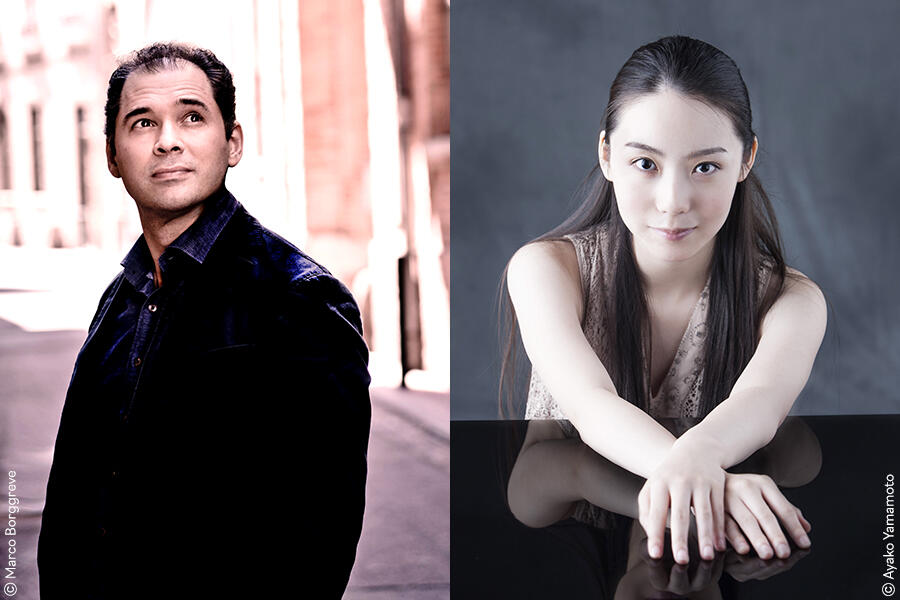
 ConductorTugan Sokhiev
Internationally renowned conductor Tugan Sokhiev, one of the last students of legendary teacher Ilya Musin at the St. Petersburg Conservatory, divides his time between the symphonic and operatic repertoire. He enjoys close and privileged relationships with orchestras such as the Wiener, Berliner and Münchner Philharmoniker orchestras, Staatskapelle Berlin, Staatskapelle Dresden, Symphonieorchester des Bayerischen Rundfunks and Gewandhausorchester Leipzig. Outside Europe, he is invited to conduct the finest U.S. orchestras including the Boston and Chicago Symphony Orchestras.
As Music Director of the Orchestre National du Capitole de Toulouse from 2008 to 2022, he propelled the orchestra to international prominence. Passionate about his work with singers, he was Music Director and Chief Conductor of the Bolshoi Theatre in Moscow from 2014 to 2022.
Recently, he has conducted a new production of Iolanta at the Wiener Staatsoper and given tours with the Wiener Philharmoniker (Asia), the Münchner Philharmoniker (Asia and Europe) and the Staatskapelle Dresden (Europe), conducting the Wiener Philharmoniker’s celebrated Sommernachtskonzert in the Schönbrunn Palace. He also led several highly acclaimed concerts of the Philharmonic Brass, the elite brass ensemble made up of members of the Berliner and Wiener Philharmoniker & Friends.
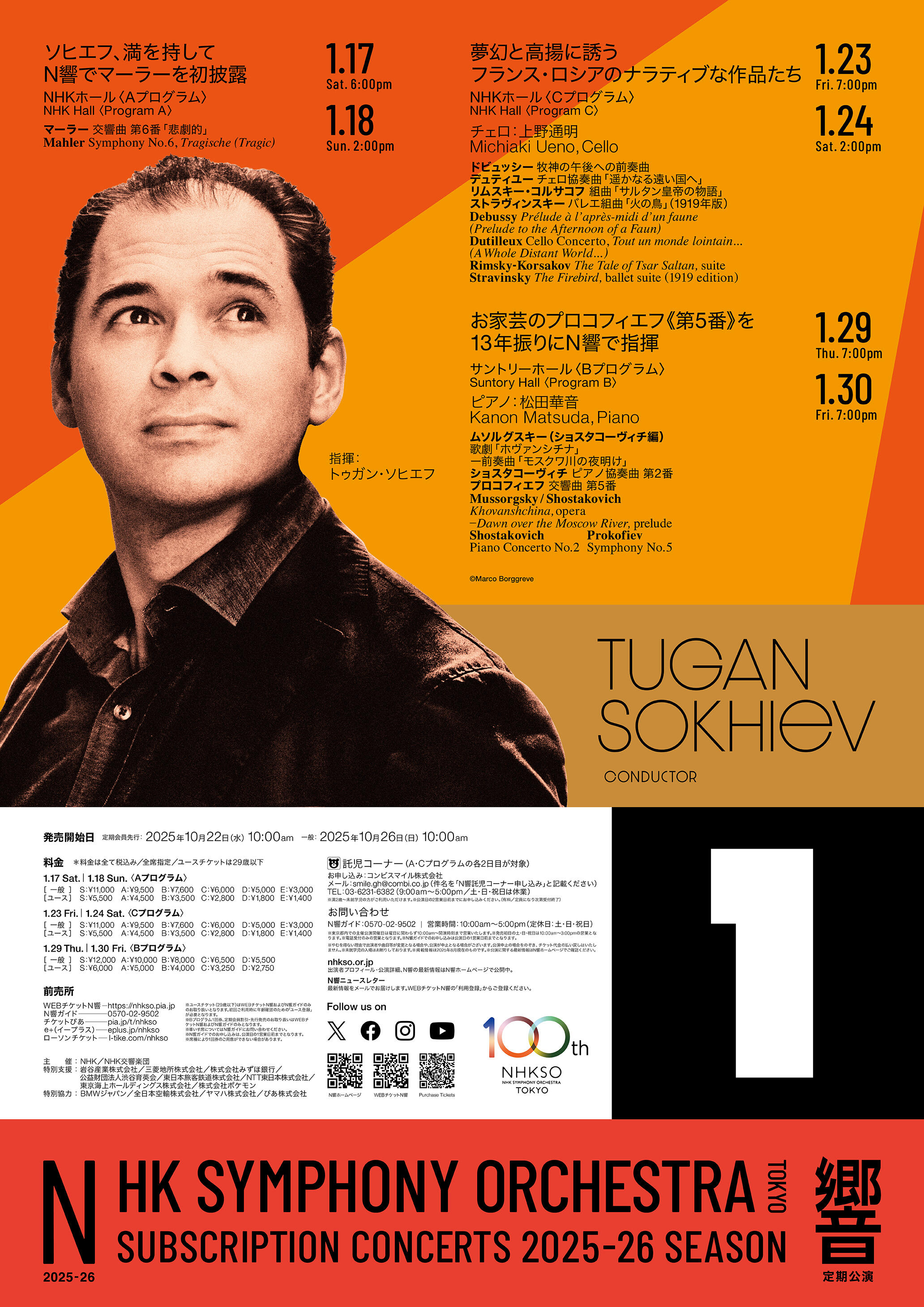
He made his NHK Symphony Orchestra debut in 2008 conducting Shostakovich’s Symphony No. 5 that he will revisit with the orchestra this time, Prokofiev’s Violin Concerto No. 2 and others. Since his first appearance at their subscription concerts in 2013, he has spent several weeks almost every year with the orchestra. For this season, he programed orchestral works by Mahler and Russian composers, coupling them with Shostakovich’s and Dutilleux’s concertos to collaborate with promising Japanese soloists Kanon Matsuda and Michiaki Ueno.
 Piano*Kanon Matsuda
Born in Kagawa, Japan, Kanon Matsuda started piano at age 4. She moved to Moscow at age 6 to study under Elena Ivanova and Mikhail Voskresensky at the Gnessin Special School of Music and the Moscow State Conservatory from both of which she graduated as a top student receiving “Red Diploma.” She continued her studies with Eliso Virsaladze at the graduate school of the Moscow Tchaikovsky Conservatory and completed the course in 2021.
She won numerous awards including the Grand Prix at the International Piano Competition in memory of Grieg in Moscow, the First Prize at the International Television Competition for Young Musicians “The Nutcracker” in Moscow, the First Prize and Gold Medal at the AADGT International Young Musicians Competition “Passion of Music” in New York and the prestigious scholarship “Path to Scriabin.”
She has performed with orchestras including the Russian National Orchestra, State Academic Symphony Orchestra of Russia, National Philharmonic of Ukraine and most Japanese major orchestras alongside such conductors as Mikhail Pletnev, Andrea Battistoni, Pietari Inkinen, Andris Poga and Alexander Vedernikov.
At her most recent collaboration with the NHK Symphony Orchestra in April 2025, she served as the soloist at Stravinsky’s Petrushka under the baton of Paavo Järvi.
Download

Ticket
Program B
No. 2056 Subscription (Program B)
Suntory Hall
Google Map
Seating Chart
Single Tickets Release Date
Pre-sales for Subscribers:Wednesday, October 22, 2025 10:00am
*about subscribers
Sale to General Public:Sunday, October 26, 2025 10:00am
Price
| S | A | B | C | D | |
|---|---|---|---|---|---|
| Ordinary Ticket | 12,000 | 10,000 | 8,000 | 6,500 | 5,500 |
| Youth Ticket | 6,000 | 5,000 | 4,000 | 3,250 | 2,750 |
*tax included
*Subscribers receive a 10% discount (Available at NHKSO WEB Ticket and N-Kyo Guide)
*For wheelchair-accessible seats, please refer to the N-Kyo Guide
*Please note that single tickets may not be available depending on ticket price range
Youth Tickets
Youth Tickets are great options for those of 29 years old and younger
Subscription tickets
Release Date
ANNUAL SUBSCRIPTION TICKETS
Sun., July 13, 2025 10:00am
[For Subscribers: Sun., July 6, 2025 10:00am]
Where to buy
NHKSO WEB Ticket | Thu., January 29 (In English / Seats not selectable on the English site)
NHKSO WEB Ticket | Fri., January 30 (In English / Seats not selectable on the English site)
NHKSO WEB Ticket (In Japanese / Seats selectable)
N-Kyo Guide (Purchase by telephone only)
Organized by: NHK (Japan Broadcasting Corporation) / NHK Symphony Orchestra, Tokyo
*Repertoire, conductor, soloists and program order are subject to change without notice.
*Pre-school children are not allowed in the concert hall.
