
- Home
- Concerts
- Subscription Concerts
- Program B
- No. 2045 Subscription (Program B)
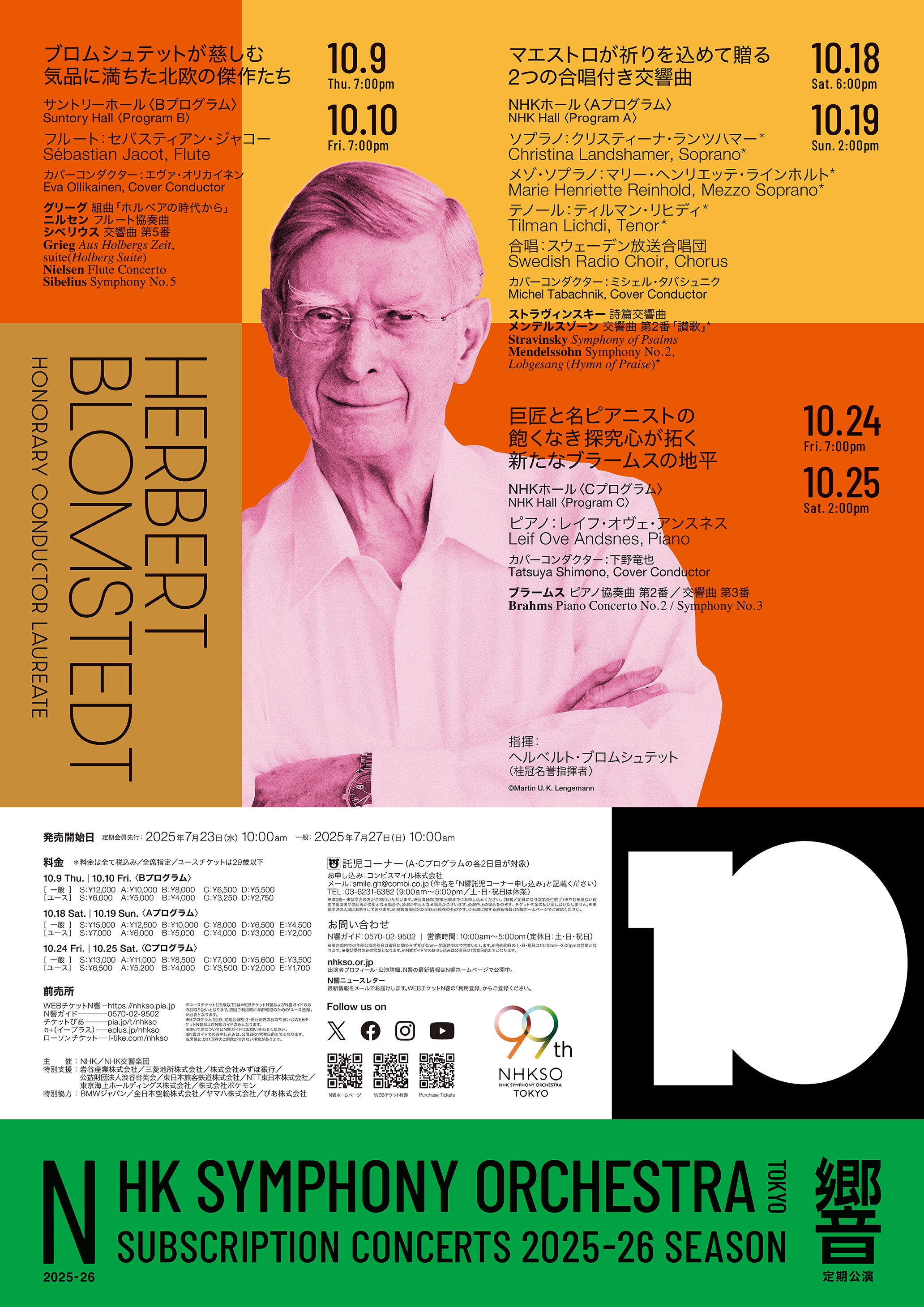
No. 2045 Subscription (Program B)


Program
Grieg / Aus Holbergs Zeit, suite Op. 40 (Holberg Suite)
Edvard Grieg (1843–1907) was born in Bergen in Norway. His musical talent was spotted by violinist Ole Bull and at the age of 15, he was sent to the Leipzig Conservatory where he studied piano with Ignaz Moscheles and composition with Carl Reinecke amongst others. It was after his return to Norway that he began to be interested in the folk music of his homeland and started to adopt a distinctively Norwegian idiom in his music, especially in his songs and piano music such as the Lyric Pieces. His large-scale works include the youthful Piano Concerto in A minor, composed in 1868, and the incidental music for Ibsen’s play Peer Gynt, premiered in 1876, which was later arranged into orchestral suites. In his later years, he settled in Troldhaugen, a house he built in Bergen.
In 1884, Grieg was commissioned to write music to commemorate the bicentenary of the birth of Ludvig Holberg (1684–1754), a writer, historian, and playwright from Bergen and regarded as the foremost representative of the Norwegian Enlightenment. For this occasion, Grieg composed the suite Aus Holbergs Zeit (From Holberg’s Time), which was conceived as a homage to the Baroque period in which the writer lived and worked. Originally written for piano, Grieg arranged it for string orchestra the following year.
The suite consists of a prelude and four baroque dance movements. The toccata-like Präludium (Prelude) is vivacious and lively, driven by the propulsive rhythms that run throughout. The Sarabande is a slow and solemn dance in triple time and features a poignant passage for three solo celli. The courtly Gavotte – Musette is followed by the elegiac Air, in which the parts are subdivided to produce a rich and sonorous texture. The final Rigaudon is a fast-paced folk dance with the solo violin and solo viola leading the group in the manner of folk fiddlers.
[Nahoko Gotoh]
Nielsen / Flute Concerto
Considered one of the most powerful and individual figures in the early 20th century orchestral music, Carl Nielsen (1865–1931) was born on the island of Funen in central Denmark. After studying violin and music theory at the Copenhagen Conservatory, he became a violinist in the opera orchestra of the Royal Theatre in 1889. He subsequently served as Kapellmeister of the theatre and conductor of the Copenhagen Musical Society, and from 1915 he taught at the Copenhagen Conservatory.
As composer, Nielsen wrote his first symphony in 1891–1892, which was premiered by the opera orchestra in 1894. He went on to compose five more symphonies and two operas, Saul og David and Maskarade. At the same time, he composed many songs and choral music based on Danish folk traditions which are loved and sung by the Danish people to this day.
Nielsen composed three concertos during his lifetime: for violin (1911), flute (1926), and clarinet (1928). The flute concerto was specifically composed for Holger Gilbert-Jespersen, the flutist of the Copenhagen Wind Quintet. After writing a wind quintet for the group in 1922, he decided to write a series of concertos for each of the instruments, but in the event, he was only able to complete two concertos. The flute concerto was premiered by Gilbert-Jespersen in Paris on October 21, 1926, with Ravel and Honegger in the audience. In fact, Nielsen didn’t have the time to complete the work, and it had to be performed with a temporary ending. Nevertheless, the work was highly praised. The complete version was premiered in Copenhagen the following year.
The two-movement concerto is scored for solo flute, 2 oboes, 2 clarinets, 2 bassoons, 2 horns, bass trombone, timpani, and strings. The first movement is quite free and improvisatory, and the flute wanders about, engaging in dialogues with the various instruments of the lightly textured orchestra. The second movement is more volatile; after presenting the charming pastoral melody, the solo flute moves through many tempos and moods, including a humorous confrontation with the bass trombone just before the end.
[Nahoko Gotoh]
Sibelius / Symphony No. 5 E-flat Major Op. 82
Born in the same year as Carl Nielsen, Finnish composer Jean Sibelius (1865–1957) was instrumental in putting Finland on the musical map. Brought up in a Swedish speaking family in the town of Hämeenlinna in southern Finland, he started playing the violin at an early age and went on to study at the Helsinki Music Institute (now known as the Sibelius Academy, named after him). Initially he had aspired to become a professional violinist but suffering from serious stage fright, he turned to composition. During his student days in Helsinki, he became interested in the Finnish language and its folk culture.
After studying in Berlin and Vienna, he achieved great success in 1892 with his Kullervo, a symphonic work with vocal soloists and male chorus based on the “Kalevala,” the Finnish-language folk epic. In 1899, he composed his Symphony No. 1, which, together with his tone poem Finlandia premiered the following year, secured his reputation both nationally and internationally. He composed six more symphonies and several tone poems, as well as incidental music for plays. Although he lived to the age of 91, he stopped composing by his late 60s; his last major work was the tone poem Tapiola.
Sibelius composed his Symphony No. 5 to be performed at a concert to celebrate his 50th birthday on 8 December 1915, held in the Great Hall of the University of Helsinki. However, the work didn’t come easily to him. In central Europe, the World War I was being fought, so he couldn’t perform abroad and his royalty from his German publishers had almost come to a halt. Confined to his home Ainola, near Lake Tuusula, he searched for inspiration in the surrounding nature.
Although Symphony No. 5 was favorably received at the premiere, Sibelius was not satisfied and he revised it repeatedly over the next few years, completing the final version in 1919. At one point, Sibelius wrote to a friend that he was working daily on the Fifth Symphony which is now “in a new form—practically composed anew.” The biggest change was that he reduced the four movements of the original version into three by reworking the first two movements into a single structure.
The first movement opens with a horn call which recurs several times as a unifying motif. Structurally, the movement is a fusion of sonata form and scherzo—the climax of the development leads into the dance-like scherzo in triple time. The second movement is pastoral in mood, with chirpy woodwinds above pizzicato strings. The third movement begins with a rushing figure from the strings, which is followed by the majestic horn theme. It is said that Sibelius conceived this melody when one day he saw a flock of swans circling above the lake as he took a walk. The symphony concludes triumphally with six fortississimo chords.
[Nahoko Gotoh]
[Encore]
Debussy / Syrinx
Flute: Sébastian Jacot
Artists
 ConductorHerbert Blomstedt
In more than seventy years of his career, Herbert Blomstedt has acquired the unrestricted respect of the musical world. His work as a conductor is inseparably linked to his religious and human ethos, and his interpretations combine great faithfulness to the score and analytical precision, with a soulfulness that awakens the music to pulsating life.
Born in the USA to Swedish parents and educated in Uppsala, New York, Darmstadt and Basel, Herbert Blomstedt gave his conducting debut in 1954 with the Royal Stockholm Philharmonic Orchestra and subsequently served as Chief Conductor of the Oslo Philharmonic, the Swedish and Danish Radio Orchestras, and the Staatskapelle Dresden. Later, he became Music Director of the San Francisco Symphony, Chief Conductor of the NDR Sinfonieorchester Hamburg (now NDR Elbphilharmonie Orchestra) and Music Director of the Gewandhausorchester Leipzig. His former orchestras in San Francisco, Leipzig, Copenhagen, Stockholm and Dresden all honored him with the title of Conductor Laureate. Since 2019, he is an Honorary Member of the Wiener Philharmoniker.
Herbert Blomstedt holds several Honorary Doctorates, is an elected member of the Royal Swedish Academy of Music and was awarded the German Great Cross of Merit with Star. Over the years, all leading orchestras around the globe have been fortunate to secure the services of the highly respected Swedish conductor. At the high age of 98, he continues to be at the helm of all leading international orchestras with enormous presence, verve and artistic drive.
Since performing together for the first time in 1981, Herbert Blomstedt has been conducting the NHK Symphony Orchestra almost every year for over 40 years; he was Honorary Conductor 1986–2016, and currently Honorary Laureate. His previous appearance was in October 2024.
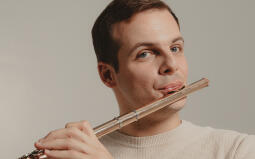 FluteSébastian Jacot
Born in Geneva, Sébastian Jacot studied at the Conservatoire Supérieur de Musique Genève in the class of Jacques Zoon and obtained his master’s degree as soloist and in teaching in 2010.
He has received many prizes including first prize at the Kobe, Nielsen, and the ARD competitions.
At the age of eighteen, he was appointed assistant principal flute in the Hong Kong Philharmonic Orchestra, a post where he remained for two years. He then returned to Europe and played in orchestras such as the Orchestra Mozart Bologna under Claudio Abbado, Mahler Chamber Orchestra, Swedish Radio Symphony Orchestra, Konzerthaus Berlin, and the Münchener Kammerorchester.
Jacot has held the position of principal solo flute of the Berliner Philharmoniker, Gewandhausorchester Leipzig, and the Ensemble Contrechamps in Geneva, and the Saito Kinen Orchestra. Besides recitals and masterclasses, Sébastian Jacot is also an enthusiastic chamber music musician, and regularly takes part in international festivals on every continent.
Upcoming highlights include Mahler’s Symphony No. 2 with the Saito Kinen Orchestra in Matsumoto, concerts and masterclasses in Korea, and a tour with the Chamber Orchestra of Europe in Vienna, Prague, and Bucharest.
This is his debut with the NHK Symphony Orchestra.
 Cover ConductorEva Ollikainen
Download

Ticket
Program B
No. 2045 Subscription (Program B)
Suntory Hall
Google Map
Seating Chart
Single Tickets Release Date
Pre-sales for Subscribers:Wednesday, July 23, 2025 10:00am
*about subscribers
Sale to General Public:Sunday, July 27, 2025 10:00am
Price
| S | A | B | C | D | |
|---|---|---|---|---|---|
| Ordinary Ticket | 12,000 | 10,000 | 8,000 | 6,500 | 5,500 |
| Youth Ticket | 6,000 | 5,000 | 4,000 | 3,250 | 2,750 |
*tax included
*Subscribers receive a 10% discount (Available at NHKSO WEB Ticket and N-Kyo Guide)
*For wheelchair-accessible seats, please refer to the N-Kyo Guide
*Please note that single tickets may not be available depending on ticket price range
Youth Tickets
Youth Tickets are great options for those of 29 years old and younger
Subscription tickets
Release Date
ANNUAL SUBSCRIPTION TICKETS
Sun., July 13, 2025 10:00am
[For Subscribers: Sun., July 6, 2025 10:00am]
Where to buy
NHKSO WEB Ticket | Thu., October 9 (In English / Seats not selectable on the English site)
NHKSO WEB Ticket | Fri., October 10 (In English / Seats not selectable on the English site)
NHKSO WEB Ticket (In Japanese / Seats selectable)
N-Kyo Guide (Purchase by telephone only)
Broadcast
 NHK-FMBest of Classic
No. 2045 Subscription (Program B)
Thursday, Oct 30, 2025 7:35PM - 9:15PM
Program:Grieg / Aus Holbergs Zeit, suite Op. 40 (Holberg Suite)
Nielsen / Flute Concerto
Sibelius / Symphony No. 5 E-flat Major Op. 82Click here for more details about the concert
Conductor:Herbert Blomstedt
Flute:Sébastian Jacot
Recorded:October 9, 2025 Suntory Hall
Organized by: NHK (Japan Broadcasting Corporation) / NHK Symphony Orchestra, Tokyo
*Repertoire, conductor, soloists and program order are subject to change without notice.
*Pre-school children are not allowed in the concert hall.
