
- Home
- Concerts
- Subscription Concerts
- Program B
- No. 2043 Subscription (Program B)
No. 2043 Subscription (Program B)


Program
Takemitsu / Three Film Scores
The next year 2026 will mark the 30th anniversary of the passing of Toru Takemitsu (1930–1996), a pioneer and one of the first Japanese composers to be warmly welcomed abroad. His concerto November Steps (1967) for two Japanese traditional instruments, premiered in New York, helped to make Takemitsu’s name known in the world.
The highly productive composer, a devoted cinephile as well, wrote the soundtrack for numerous movies and TV series, collaborating with leading directors including Akira Kurosawa (for Dodes’ka-den and Ran). For Takemitsu, film music was the perfect field to experiment with instruments—especially Japanese traditional ones—and idioms/styles/genres new to him, to utilize them later in his concert works. In so doing, he ushered in a new phase in Japanese film scoring.
In his later years, Takemitsu eagerly arranged his soundtracks for concert. Three Film Scores, a suite for string orchestra, was prepared in 1994–1995 and premiered at Gstaad’s CineMusic Festival, Switzerland in 1995, a year before the composer’s death. I Music of Training and Rest from Jose Torres is tinged with jazz. This is a rework of his score for Jose Torres (1959, directed by Hiroshi Teshigahara), a documentary on the Puerto Rican boxer filmed in New York. II Funeral Music from Black Rain is from the score for Black Rain (1989, by Shōhei Imamura) portraying survivors of the atomic bombing in Hiroshima. III Waltz from Face of Another, melancholic and tuneful, is heard with German lyrics in the Kafkaesque movie Face of Another (1966, by Hiroshi Teshigahara) based on Kōbō Abe’s intensely dramatic novel.
[Kumiko Nishi]
Beethoven / Violin Concerto D Major Op. 61
In music history, not a few masterpieces have been unfavorably received at the outset, because of being ahead of the time and/or being first performed unideally. And Beethoven’s Violin Concerto was a perfect example of that.
Op. 61 (1806) is the only violin concerto completed by Ludwig van Beethoven (1770–1827) apart from two short Romances for violin and orchestra. It dates from his exceptionally productive period when his great masterpieces such as the Symphonies No. 4 and No. 5, the Piano Concerto No. 4 and the three Razumovsky string quartets were written. It was the composer’s friend and violinist Franz Clement, the commissioner of the concerto, who played the solo part for the premiere in 1806 in Vienna. Beethoven reportedly finished writing it barely in time for the concert and Clement had to play it mostly at sight. The piece was hardly programmed again during the composer’s lifetime. After Beethoven’s death in 1844, the legendary violinist Joseph Joachim, well-known today as Johannes Brahms’ best friend, performed it under the baton of Felix Mendelssohn (mentioned below). This successful event was the impetus for the revival of the piece.
The Violin Concerto’s start with timpani solo, unwonted at the time, already tells us why this music perplexed people at the premiere. The unusual length of the first movement in sonata form might have surprised them, too. On top of that, they had to wait for as long as four minutes listening to the woodwinds introducing the pastoral first theme and the arched second theme, until the leading role—violin solo—finally entered. The slow movement is an equable variation on the theme given at the beginning by the strings utilizing mutes, a device used to make a softer sound. It ends with the soloist’s brief cadenza (improvisatory passage) which is followed seamlessly without pause by the lively final movement in rondo form. It is opened by the solo violin stating instantly the folkish, recurrent main theme.
[Kumiko Nishi]
Mendelssohn / Symphony No. 4 A Major Op. 90, Italienische (Italian)
Born and raised in northern Germany, Felix Mendelssohn-Bartholdy (1809–1847) is known as a musician representative of early German Romanticism alongside Robert Schumann (1810–1856) and Franz Liszt (1811–1886). Gifted but short-lived (he died of a sudden death at age 38), Mendelssohn wore many hats: as a masterly composer, an excellent pianist, an inspirational conductor who led the prestigious Gewandhausorchester Leipzig, an indefatigable educator who founded the Leipzig Conservatory and a leader of the “revival” of J. S. Bach’s works.
Mendelssohn’s Italienische (Italian) Symphony No. 4, one of his most popular works, was the fruit of his trip to Italy as with Johannes Brahms’ Piano Concerto No. 2 (1881) and Jean Sibelius’ Symphony No. 2 (1902): Italy has always fascinated composers traveling from northern countries to stir their creativity with its luminous sunlight, beautiful views, abundant historical artworks and architecture as well as religious authority. As it was the custom of the time among wealthy upper classes in Europe, Mendelssohn in his early twenties was sent on a European grand tour “to refine his own taste” (his own words). Having a gift for painting as well, he sketched diversified scenery in his journal during this journey.
The young traveler visited Venice and Florence in October 1830 to be exposed to Italian Renaissance and Baroque art. He then arrived in Rome coincidentally when the Vatican mourned the demise of Pope Pius VIII (Papacy: –November 1830) and celebrated the ascension of Pope Gregory XVI (February 1831–). Mendelssohn experienced Rome’s renowned Carnival and the Papal choir singing at Easter services in the Sistine Chapel. And during this sojourn in Rome, he interacted with Hector Berlioz (1803–1869)—the latter would complete his Harold en Italie in 1834—, penned the Hebrides Overture—a musical souvenir from his trip to Scotland—and developed the idea for the Italian Symphony. He also stayed over Naples and Milan before leaving for Switzerland and then France. Completed in 1833, the Italian Symphony was premiered under the composer’s own baton in London the same year.
Interestingly, the Italian Symphony doesn’t just sound sunny. It instead shows a vivid contrast between light and shade alternating major with minor keys, which provides a profoundness for this mature symphony. The opening sonata movement lets the violins immediately sing the sunshiny first theme in A major, before the serenely hopping second theme is given by the woodwinds. The slow second movement in D minor, a rondo in ABABA form, evokes a prayerful procession, while the third movement in A major is a minuet-like dance having the idyllic central section with horn calls. A surprise is the finale which starts and concludes in A minor but not A major. Here we hear a saltarello, an Italian high-speed dance in triple time traditionally danced at Rome’s Carnival, and a tarantella, a feverish three-beat folk dance originally from southern Italy.
[Kumiko Nishi]
Artists
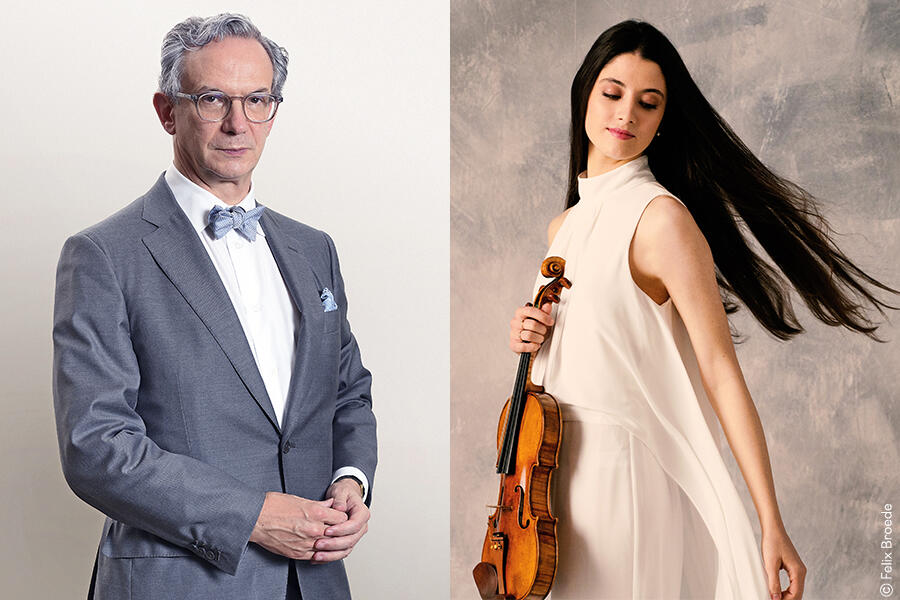
 ConductorFabio Luisi
Fabio Luisi hails from Genoa. He first conducted the NHK Symphony Orchestra in 2001 and became its Chief Conductor in September 2022. He performed Verdi’s Requiem to celebrate his appointment, and Mahler’s Symphonie der Tausend for the orchestra’s 2000th subscription concert in 2023. In 2024, he led the orchestra’s Taiwanese tour, and then in May 2025, he successfully led its European tour scheduled in conjunction with Amsterdam’s Mahler Festival at The Concertgebouw, the Prague Spring Festival and the Dresdner Musikfestspiele: the NHK Symphony Orchestra was the first Asian orchestra to appear at the Mahler Festival, performing the composer’s Symphonies No. 3 and No. 4 to critical praise.
Currently the Principal Conductor of the Danish National Symphony Orchestra and the Music Director of the Dallas Symphony Orchestra, he was General Music Director of the Opernhaus Zürich, Principal Conductor of New York’s Metropolitan Opera, Chief Conductor of the Wiener Symphoniker, General Music Director of the Staatskapelle Dresden and the Sächsische Staatsoper, Principal Conductor and Chief Conductor of the MDR-Sinfonieorchester, Artistic Director of the Orchestre de la Suisse Romande, Chief Conductor of the Tonkünstler Orchester and Artistic Director of the Grazer Symphonisches Orchester. He is also Music Director of Puglia’s Festival della Valle d’Itria Martina Franca and Emeritus Conductor of Orchestra Sinfonica Nazionale della Rai. He is a frequent guest of leading orchestras including the Berliner Philharmoniker, the Royal Concertgebouw Orchestra and the Saito Kinen Orchestra, opera houses and festivals worldwide.
In recording, his complete Nielsen symphonic cycle with the Danish National Symphony Orchestra was recognized with Limelight and Abbiati Awards in 2023, while its first volume was named Recording of the Year by Gramophone. He received a Grammy Award for his leadership of the last two operas of Wagner’s Ring cycle at the Metropolitan Opera, as released on DVD. His first CD with the NHK Symphony Orchestra, Bruckner: Symphony No. 8 (1st version) was released in May 2025.
He is an accomplished composer and maker of perfumes.
 ViolinMaría Dueñas
Born in Granada, Spain in 2002, María Dueñas has emerged as a luminous talent in classical music, captivating audiences with her extraordinary range of tonal colours, impeccable technical prowess, and artistic maturity.
She produced a great sensation in 2021 by winning the Menuhin International Competition for Young Violinists. She has performed with the world’s leading orchestras including the Philadelphia Orchestra, Cleveland Orchestra, Staatskapelle Berlin, Münchner Philharmoniker, Accademia Nazionale di Santa Cecilia and Orchestre de Paris alongside a constellation of esteemed conductors. Upcoming highlights include debuts with the New York Philharmonic, Wiener Philharmoniker and Maestro Zubin Mehta.
Praised by The New York Times for her ability to breathe “new life into well-known pieces,” she will perform Beethoven’s Violin Concerto during her highly anticipated first collaboration with the NHK Symphony Orchestra. Her debut album Beethoven and Beyond (2023) showcasing her remarkable interpretation of this concerto featuring cadenzas composed by herself, earned her the prestigious Opus Klassik Young Talent of the Year award in 2024.
She performs on a Nicolò Gagliano from 1774 on loan from Deutsche Stiftung Musikleben, and has also been entrusted with the Stradivarius “Camposelice” from 1710 by the Nippon Music Foundation.
Download


Ticket
Program B
No. 2043 Subscription (Program B)
Suntory Hall
Google Map
Seating Chart
Single Tickets Release Date
Pre-sales for Subscribers:Wednesday, July 23, 2025 10:00am
*about subscribers
Sale to General Public:Sunday, July 27, 2025 10:00am
Price
| S | A | B | C | D | |
|---|---|---|---|---|---|
| Ordinary Ticket | 12,000 | 10,000 | 8,000 | 6,500 | 5,500 |
| Youth Ticket | 6,000 | 5,000 | 4,000 | 3,250 | 2,750 |
*tax included
*Subscribers receive a 10% discount (Available at NHKSO WEB Ticket and N-Kyo Guide)
*For wheelchair-accessible seats, please refer to the N-Kyo Guide
*Please note that single tickets may not be available depending on ticket price range
Youth Tickets
Youth Tickets are great options for those of 29 years old and younger
Subscription tickets
Release Date
ANNUAL SUBSCRIPTION TICKETS
Sun., July 13, 2025 10:00am
[For Subscribers: Sun., July 6, 2025 10:00am]
Where to buy
NHKSO WEB Ticket | Thu., September 18 (In English / Seats not selectable on the English site)
NHKSO WEB Ticket | Fri., September 19 (In English / Seats not selectable on the English site)
NHKSO WEB Ticket (In Japanese / Seats selectable)
N-Kyo Guide (Purchase by telephone only)
Organized by: NHK (Japan Broadcasting Corporation) / NHK Symphony Orchestra, Tokyo
*Repertoire, conductor, soloists and program order are subject to change without notice.
*Pre-school children are not allowed in the concert hall.
