
- Home
- Concerts
- Subscription Concerts
- Program A
- No. 2042 Subscription (Program A)
No. 2042 Subscription (Program A)


Program
Beethoven / Piano Concerto No. 5 E-flat Major Op. 73, Emperor
Among many historic concerts left on record, one in particular held on December 22nd, 1808 in Vienna was highly significant, for the audience witnessed the world premieres of Beethoven’s Symphonies No. 5 (Destiny) and No. 6 (Pastorale) besides the first Viennese performance of his Piano Concerto No. 4 with the composer as soloist. He set to work on Piano Concerto No. 5 around the end of this December, to complete it by the summer of 1809 in Vienna while the city was occupied by Napoleon’s army. Deafening bombarding sounds are said to have damaged the already-decreased hearing of Ludwig van Beethoven (1770–1827) who had to cover his ears and seek refuge in the cellar of his brother’s house.
No. 5 is Beethoven’s only piano concerto for which he couldn’t serve as soloist at the premiere, as his ears had seriously deteriorated by then. Presumably because of that, he subsequently never wrote a new concerto for his instrument. This is also why there is no traditional cadenza (where a soloist improvises freely without the orchestra, towards the end of the sonata movement) in the No. 5. The cautious composer writes out all the cadential passages and reminds soloists on the score not to add any cadenza of their own.
No. 5 has an astounding, unheard-of beginning for a concerto: the soloist, backed up by the orchestra, gives a brilliant cadenza-like highlight before even the main sonata starts. Then the flowing grand first theme is contrasted with the crisp second theme introduced in a minor key. The middle movement is a sublime variation on the theme sung at the beginning by violins utilizing mutes, a devise used to make a softer sound. This movement is followed seamlessly without pause by the frisky finale in rondo sonata form. Towards the closing, the serene duet between timpani and piano leads to the majestic conclusion worthy of the byname Emperor, although the appellation didn’t originate with Beethoven.
[Kumiko Nishi]
Franz Schmidt / Symphony No. 4 C Major
Junior to Beethoven by almost a century, the Austrian musician Franz Schmidt (1874–1939) wore many hats as a composer, cellist, pianist, organist and conductor. Born into a German-Hungarian family in Pressburg (then a part of the Austro-Hungarian Empire, now Bratislava in Slovakia), Schmidt learned piano and organ before moving to Vienna in 1888 with his family. Two years later, he entered the Vienna Conservatory where he studied music theory with Robert Fuchs (Gustav Mahler’s teacher) and cello under the tutelage of Ferdinand Hellmesberger, a member of the renowned Hellmesberger Quartet. Schmidt was fortunate to take some counterpoint lessons with Anton Bruckner (1824–1896) there as well.
The young graduate became a cello player in the Vienna Court Opera (from 1896 to 1914) and the Vienna Philharmonic Orchestra (from 1896 to 1911) working presumably in close cooperation with Mahler (1860–1911) who led the two closely linked institutions around the same period. It seems that Mahler’s daring, late-Romantic-style symphonies didn’t particularly inspire Schmidt who had instead deep respect for the tradition of Austro-German Classicism and Romanticism. In contrast to the Vienna-born progressive Arnold Schönberg (1874–1951), the same age as him, Schmidt relied on the conventional tonal language over the course of his career. Partly due to these moderate stances, his compositions have been, on the whole, underestimated in music history, although he was highly ingenious without being a mere copy of his predecessors as shown in his Symphony No. 4.
The last of Schmidt’s four symphonies, No. 4 (1933) was penned from 1932 as a requiem for his daughter Emma who lost her life in childbirth the same year. This explains its overall grievous atmosphere and the presence of a funeral march in it. The symphony was premiered at Vienna’s Musikverein in 1934, five years prior to the composer’s death at age 64 on the eve of World War II.
A peculiarity of No. 4 is the structure: it is a single-movement symphony with four sections performed without pause. As the final section serves as the recapitulation of the first section, the entire symphony with the two main themes could be considered a sonata as well. The opening sonata section immediately introduces the first theme, a long plaintive trumpet solo over twenty-two bars. This melody will recur throughout the symphony as a unifying material. The second theme, developed over harps, is passionate in nature. The following slow Adagio section is opened by an expressive cello solo before the music reaches a climax, a funeral march led by gloomily repetitive timpani rhythm. The third Scherzo section is in the feverish 6/8-time rhythm of “tarantella”, an Italian trance folk dance evoking death. The final section recalls the cyclic melody at the start, this time on a French horn solo, and heads to a peaceful conclusion with the same melody on a trumpet solo as if to come full circle.
[Kumiko Nishi]
Artists
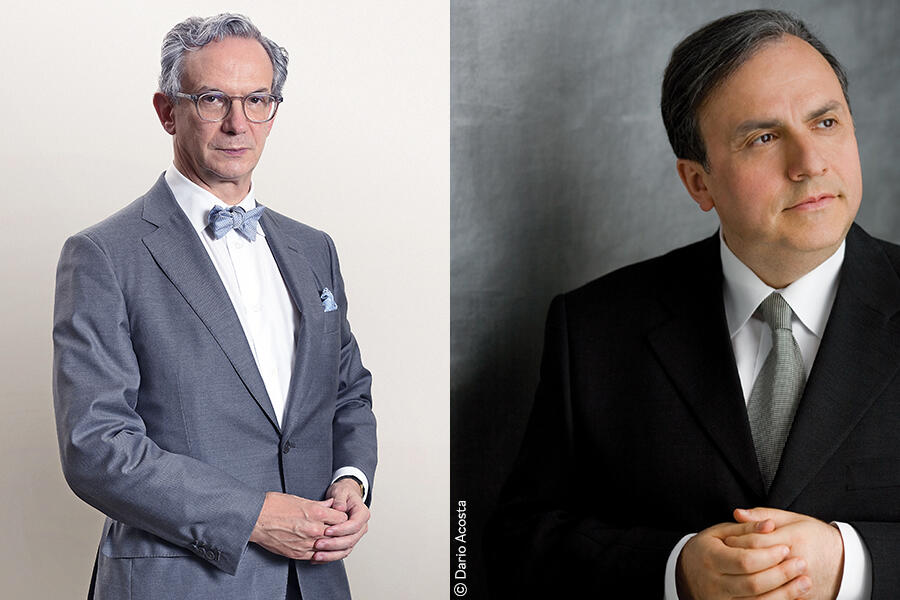
 ConductorFabio Luisi
Fabio Luisi hails from Genoa. He first conducted the NHK Symphony Orchestra in 2001 and became its Chief Conductor in September 2022. He performed Verdi’s Requiem to celebrate his appointment, and Mahler’s Symphonie der Tausend for the orchestra’s 2000th subscription concert in 2023. In 2024, he led the orchestra’s Taiwanese tour, and then in May 2025, he successfully led its European tour scheduled in conjunction with Amsterdam’s Mahler Festival at The Concertgebouw, the Prague Spring Festival and the Dresdner Musikfestspiele: the NHK Symphony Orchestra was the first Asian orchestra to appear at the Mahler Festival, performing the composer’s Symphonies No. 3 and No. 4 to critical praise.
Currently the Principal Conductor of the Danish National Symphony Orchestra and the Music Director of the Dallas Symphony Orchestra, he was General Music Director of the Opernhaus Zürich, Principal Conductor of New York’s Metropolitan Opera, Chief Conductor of the Wiener Symphoniker, General Music Director of the Staatskapelle Dresden and the Sächsische Staatsoper, Principal Conductor and Chief Conductor of the MDR-Sinfonieorchester, Artistic Director of the Orchestre de la Suisse Romande, Chief Conductor of the Tonkünstler Orchester and Artistic Director of the Grazer Symphonisches Orchester. He is also Music Director of Puglia’s Festival della Valle d’Itria Martina Franca and Emeritus Conductor of Orchestra Sinfonica Nazionale della Rai. He is a frequent guest of leading orchestras including the Berliner Philharmoniker, the Royal Concertgebouw Orchestra and the Saito Kinen Orchestra, opera houses and festivals worldwide.
In recording, his complete Nielsen symphonic cycle with the Danish National Symphony Orchestra was recognized with Limelight and Abbiati Awards in 2023, while its first volume was named Recording of the Year by Gramophone. He received a Grammy Award for his leadership of the last two operas of Wagner’s Ring cycle at the Metropolitan Opera, as released on DVD. His first CD with the NHK Symphony Orchestra, Bruckner: Symphony No. 8 (1st version) was released in May 2025.
He is an accomplished composer and maker of perfumes.
 PianoYefim Bronfman
Born in Tashkent in the Soviet Union in 1958, Yefim Bronfman immigrated to Israel with his family in 1973, where he studied with pianist Arie Vardi, head of the Rubin Academy of Music at Tel Aviv University. In the United States, he studied at The Juilliard School, Marlboro School of Music and the Curtis Institute of Music, under Rudolf Firkušný, Leon Fleisher and Rudolf Serkin. His commanding technique, power and exceptional lyrical gifts have since made him internationally recognized as one of today’s most acclaimed and admired pianists.
He works regularly with the world’s greatest orchestras including Wiener Philharmoniker, Berliner Philharmoniker, Royal Concertgebouw Orchestra and New York Philharmonic under the baton of an illustrious group of conductors such as Fabio Luisi, Herbert Blomstedt, Daniel Barenboim, Riccardo Chailly, Zubin Mehta, Riccardo Muti, Simon Rattle and Andris Nelsons.
This is his first appearance with the NHK Symphony Orchestra in almost a quarter century since June 2001. He will perform for us Beethoven’s majestic Fifth Concerto Emperor, a repertoire he has been very much at home with, particularly since he recorded all the composer’s piano concertos and Triple Concerto together with the Tonhalle-Orchester Zürich under David Zinman to critical praise.
Download


Ticket
Single Tickets Release Date
Pre-sales for Subscribers:Wednesday, July 23, 2025 10:00am
*about subscribers
Sale to General Public:Sunday, July 27, 2025 10:00am
Price
| S | A | B | C | D | E | |
|---|---|---|---|---|---|---|
| Ordinary Ticket | 11,000 | 9,500 | 7,600 | 6,000 | 5,000 | 3,000 |
| Youth Ticket | 5,500 | 4,500 | 3,500 | 2,800 | 1,800 | 1,400 |
*tax included
*Subscribers receive a 10% discount (Available at NHKSO WEB Ticket and N-Kyo Guide)
*For wheelchair-accessible seats, please refer to the N-Kyo Guide
*Please note that single tickets may not be available depending on ticket price range
Youth Tickets
Youth Tickets are great options for those of 29 years old and younger
Subscription tickets
Release Date
ANNUAL SUBSCRIPTION TICKETS/
SEASONAL SUBSCRIPTION TICKETS (AUTUMN)
Sun., July 13, 2025 10:00am
[For Subscribers: Sun., July 6, 2025 10:00am]
Where to buy
NHKSO WEB Ticket | Sat., September 13 (In English / Seats not selectable on the English site)
NHKSO WEB Ticket | Sun., September 14 (In English / Seats not selectable on the English site)
NHKSO WEB Ticket (In Japanese / Seats selectable)
N-Kyo Guide (Purchase by telephone only)
Other Ticket Agents
Organized by: NHK (Japan Broadcasting Corporation) / NHK Symphony Orchestra, Tokyo
*Repertoire, conductor, soloists and program order are subject to change without notice.
*Pre-school children are not allowed in the concert hall.
