
- Home
- Concerts
- Subscription Concerts 2023-2024
- Program A
- No. 1989 Subscription (Program A)
No. 1989 Subscription (Program A)
NHK Hall
Google Map Seating Chart


Program
R. Strauss / Till Eulenspiegels lustige Streiche, symphonic poem Op. 28 (Till Eulenspiegel’s Merry Pranks)
Considered an invention by Franz Liszt, the tone (symphonic) poem is the genre that the Munich-born composer Strauss explored during the early stage of his long creative life. For this preeminent musical artisan who was all imagination, nothing was beyond his capacity to give a vivid musical description solely utilizing the orchestra.
His tone poem Till Eulenspiegels lustige Streiche (Till Eulenspiegel's Merry Pranks) (1895) is the exact opposite in character of its predecessor Tod und Verklärung (Death and Transfiguration) (1889). One of the best-known European tricksters, Till is a German folk hero who teases people of every grade of society with his witty mischiefs. Upon creating a musical version of this old tale consisting of different happenings, Strauss had a stroke of genius choosing the rondo form where the recurrent principal theme (or the refrain) alternates with other motifs.
According to the verbal descriptions the composer left us, though unofficially, the work begins with the "Once upon a time, there lived a rogue" melody on violins. Then the horn solo introduces the principal theme stating "His name was Till Eulenspiegel" whose unusualness is reflected in the septuple time. The brief, laughter-like waggish secondary theme given by clarinet solo represents "who was an unruly imp!" After four mischievous adventures, Till gets the gallows for blasphemy before the silence suggests his end. The "Once upon a time" melody returns to open the epilogue which is concluded merrily by the laughter-like theme.
[Kumiko Nishi]
R. Strauss / Burleske, D Minor*
Strauss was a musical prodigy from a prosperous family and became a cultured man of versatile musical gifts, just like Mendelssohn. Son of a horn virtuoso father, Strauss began to take piano lessons at age 4, to compose at 6 and to play violin at 8. In 1885, the artist in his early twenties took up his first professional position as the assistant to Hans von Bülow at the Meiningen Court Orchestra. Under this top-ranked conductor-pianist-composer, Strauss devoted himself to conducting studies and he, after taking over the orchestra in December 1885, made even a pianist debut with his ensemble performing Mozart's 24th Piano Concerto in C minor.
It was during this period, from 1885 to 1886, that Strauss wrote the single-movement concerto named Scherzo, hoping von Bülow as pianist would premiere it. He turned it down on the grounds that it was unplayable (presumably because of his small hands). It was also beyond Strauss’ ability so it had to wait until 1890 for the first performance by the pianist Eugen d'Albert, a high-caliber disciple of Liszt, under the new title Burleske (burlesque, farce). The instrument taking a vital role in it – besides piano – is timpani which state the first theme alone at the beginning. After a while, the romantic second theme is given by pianist. Its warmth and lyricism are often associated with the writing of Brahms who greatly influenced the young Strauss. The piece is ended calmly by piano and timpani in dialogue.
[Kumiko Nishi]
R. Strauss / Aus Italien, symphonic fantasy Op. 16 (From Italy)
Italia has always fascinated composers traveling from northern countries to stir their creativity. Even within the orchestral field, the examples are too numerous to mention, with Mendelssohn (Symphony Italian, 1833), Tchaikovsky (Capriccio Italien, 1880), Brahms (Piano Concerto No. 2, 1881) and Sibelius (Symphony No. 2, 1901) to name a few. Interestingly, many of those pieces seem to be inspired less by Italian opera than by the country’s climate, nature, folklore and history.
Aus Italien (From Italy) has a rightful place in the group. It is a “souvenir” from Strauss’ first trip to Italy in the spring of 1886: he visited Bologna, Florence, Rome, Naples (including the Mount Vesuvius), Capri, Amalfi and Sorrento but gave up stopping by Venice because of a cholera outbreak there. He started to sketch the work while still travelling, before completing it in Munich in September 1886.
Aus Italien, although named “symphonic fantasy” by Strauss and cast in four movements (on top of that, the last three ones are in sonata form), is regarded by experts as the young composer’s consequential first step into the genre of tone poem. In fact, this was his first programmatic music: each movement has the concrete, evocative title and thus can be heard as a tone poem. Written in the freest form of the whole work, the slow opening movement evokes some impressions Strauss had while viewing, from the Villa d’Este in Tivoli, the vast Roman Campagna bathed in sunlight. The next, In Romas Ruinen (In the Ruins of Rome), is subtitled “Fantastic images of vanished glory, feelings of melancholy and sorrow amid the brilliant sunshine of the present”. Following the third movement Am Strande von Sorrent (On the Beach at Sorrentonot far from Impressionist scorings, the final Neapolitanisches Volksleben (Neapolitan Folk Life) lets violas and cellos introduce the dotted, lively main theme. Strauss quoted this tune mistaking it for a Neapolitan traditional song. As it was actually from the song Funiculì, Funiculà recently written to promote the funicular railway on Mount Vesuvius, Strauss, sued by the author, had to pay him royalties.
[Kumiko Nishi]
Artists
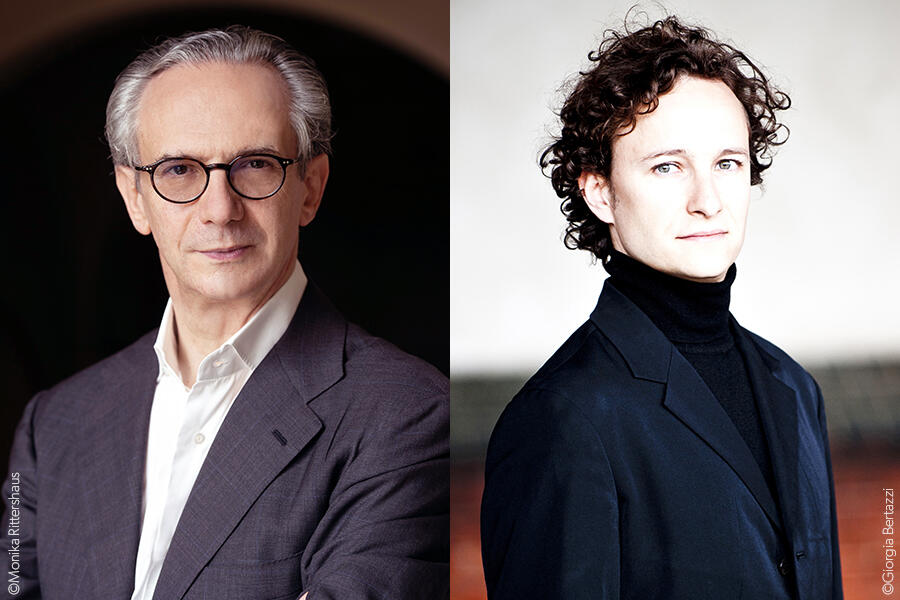
 ConductorFabio Luisi
Fabio Luisi hails from Genoa. He is the Principal Conductor of the Danish National Symphony Orchestra and the Music Director of the Dallas Symphony Orchestra. In September 2022, he assumed the position of Chief Conductor of the NHK Symphony Orchestra, Tokyo.
Fabio Luisi was Principal Conductor of the Metropolitan Opera in New York, General Music Director of the Opernhaus Zürich, Principal Conductor of the Wiener Symphoniker, as well as General Music Director of the Staatskapelle Dresden and the Sächsische Staatsoper, Artistic Director and Principal Conductor of the MDR Sinfonieorchester Leipzig, and Music Director of the Orchestre de la Suisse Romande. He is Music Director of the Festival della Valle d’Itria in Martina Franca (Apulia) and has appeared as guest conductor with numerous renowned ensembles, including the Philadelphia Orchestra, the Cleveland Orchestra, the Münchener Philharmoniker, the Filarmonica della Scala, the London Symphony Orchestra, the Concertgebouworkest, and the Saito Kinen Orchestra, while also conducting operas at world’s major opera houses.
Important recordings include Verdi, Bellini, Schumann, Berlioz, Rachmaninov, Rimsky-Korsakov, Frank Martin, and Franz Schmidt, the largely forgotten Austrian composer. In addition, he has recorded various symphonic poems by Richard Strauss, and a lauded reading of Bruckner’s Symphony No. 9 with the Staatskapelle Dresden. His recordings of Wagner’s Siegfried and Götterdämmerung with the Metropolitan Opera won Grammy awards.
 PianoMartin Helmchen*
German pianist Martin Helmchen was born in Berlin on June 21st, 1982. He studied with Galina Iwanzowa at Hans Eisler School of Music Berlin, then with Arie Vardi at Hanover University of Music, Drama and Media. After winning the Clara Haskil International Piano Competition in 2001, he has developed his career internationally as a leading German soloist, while also ardently working on chamber music influenced by cellist Boris Pergamenščikov. He has made many recordings including those of Beethoven’s complete piano concertos with the Deutsches Symphonie-Orchester Berlin which won the Gramophone Music Award.
His first collaboration with the NHK Symphony Orchestra was in 2005 playing Brahms Piano Concerto No. 2. Since then, he has played Beethoven Piano Concertos No. 4, No. 5 and Triple Concerto, weaving grandeur music with a soft and round touch. He returns this year after an absence of 11 years to perform R. Strauss’s Burleske, a work which requires a much tighter ensemble of solo and the orchestra than a concerto does. He will delight us with his performance by fully displaying his own technique combined with his experience in chamber music.
[Atsufumi Suzuki, music critic]
Download

Ticket
Program A
No. 1989 Subscription (Program A)
NHK Hall
Google Map
Seating Chart
Single Tickets Release Date
Pre-sales for Subscribers:Thursday, July 27, 2023
*about subscribers
Sale to General Public:Sunday, July 30, 2023
Price
| S | A | B | C | D | E | |
|---|---|---|---|---|---|---|
| Ordinary Ticket | 9,800 | 8,400 | 6,700 | 5,400 | 4,400 | 2,800 |
| Youth Ticket | 4,500 | 4,000 | 3,300 | 2,500 | 1,800 | 1,400 |
Seating chart Enlarge Print PDF
*tax included
*Subscribers receive a 10% discount (Available at NHKSO WEB Ticket and N-Kyo Guide)
*For wheelchair-accessible seats, please refer to the N-Kyo Guide
Youth Tickets
Youth Tickets are great options for those of 25 years old and younger
Subscription tickets
Release Date
ANNUAL SUBSCRIPTION TICKETS/
SEASONAL SUBSCRIPTION TICKETS (AUTUMN)
Mon., July 17, 2023 10:00am
[For Subscribers: Sun., July 9, 2023 10:00am]
For further information and
subscription application
Other Ticket Agents
Broadcast
 NHK-FMNo. 1989 Subscription (Program A)
Thursday, Sep 14, 2023 7:30PM - 9:10PM
Program:
R. Strauss / Till Eulenspiegels lustige Streiche, symphonic poem Op. 28 (Till Eulenspiegel’s Merry Pranks)
R. Strauss / Burleske, D Minor*
R. Strauss / Aus Italien, symphonic fantasy Op. 16 (From Italy)
Conductor:Fabio Luisi
Piano:Martin Helmchen*
Recorded:September 9, 2023 NHK Hall
*Repertoire, conductor, soloists and program order are subject to change without notice.
*Pre-school children are not allowed in the concert hall
